
Summit - University in Saint Paul in Ramsey County, Minnesota — The American Midwest (Upper Plains)
Hmong in the Rondo Neighborhood
⎯⎯⎯
The Oromo of Rondo

Photographed by McGhiever, July 13, 2021
1. Hmong in the Rondo Neighborhood / The Oromo of Rondo Marker
Lee Pao Xiong
In 1976, Rondo became the home of the first Hmong refugee in Minnesota, Leng Vang. His sponsors, the Dayton Avenue Presbyterian Church and Macalester Plymouth United Church, placed his family at Liberty Plaza on Concordia and Western Avenue.
Today more than 30,000 Hmong people live in St. Paul. But who are the Hmong? Why did they come here?
They go back 5,000 years to the Yellow River in China. The Hmong are credited as one of the first to cultivate rice and were advanced in the development of gunpowder and forging metal into weapons. In the 1800s, a series of failed rebellions forced many Hmong to migrate to the mountains of Vietnam, Thailand, Laos, and Burma. Today, 10 million Hmong still live in China.
In the 1960s during the Vietnam War, the CIA recruited Hmong people to help the U.S. fight communists in Laos and Vietnam. They became surrogate soldiers in the Secret War. As many as 40,000 Hmong soldiers died in combat, but they saved 50,000 U.S. soldiers.
When the U.S. pulled out in 1975, the Lao communists persecuted the Hmong. Many fled to Thailand and
this page online
That's how Leng Vang came to Liberty Plaza. In 1977 the Hmong Association of Minnesota, now Lao Family Community of Minnesota, was founded to assist the many Hmong refugees. The first Hmong grocery store, LH Oriental Grocery, was at Selby and Western Avenue. Others established thriving businesses along University Avenue.
In 2002, Cy Thao was the first Hmong elected to the Minnesota House of Representatives, representing District 65A, which includes Rondo. In 2013, Dai Thao became the first Hmong on the Saint Paul City Council, representing Ward 1, which includes Rondo.
Rondo is also home to the Hmong Culture Center and the Center for Hmong Studies, which attracts Hmong scholars from all over the world.
The Late Congressman Bruce Vento meeting with local Hmong leaders in front of the Liberty Plaza Community Center 1978. Also pictured on his left are Mr. Xang Vang (Executive Director of Lao Family Community of Minnesota), Mr. Weng Wong (the first Hmong refugee to come to Minnesota in 1976).
Mailiakhang Houatouxay and her husband, Lee Pao Xiong, moved into the Rondo Neighborhood in 2004. They lived on St. Anthony Avenue. Lee Pao works at Concordia University.
Hmong General Vang Pao, commander of Military Region 2, conferring with US CIA advisor on a mountain top base in Laos, 1972.
Hassen Hussein
Ask
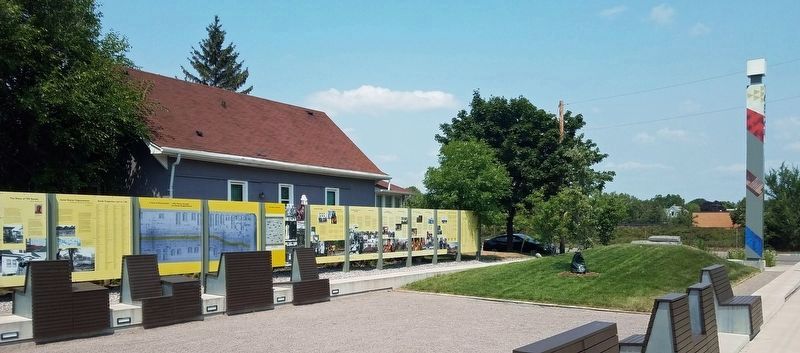
Photographed by McGhiever, July 13, 2021
2. Marker, fourth panel from the end at the Rondo Commemorative Plaza
This despite the fact that the Oromo Community Center is in the neighborhood—at the site of a former African American church. Rondo is also home to an Oromo mosque, a church, and several businesses. Awash Market, across from the Rondo Library, is a major hangout.
The Oromo are Minnesota's second largest African immigrant group. There are over 40,000 Oromo, living in Minnesota making it the largest concentration outside their homeland of Ethiopia. The Oromo make up more than one third of the population of Ethiopia, yet they faced centuries of marginalization.
Tensions in their home country accelerated in the 1960s—provoking harsh retributions and repression by the state. Because of this, many Oromo came to the Twin Cities in large numbers during the 1970s. Coming from a warm climate, it is a mystery why they chose Minnesota and not a warmer place.
Perhaps the Oromo were drawn here by the University of Minnesota and the Lutheran connection. The Reverend Gudina Tumsa, a martyr, who is considered the Martin Luther King Jr. of the Oromo, attended Saint Paul Seminary in the early 1960s. He returned to Ethiopia just before its 1974 revolution, when a military junta toppled Africa's longest-serving monarch, Haile Selassie. The new regime executed Gudina Tumsa for his efforts to emancipate the Oromo.
Unlike their Somali neighbors from the east, predominantly Muslim, and their northern neighbors such as the Amhara and Tigreans, overwhelmingly Orthodox Christians, the Oromo are religiously diverse. It is not unusual to find households with individuals espousing a variety of religious persuasions. The Oromo continue to hold on to their prehistoric African religion, Wakefanna, in which man and woman live in harmony with nature.
Top: picnic, 2010
Middle: in front of the Oromo Community of Minnesota Center, 465 Mackubin Street
Bottom: groundbreaking for new parking lot, council member Dai Thao in attendance
All photos courtesy Oromo Community of Minnesota
Topics. This historical marker is listed in these topic lists: Asian Americans • Immigration • Religion & Religious Structures • War, Vietnam. A significant historical year for this entry is 1976.
Location. 44° 57.064′ N, 93° 8.107′ W. Marker is in Saint Paul, Minnesota, in Ramsey County. It is in Summit - University. It is at the intersection of N. Fisk Street and Concordia Avenue, on the right when traveling south on N. Fisk Street. The marker is at the Rondo Commemorative Plaza. Touch for map. Marker is at or near this postal address: 820 Concordia Avenue, Saint Paul MN 55104, United States of America. Touch for directions.

Regionally, this marker is in the Twin Cities Metropolitan Area. It is also in the American Midwest, in the Corn Belt, and in the Great River Road Region. Globally, it is in North America, the Western Hemisphere, the Western World, and the Anglosphere. Historically, it finds itself in what was once Rupert’s Land, the territory of the Mississippian Culture, and the Louisiana Purchase.
Other nearby markers. At least 8 other markers are within walking distance of this marker: Karen People in Rondo / Somalis in Rondo (here, next to this marker); Rondo Commemorative Plaza Site / Rondo Today (here, next to this marker); Rondo 1970–1982 / Words from the Founders (here, next to this marker); Serial Racial Displacement / Rondo Properties Lost to I-94 (a few steps from this marker); Rondo Landmarks / The Story of 755 Rondo (a few steps from this marker); History of Rondo / Redlining Rondo (a few steps from this marker); Pilgrim Baptist Church (approx. ¼ mile away); From Service to Solidarity (approx. 0.3 miles away). Touch for a list and map of all markers in Saint Paul.
Credits. This page was last revised on October 21, 2024. It was originally submitted on May 5, 2024, by McGhiever of Minneapolis, Minnesota. This page has been viewed 229 times since then and 26 times this year. Photos: 1. submitted on May 5, 2024, by McGhiever of Minneapolis, Minnesota. 2. submitted on March 20, 2024, by McGhiever of Minneapolis, Minnesota.
