Paint Township near Bainbridge in Highland County, Ohio — The American Midwest (Great Lakes)
Welcome
⎯⎯⎯
History
Miller Nature Sanctuary State Nature Preserve

Photographed by Craig Doda, May 4, 2024
1. Welcome side of the marker
Over millions of years, this land was shaped by flowing water and glaciers, creating the natural arches, slump blocks, and waterfalls which make Miller Nature Sanctuary a fascinating and unique place.
Those natural forces also influenced the soil which provides the perfect conditions for some of Ohio's rarest and most beautiful plants. In spring, the area boasts one of the best wildflower displays in southern Ohio.
In 1982, Eugene and Henrietta Miller generously donated a beautiful 25-acre section of the gorge to the Division of Natural Areas and Preserves. In 1986, the Division purchased an additional 61 acres of hardwood forests, old field habitats, and calcareous cliff communities to expand protected habitat for birds, insects, and other wildlife to thrive.
A slump block along the Arch Trail. Slump blocks are formed when on underlying, less resistant unit of bedrock erodes away, destobilizing the overlying rock until it collapses along points of weakness and tumbles downhill. They create perfect habitat for ferns, wildflowers, mosses, and even trees. Photo Credit: David Patrick
Discover
Stories told over millions of years in the bedrock and botany Some 430 million years ago this part of Ohio was covered in a warm, shallow sea. Sediments settled to the sea bottom-providing the components that became distinct bedrock layers called Peebles Dolomite, the Lilley Formation, and the Bisher Formation.
Peebles Dolomite is the uppermost, gray to blue-gray layer of bedrock visible at Miller Nature Sanctuary and is the prominent bedrock from which many of Ohio's natural arches and bridges arise. It also has abundant fossils-including crinolds, brachiopods, bryozoans, corals, and sea sponges. Both arches in the preserve- Miller Natural Bridge and Miller Arch (seen above)-are formed in the Peebles Dolomite.
Bisher Dolomite is the lowest layer of exposed bedrock at Miller, It has unique sloping and hatched patterns in its layers, known as crossbedding, which indicate both the flow and direction of sediments as they were deposited and the tidal action that occurred in the shallow sea as the bedrock was forming. Its brown to orange color is distinct. Both waterfalls along the Falls Trail are formed in the Bisher Dolomite. Photo Credit: David Patrick
Shooting-star (Dodecatheon meadia) is a rare and lovely native wildflower that thrives in the dry, open woods and limestone soils at Miller Nature Sanctuary, It can be found along the Falls Trail in the oak forest where the trail dips down low enough to reach the dolomite bedrock. When the flower is in bloom, bumblebees visit frequently and pollinate the flower in a unique way called "buzz pollination-they rapidly vibrate their thoracic muscles which causes the pollen to loosen and fall from the flower.
Sullivantia (Sullivantia sullivantii) is a rare, delicate summer wildflower discovered by Ohio botanists Eliza and William Starling Sullivant in 1839, within a few miles of this preserve. Only known from 10 states-it thrives in the cracks, crevices, and shallow ledges of the continually moist, shaded dolomite here. Eliza is buried at the historic Green Lawn Cemetery in Columbus, where William memorialized her with a white marble monument carved with her likeness, framed with beautiful Sullivantia.
The tricky pawpaw tree: its stinky strategy with a busy beetle
Can
this page online
What a tricky plant, and poor busy beetle!
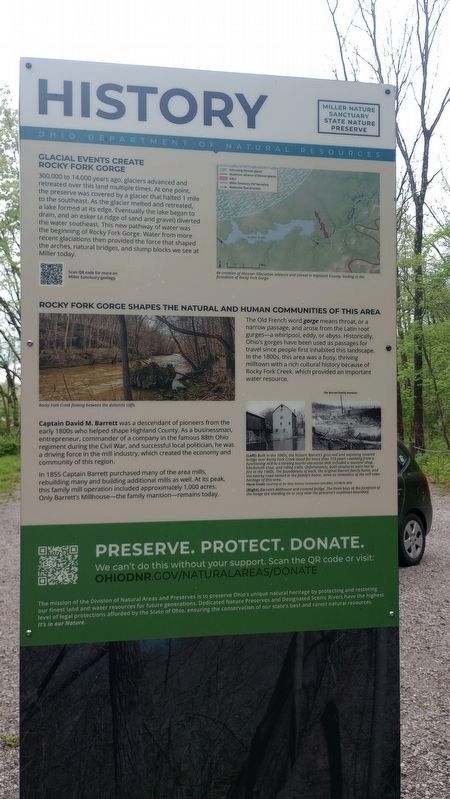
Glacial events create rocky fork gorge
300,000 to 14,000 years ago, glaciers advanced and retreated over this land multiple times. At one point, the preserve was covered by a glacier that halted 1 mile to the southeast. As the glacier melted and retreated, a lake formed at its edge. Eventually the lake began to drain, and an esker (a ridge of sand and gravel) diverted the water southeast. This new pathway of water was the beginning of Rocky Fork Gorge. Water from more recent glaciations then provided the force that shaped the arches, natural bridges, and slump blocks we see at Miller today.
Rocky Fork Gorge shapes the natural and human communities of this area
The
Photographed by Craig Doda, May 4, 2024
2. History side of the marker
Captain David M. Barrett was a descendant of pioneers from the early 1800s who helped shape Highland County. As a businessman, entrepreneur, commander of a company in the famous 88th Ohio regiment during the Civil War, and successful local politician, he was a driving force in the mill industry, which created the economy and community of this region.
In 1855 Captain Barrett purchased many of the area mills, rebuilding many and building additional mills as well. At its peak, this family mill operation included approximately 1,000 acres. Only Barrett's Millhouse-the family mansion-remains today.
[Captions:]
(Left) Built in the 1860s, the historic Barrett's grist mill and adjoining covered bridge over Rocky Fork Creek stood for more than 110 years-evolving from a functioning mill to a thriving tourist attraction that included a souvenir shop, blacksmith shop, and riding trails. Unfortunately, both structures were lost to fire in the 1980s. The foundations of each, the original Barrett family home, and the nearby road named in the family's honor, serve as reminders of the mill town heritage of this area.
(Right) Barrett's Millhouse and covered bridge. The three boys at the forefront of the image are standing on or very near the preserve's southeast boundary.
Erected by Ohio

Photographed by Craig Doda, May 4, 2024
3. Welcome / History Marker
Topics. This historical marker is listed in these topic lists: Natural Resources • Parks & Recreational Areas. A significant historical year for this entry is 1982.
Location. 39° 12.135′ N, 83° 23.593′ W. Marker is near Bainbridge, Ohio, in Highland County. It is in Paint Township. It is on Barrett Mill Road (County Road 1) 0.3 miles west of Ferneau Road (County Road 259), on the right when traveling east. Touch for map. Marker is at or near this postal address: 13571 Barrett Mill Rd, Bainbridge OH 45612, United States of America. Touch for directions.

Regionally, this marker is in Southern Ohio Hill Country. It is also in the American Midwest, in the Corn Belt, in Appalachia, and specifically in Northern Appalachia. Globally, it is in North America, the Western Hemisphere, the Western World, and the Anglosphere. Historically, it finds itself in what was once the Haudenosaunee (Iroquois) Confederacy, the territory of the Mississippian Culture, and the Northwest Territory.
Other nearby markers. At least 8 other markers are within 9 miles of this marker, measured as the crow flies: Paint Creek Lake (approx. 3.8 miles away); Home of General Nathaniel Massie (approx. 5½ miles away); People of the Forest, 2000 B.P. (approx. 5.6 miles away); Bainbridge (approx. 6.6 miles away); The Cradle Of Dental Education (approx. 6.7 miles away); a different marker also named Bainbridge (approx. 6.8 miles away); Last Battle in the Scioto Country (approx. 8.7 miles away); Governor Charles Willing Byrd (approx. 8.8 miles away). Touch for a list and map of all markers in Bainbridge.
Credits. This page was last revised on May 10, 2024. It was originally submitted on May 8, 2024, by Craig Doda of Napoleon, Ohio. This page has been viewed 392 times since then and 51 times this year. Photos: 1, 2, 3. submitted on May 8, 2024, by Craig Doda of Napoleon, Ohio. • Devry Becker Jones was the editor who published this page.
