Saint-Denis in Seine-Saint-Denis, Île-de-France, France — Western Europe
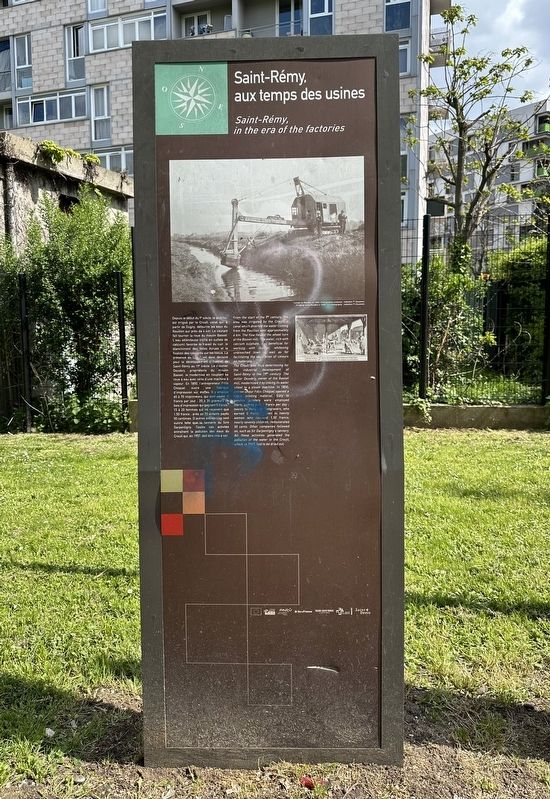
Saint-Rémy: aux temps des usines
⎯⎯⎯
in the era of the factories
Photographed by Andrew Ruppenstein, April 18, 2024
1. Saint-Rémy: aux temps des usines / in the era of the factories Marker

this page online
The Croult was thus determining for the of industrial development Saint-Rémy in the 19th century. The miller Dezobry, owner of the Basset mill, modernized it by linking its water wheel to a steam machine. In 1850, entrepreneur Félix Choquel opened a fabric printing material. Sixty to seventy printers were employed there, getting paid 6 francs per day; twenty to thirty wood engravers, who earned 5 francs, fifteen to twenty women who received 1,50 francs; nearly seventy children, remunerated 50 cents. Other companies followed on, such as Sir Darpentigny's tannery. All these activities generated the pollution of the water in the Croult, which, in 1957, had to be dried out.
Topics. This historical marker is listed in these topic lists: Industry & Commerce • Waterways & Vessels. A significant historical year for this entry is 1850.
Location. 48° 56.165′ N,
Photographed by Andrew Ruppenstein, April 18, 2024
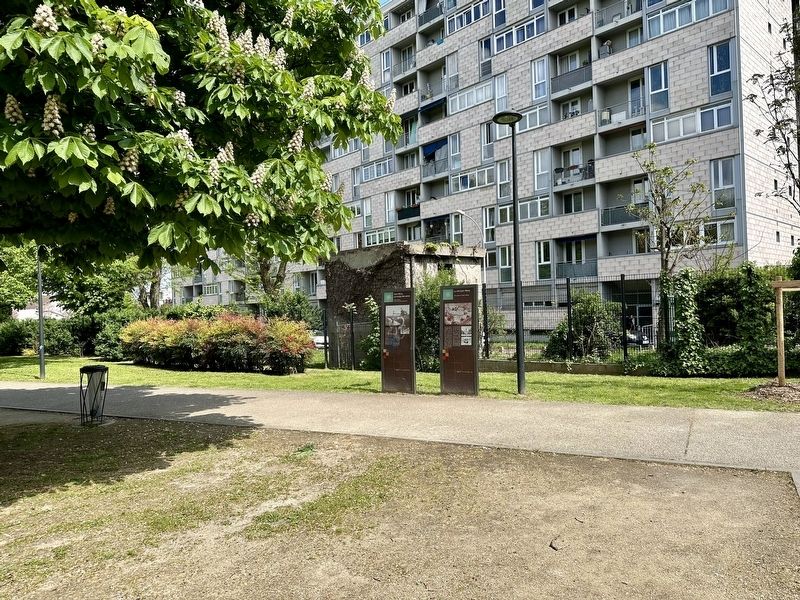
2. Saint-Rémy: aux temps des usines / in the era of the factories Marker - wide view
The subject marker is the leftmost of the two panels visible here.

Regionally, it is in the North Atlantic Region, Europe, the European Union, Atlantic Europe, the Schengen Area, Western Europe, a coastal Mediterranean country, and the Western World. Historically, it finds itself in what was once a French colony and also the Roman Empire.
Other nearby markers. At least 8 other markers are within walking distance of this marker: La cité Saint-Rémy / The estate of Saint-Rémy (here, next to this marker); Saint-Rémy: aux origines du quartier / to the sources of the neighbourhood (within shouting distance of this marker); Saint-Rémy: une histoire mouvementée / a restless history (within shouting distance of this marker); Jean Leick (within shouting distance of this marker); La cimetière / The Cemetery (approx. 0.3 kilometers away); Saint-Denis Municipal Cemetery Resistance Memorial
Photographed by Encyclopédie de Diderot et d’Alembert, April 18, 2024
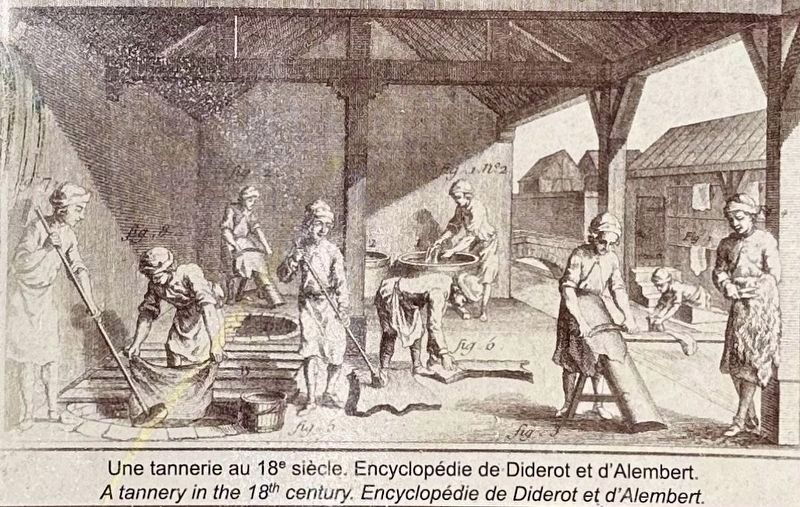
3. Marker photo: A tannery in the 18th Century
Also see . . . The Croult and river-based trades (Archeologie.culture.fr).
Excerpt: During the Carolingian period, the waters of the Rouillon river were partially diverted. In 832, we find the first mention of this river-the Croult (Crodoaldus flumen) - in the charter establishing the monastery's estate which also states that it should be cleaned once a year. The name Croult may come from a German patronymic Crodoald, perhaps the name of the person who organized the diversion.(Submitted on May 11, 2024.)
Credits. This page was last revised on May 11, 2024. It was originally submitted on May 11, 2024, by Andrew Ruppenstein of Lamorinda, California. This page has been viewed 141 times since then and 12 times this year. Photos: 1, 2, 3. submitted on May 11, 2024, by Andrew Ruppenstein of Lamorinda, California.
