Gonesse in Val-d'Oise, Île-de-France, France — Western Europe
L’hôtel-Dieu de 1208
Inscrit a l’inventaire supplementaire des monuments historiques

Photographed by Andrew Ruppenstein, April 17, 2024
1. L’hôtel-Dieu de 1208 Marker

Au nord se trouvait une chapelle orientée ouest - est dont seuls subsistent le mur sud et celui du chevet plat.
Riche et prospère, dotée d'un important patrimoine foncier, la « maison-Dieu » de Gonesse reçut le soutien et la protection de plusieurs rois et papes. Un couvent y fut installé à l'initiative des frères Jacobins en charge de l'établissement à partir de 1621. Les arcades de l'aile ouest du cloître en sont les derniers vestiges.
Charte de Philippe Auguste plaçant l'hôtel-Dieu de Gonesse sous protection royale en 1219.
...Nous avons, pour la mettre à l'abri de toute puissance et autorité séculières, à l'exemple d'une aumône, octroyé la liberté et l'immunité, son pourpris y compris, à la maison-Dieu de Gonesse fondée par l'autorité de notre cher et fidèle Pierre de Theilley - désireux que nous sommes, de la faire jouir de la liberté à perpétuité, sous la protection royale et ecclésiastique.
Founded
this page online
To the north was a east-west facing chapel of which only the south wall and that of the flat apse remain.
Rich and prosperous, with a significant land heritage, the “Maison-Dieu” of Gonesse received the support and protection of several kings and popes. A convent was installed there on the initiative of the Jacobin brothers in charge of the establishment from 1621. The arcades of the west wing of the cloister are the last vestiges.
(From the) Charter from Philippe Auguste placing the Hôtel-Dieu de Gonesse under royal protection in 1219: ...We have, to protect it from all secular power and authority, and following the example of generousity, granted freedom and immunity, including its members, to the Maison-Dieu of Gonesse founded under the authority of our dear and faithful Pierre de Theilley - eager as we are, to grant her freedom in perpetuity, under royal and ecclesiastical protection.
Topics.
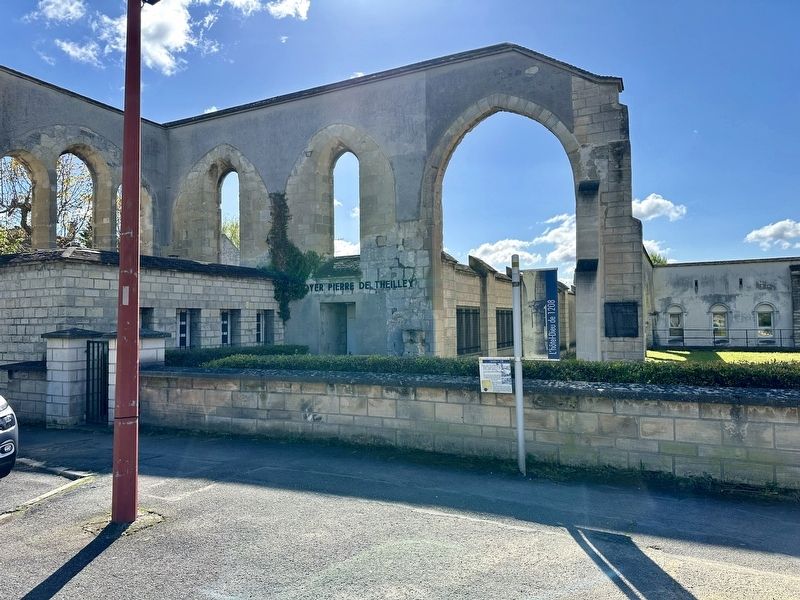
Photographed by Andrew Ruppenstein, April 17, 2024
2. L’hôtel-Dieu de 1208 Marker - wide view
Location. 48° 59.303′ N, 2° 26.88′ E. Marker is in Gonesse, Île-de-France, in Val-d'Oise. It is at the intersection of Rue Bernard Février and Rue de l’Hôtel Dieu, on the right when traveling east on Rue Bernard Février. Touch for map. Marker is in this post office area: Gonesse, Île-de-France 95500, France. Touch for directions.

Regionally, it is in the North Atlantic Region, Europe, the European Union, Atlantic Europe, the Schengen Area, Western Europe, a coastal Mediterranean country, and the Western World. Historically, it finds itself in what was once a French colony and also the Roman Empire.
Other nearby markers. At least 8 other markers are within 6 kilometers of this marker, measured as the crow flies: L’hôpital de 1841 / The Hospital of 1841 (a few steps from this marker); Eglise Saint-Pierre Saint-Paul (about 90 meters away, measured in a direct line); Modeste Camille Debue (approx. 0.3 kilometers away); Concorde AF 4590 Crash Site
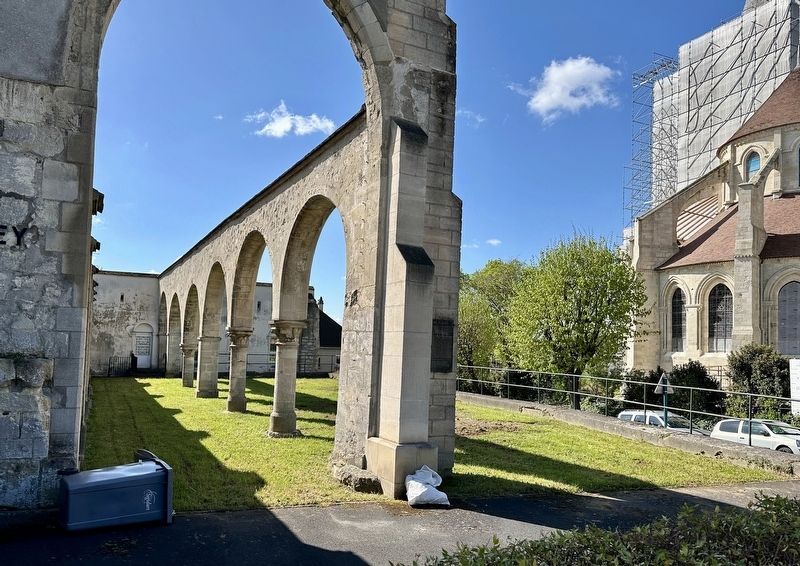
Photographed by Andrew Ruppenstein, April 17, 2024
3. L’hôtel-Dieu de 1208 - cloisters
Taking a few steps to the east of the marker affords one a good view of the cloisters.
Also see . . . Un peu d’histoire - au début (Centre Hospitalier de Gonesse, in French).
Excerpt (in translation): The history of the Gonesse hospital dates back to September 26, 1208. The Bishop of Bayeux confirms that Pierre de Theilley and his wife Aveline de Saint Cyr gave land to Gonesse for the construction of a Hôtel-Dieu.(Submitted on May 12, 2024.)
Pierre de Theilley was close to Philippe Auguste, King of France, who was born or baptized in Gonesse. The Hôtel-Dieu is a place administered by the Church which offers hospitality to poor or sick people, men, women, children or the elderly. Priority is given to souls to relieve bodily ailments. As a result, the archives of the time shed little light on the care provided at the time.
In 1213, Gauthier de Gonesse bequeathed part of his lands against the promise of respecting charity towards the poor.
In 1369, a regulation recalled that travelers received at the Hôtel-Dieu must be provided with a piece of bread in order to continue their journey.
In the Middle Ages, the Hôtel-Dieu de Gonesse had a sick room divided in two, kitchens, a cellar, a chapel and a dormitory for religious people. Thanks to the archives, we know that 13 brothers, including the prior, and seven sisters, including the prioress, were present in 1351. The Hôtel-dieu then had around fifty beds for the poorest.
Credits. This page was last revised on May 12, 2024. It was originally submitted on May 12, 2024, by Andrew Ruppenstein of Lamorinda, California. This page has been viewed 217 times since then and 29 times this year. Photos: 1, 2, 3. submitted on May 12, 2024, by Andrew Ruppenstein of Lamorinda, California.
