Saint-Denis in Seine-Saint-Denis, Île-de-France, France — Western Europe
Saint-Rémy: une histoire mouvementée
⎯⎯⎯
a restless history

Photographed by Andrew Ruppenstein, April 18, 2024
1. Saint-Rémy: une histoire mouvementée / a restless history Marker

A partir du 8° siècle, une petite agglomération se concentre autour de l'église. Ses habitants pratiquent l'agriculture comme l'atteste la découverte de plusieurs fosses servant à stocker des grains. En 1370, le roi Charles V ordonne de détruire les maisons de ce faubourg qui ne peut être protégé par les remparts de Saint-Denis. Le quartier redevient une campagne avec, comme seuls bâtiments, l'église Saint-Remi et le moulin Basset sur le canal du Croult. En 1411, en pleine guerre de Cent Ans. Saint-Denis est occupée par les Bourguignons. Leurs ennemis, les Armagnacs, les assiègent et s'emparent de Saint-Rémy pour y fabriquer des machines de guerre. En mars 1814, c'est l'armée russe qui occupe le quartier. Finalement, il faut attendre 1840-1845 pour qu'il soit mis à l'abri par une digue. En faisant barrage au Croult, ce dispositif permet d'inonder les terrains situés au-devant, améliorant ainsi le système défensif de l'Est de Saint-Denis. Aujourd'hui, la rue du Docteur Lamaze a remplacé la digue.
From the 8th century onwards, a small urban area was concentrated around the church. Its inhabitants practiced farming, as shown when various grain pits were discovered nearby. In 1370, King Charles V ordered the destruction of the houses of the neighbourhood, which could not be protected by the ramparts of Saint-Denis. The area became countryside once more, with only two buildings remaining, the church of Saint-Remi and the Basset mill on the Croult canal.
In 1411, in the midst of the Hundred Years War, Saint-Denis was occupied by the Burgundians (from Burgundy). The town was then besieged by their enemies, the Armagnacs, who took over Saint-Rémy as a base to build their war machines.
this page online
Topics. This historical marker is listed in these topic lists: Forts and Castles • Settlements & Settlers • Wars, Non-US.
Location. 48° 56.147′ N, 2° 22.098′ E. Marker is in Saint-Denis, Île-de-France, in Seine-Saint-Denis. It is at the intersection of Rue de Strasbourg and Avenue de Saint-Rémy on Rue de Strasbourg. Touch for map. Marker is at or near this postal address: 2 Avenue de Saint-Rémy, Saint-Denis, Île-de-France 93200, France. Touch for directions.

Regionally, it is in the North Atlantic Region, Europe, the European Union, Atlantic Europe, the Schengen Area, Western Europe, a coastal Mediterranean country, and the Western World. Historically, it finds itself in what was once a French colony

Photographed by Andrew Ruppenstein, April 18, 2024
2. Saint-Rémy, a restless history marker, wide view, looking east
Of the two markers visible here, the subject marker is the one on the right.
Other nearby markers. At least 8 other markers are within walking distance of this marker: Saint-Rémy: aux origines du quartier / to the sources of the neighbourhood (here, next to this marker); La cité Saint-Rémy / The estate of Saint-Rémy (within shouting distance of this marker); Saint-Rémy: aux temps des usines / in the era of the factories (within shouting distance of this marker); Jean Leick (about 90 meters away, measured in a direct line); La cimetière / The Cemetery (approx. 0.3 kilometers away); Saint-Denis Municipal Cemetery Resistance Memorial (approx. half a kilometer away); Saint-Denis Municipal Cemetery Holocaust Memorial (approx. half a kilometer away); Jardin Pierre-de-Montreuil (approx. 0.6 kilometers away). Touch for a list and map of all markers in Saint-Denis.
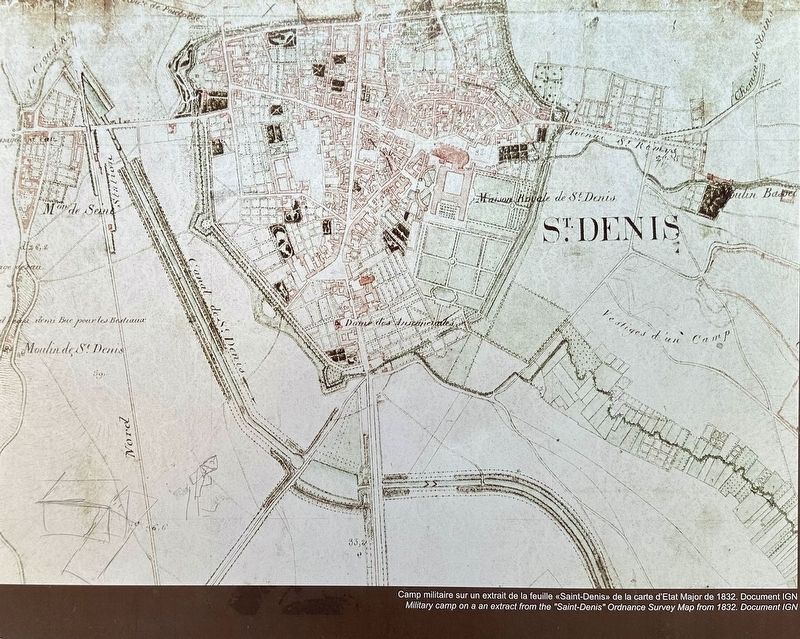
Photographed by Document IGN, 1832
3. Inset map: Military camp from an extract from the “Saint-Denis” ordinance survey map

Photographed by I. Andréani, 1870
4. Inset illustration: A Prussian Convoy in Saint-Denis
Credits. This page was last revised on May 14, 2024. It was originally submitted on May 14, 2024, by Andrew Ruppenstein of Lamorinda, California. This page has been viewed 111 times since then and 13 times this year. Photos: 1, 2, 3, 4. submitted on May 14, 2024, by Andrew Ruppenstein of Lamorinda, California.
