
Lawrence Township near Canal Fulton in Stark County, Ohio — The American Midwest (Great Lakes)
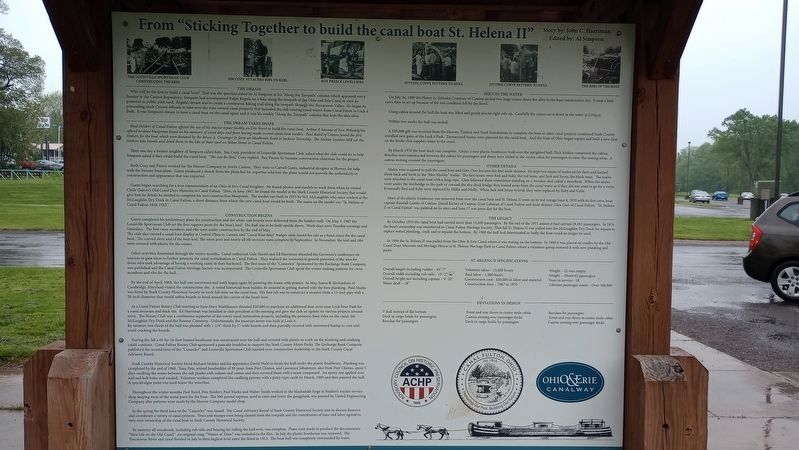
From "Sticking Together to build the canal boat St. Helena II"
Photographed by Craig Doda, May 11, 2024
1. From "Sticking Together to build the canal boat St. Helena II" Marker
this page online
Then one day a former neighbor of Simpson called him. Jim Cozy, president of Louisville Sportsman Club, asked what the club could do to help. Simpson asked if they could build the canal boat. "We can do that," Cozy replied. Roy Preece Sr. became construction chairman for the project.
Both Cozy and Preece worked for the Hoover Company in North Canton. They went to Carroll Gantz, industrial designer at Hoover, for help with the Sweany boat plans. Gantz produced a sketch from the plans but his expertise told him the plans would not provide the authenticity in construction and appearance that was expected.
Gantz began searching for a true representation of an Ohio & Erie Canal freighter. He found photos and models to work from when he visited Clyde Gainey's Old Canal Days Museum in Canal Fulton. Then, in June 1967, he found the model at the Stark County Historical Society that would give him he details he needed to complete his own construction blueprints. The model was built in
Photographed by Craig Doda, May 11, 2024
2. From "Sticking Together to build the canal boat St. Helena II" Marker
The club also created a canal boat display at Central Plaza in Canton and "Canal Boat Boss" badges were issued for sale as a fund-raiser for the canal boat. The curved stern end of the boat keel. The stern post and nearly all rib sections were complete by September. In November, the keel and ribs were covered with plastic for the winter.
Other activities flourished through the winter months. Canal enthusiast Gale Hartel and Ed Harriman attended the Governor's conference on tourism to gain ideas to further promote the canal revitalization
Photographed by Craig Doda, May 11, 2024
3. From "Sticking Together to build the canal boat St. Helena II" Marker
By the end of April, 1968, the hull was uncovered and work began again by painting the frame with primer. In May, James B. Richardson of Cambridge, Maryland visited the construction site. A noted historical-boat builder, he assisted in getting started with the bow planking. Paul Marks was hired by Stark County Historical Society to work full time on the canal boat. His first job was to construct a steamer from a 15-foot pipe with a 20-inch diameter that would soften boards to bend around the curves of the boat's bow.
At a Canal Fulton Rotary Club meeting in June Mary Muhlhauser donated $20,000 to purchase an additional four acres near Lock Four Park for a canal museum and dock site. Ed Harriman was installed as club president at the meeting and gave the club an update on various projects around town. The Rotary Club was a continuous supporter of the town's canal restoration projects, including the pontoon-boat rides on the canal, the McLaughlin Dry Dock and the Pioneer Cemetery. Unfortunately, the museum never was built at Lock 4.
By summer two thirds of the hull was planked with 1-1/4"-thick by 5"-wide boards and then partially covered with moistened burlap to cure and avoid cracking the boards.
During the fall a 65-by-16-foot framed boathouse was constructed over the hull and covered with plastic so work on the planking and caulking could continue. Canal Fulton Rotary Club sponsored a pancake breakfast to support the Stark County Metro Parks, The Exchange Bank Company published the second issue of the "Canawler" and Louisville Sportsman Club handed over construction leadership to the Stark County Canal Advisory Board.
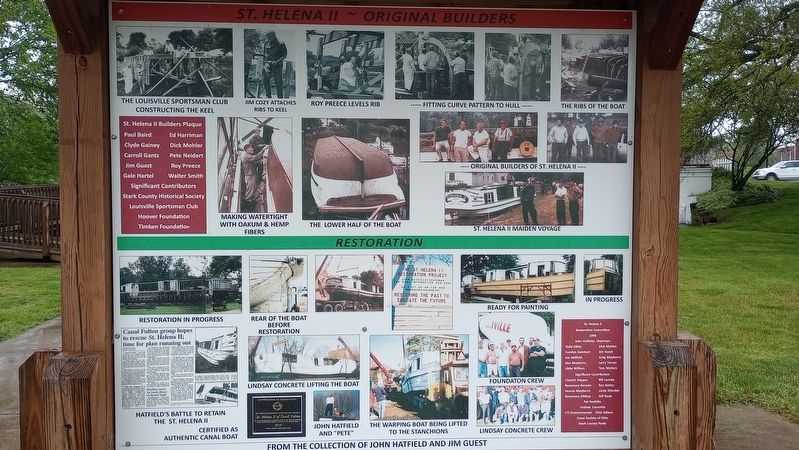
Stark County Historical Society hired Richard Mohler and his apprentice David Wahl to finish the hull under the plastic boathouse. Planking was 'completed by the end of 1968. Tony Patz, retired boatbuilder of 39 years from Port Clinton, and Lawrence Johannsen, also from Port Clinton, spent 5 days caulking the seams between the oak planks with oakum and cotton and then covered them with a seam compound. An epoxy was applied over nail and bolt holes and sanded. Volunteer workers completed the caulking process with a putty-type caulk by March, 1969 and then painted the hull. A special algae paint was used below the waterline.
Throughout the winter months Paul Baird, Pete Neidert, Paul Marks and Walter Smith worked in the blacksmith forge at Neidert's tractor-service shop shaping most of the metal parts for the boat. The 300-pound capstan, used to raise and lower the gangplank, was poured by United Engineering Company after patterns were made by the Hoover Company model shop.
In the spring the third issue of the "Canawler" was issued. The Canal Advisory Board of Stark County Historical Society met to discuss finances and coordinate a variety of canal projects. Trees and stumps were being cleared from the towpath and the contributors of time and labor agreed to turn over ownership of the canal boat to Stark County Historical Society.
By summer all woodwork, including rub rails and bracing for rolling the hull over, was complete. Plans were made to produce the documentary "New Life on the Old Canal." An original song, "Waters of Time," was included in the film. In July the plastic boathouse was removed. The Tuscarawas River and canal flooded in July to their highest level since the flood in 1913. The boat hull was completely surrounded by water.
Using cables around the hull the boat was lifted and gently placed right side up. Carefully the cranes set it down in the water at 2:35p.m.
Within two weeks the hull was sealed.
A $20,000 gift was received from the Hoover, Timken and Stark foundations to complete the boat as other canal projects continued Stark County installed new gates at the Lock 4 Park. Turnaround basins were planned for the canal boat. And the State of Ohio began repairs and built a new dam on the feeder that supplies water to the canal.
By March 1970 the boat dock was complete. Under a new plastic boathouse built over the uprighted hull, Dick Mohler completed the cabins. Benches were constructed between the cabins for passengers and doors were added in the center cabin for passengers to enter the seating areas. A canvas awning covered the passengers.
Most of the plastic boathouse was removed from over the canal boat and St. Helena II went on its test voyage June 8, 1970 with its first crew, boat captain Randall Lemke of Canton, David Richey of Canton, Scott Lehman of Canal Fulton and mule skinner Glen Oser of Canal Fulton. "St. Helena II of Canal Fulton" was painted on its stern and June 17 was press day for the boat.
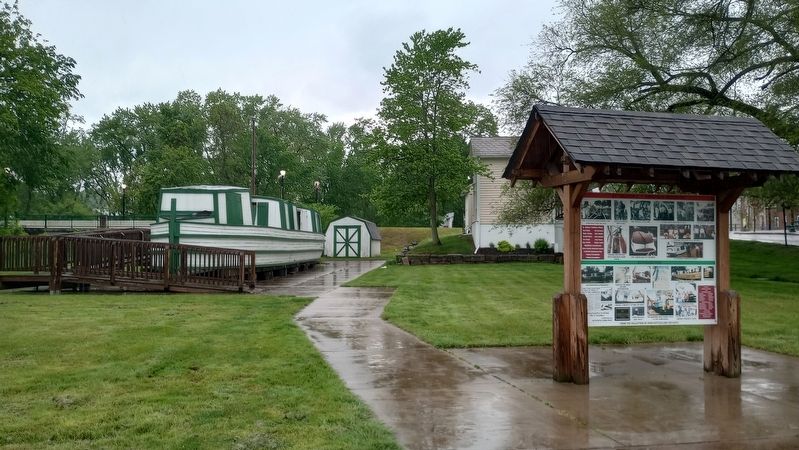
In 1994 the St. Helena II was pulled from the Ohio & Erie Canal where it was resting on the bottom. In 1999 it was placed on cradles by the Old Canal Days Museum and Heritage House in St. Helena Heritage Park in Canal Fulton where a volunteer group restored it with new planking and paint.
St. Helena II Specifications Overall length including rudder - 65'-7"
Overall width including rub rails - 13'-2"
Overall height not including capstan - 9'-10"
Water draft-18"
Volunteer labor - 15,000 hours
Paid labor 1,000 hours
Construction cost- $50,000 in labor and material
Construction time - 1967 to 1970
Weight-22 tons empty
Freight-About 65 passengers
Years in service - 18
Lifetime passenger count - Over 500,000
Deviations In Design
V hull instead of flat bottom
Deck in cargo holds for passengers
Benches for passengers
Front and rear doors in center mule cabin
Canvas awning over passenger decks
Deck in cargo holds for passengers
Benches for passengers
Front and rear doors in center mule cabin
Canvas awning over passenger decks
Topics. This historical marker is listed in these topic lists: Industry & Commerce • Waterways & Vessels. A significant historical month for this entry is March 1969.
Location. 40° 53.321′ N, 81° 35.892′ W. Marker is near Canal Fulton, Ohio, in Stark County. It is in Lawrence Township. It is on Tuscarawas Street Northwest 0.2 miles south of Cherry Street West, on the right when traveling south. Touch for map. Marker is at or near this postal address: 103 Tuscarawas St NW, Canal Fulton OH 44614, United States of America. Touch for directions.

Regionally, this marker is in Amish Country and in Greater Cleveland. It is also in the American Midwest. Globally, it is in North America, the Western Hemisphere, the Western World, and the Anglosphere. Historically, it finds itself in what was once the Haudenosaunee (Iroquois) Confederacy, the territory of the Mississippian Culture, and the Northwest Territory.
Other nearby markers. At least 8 other markers are within one mile of this marker, measured as the crow flies: Babst Tavern (within shouting distance of this marker); Historical Flood Mark (within shouting distance of this marker); The Ohio Canals (within shouting distance of this marker); Great Western (about 300 feet away, measured in a direct line); Easly House (about 500 feet away); Public Square (about 600 feet away); The Robinson House (about 700 feet away); Past, Present, Future (approx. 1.1 miles away). Touch for a list and map of all markers in Canal Fulton.
Credits. This page was last revised on May 15, 2024. It was originally submitted on May 14, 2024, by Craig Doda of Napoleon, Ohio. This page has been viewed 294 times since then and 48 times this year. Photos: 1, 2, 3. submitted on May 14, 2024, by Craig Doda of Napoleon, Ohio. • Devry Becker Jones was the editor who published this page.
