Cazenovia in Madison County, New York — The American Northeast (Mid-Atlantic)
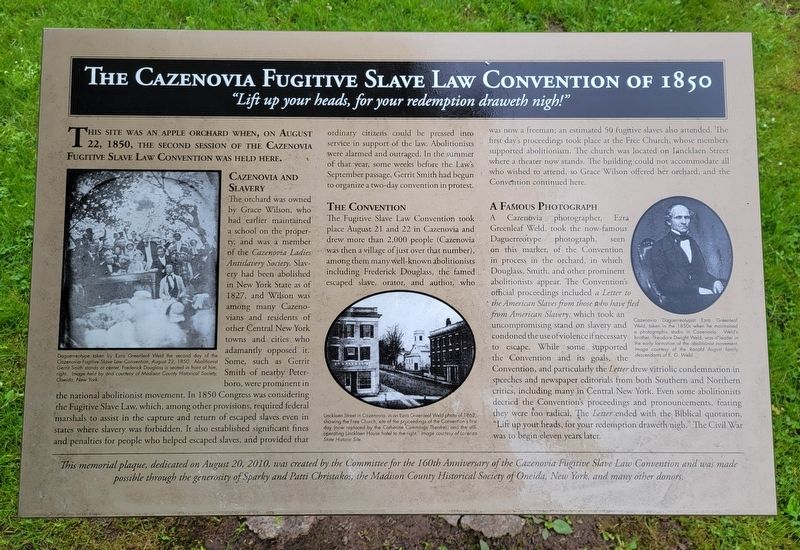
The Cazenovia Fugitive Slave Law Convention of 1850
"Lift up your heads, for your redemption draweth nigh!"
Photographed by Kevin W., May 15, 2024
1. The Cazenovia Fugitive Slave Law Convention of 1850 Marker
CAZENOVIA AND SLAVERY
The orchard was owned by Grace Wilson, who had earlier maintained a school on the property, and was a member of the Cazenovia Ladies Antislavery Society. Slavery had been abolished in New York State as of 1827, and Wilson was among many Cazenovians and residents of other Central New York towns and cities who adamantly opposed it. Some, such as Gerrit Smith of nearby Peterboro, were prominent in the national abolitionist movement. In 1850 Congress was considering the Fugitive Slave Law, which, among other provisions, required federal marshals to assist in the capture and return of escaped slaves even in states where slavery was forbidden. It also established significant fines and penalties for people who helped escaped slaves, and provided that ordinary citizens could be pressed into service in support of the law. Abolitionists were alarmed and outraged. In the summer of that year, some weeks before the Law's September passage, Gerrit Smith had begun to organize a two-day convention in protest.
THE CONVENTION
The
this page online
A FAMOUS PHOTOGRAPH
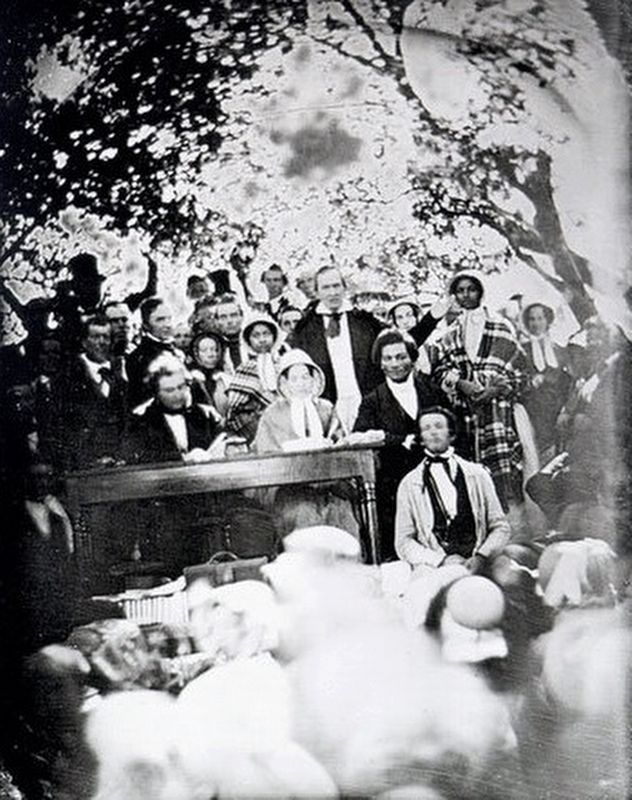
A Cazenovia photographer, Ezra Greenleaf Weld, took the now-famous Daguerreotype photograph, seen on this marker, of the Convention in process in the orchard, in which Douglass, Smith, and other prominent abolitionists appear. The Convention's official proceedings included a Letter to the American Slaves from those who have fled from American Slavery, which took an uncompromising stand on slavery and condoned the use of violence if necessary to escape. While some supported
Photographed by Kevin W., May 15, 2024
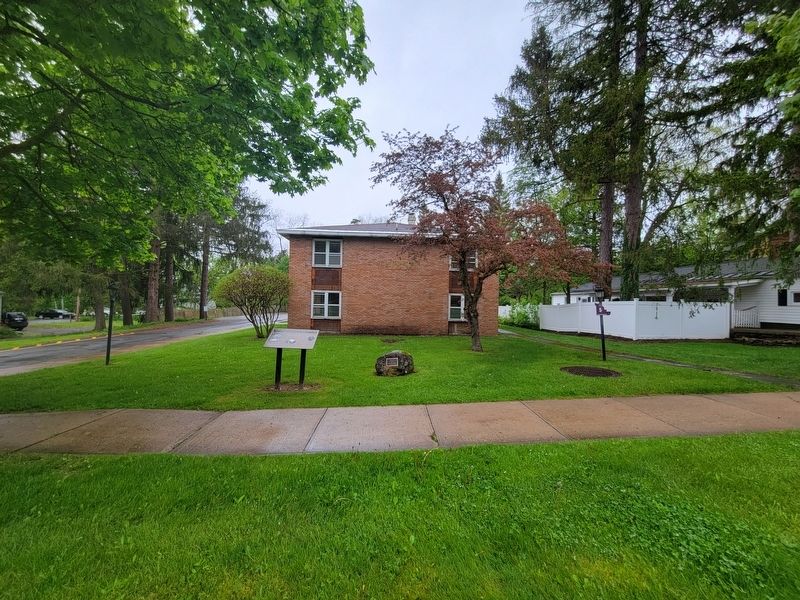
2. The Cazenovia Fugitive Slave Law Convention of 1850 Marker
This memorial plaque, dedicated on August 20, 2010, was created by the Committee for the 160th Anniversary of the Cazenovia Fugitive Slave Law Convention and was made possible through the generosity of Sparky and Patti Christakos, the Madison County Historical Society of Oneida, New York, and many other donors.
Erected 2010 by the Committee for the 160th Anniversary of the Cazenovia Fugitive Slave Law Convention.
Topics. This historical marker is listed in these topic lists: Abolition & Underground RR • African Americans. A significant historical date for this entry is August 22, 1850.
Location. 42° 55.889′ N, 75° 51.32′ W. Marker is in Cazenovia, New York, in Madison
Photographed by Kevin W.
3. Daguerreotype image from the Marker
Daguerreotype taken by Ezra Greenland Weld the second day of the Cazenovia Fugitive Slave Law Convention, August 22, 1850. Abolitionist Gerit Smith stands at center, Frederick Douglass is seated in front of him, right.
Image held by and courtesy of Madison County Historical Society, Oneida, New York.
Image held by and courtesy of Madison County Historical Society, Oneida, New York.

Regionally, this marker is in Upstate New York, specifically in Central New York, and in the Syracuse Metropolitan Area. It is also in the American Northeast and in the Mid-Atlantic. Globally, it is in North America, the Western Hemisphere, the Western World, and the Anglosphere. Historically, it finds itself in what was once the Haudenosaunee (Iroquois) Confederacy, New Netherland, and one of the original Thirteen Colonies.
Other nearby markers. At least 8 other markers are within walking distance of this marker: The Cazenovia Fugitive Slave Law Convention (here, next to this marker); First Madison County Court House (about 500 feet away, measured in a direct line); First County Seat (about 500 feet away); Cazenovia War Memorial (about 600 feet away); Cazenovia Revolutionary War Memorial (about 700 feet away); Parade Grounds (about 700 feet away); The Last Land Office (approx. 0.2
Photographed by Kevin W.
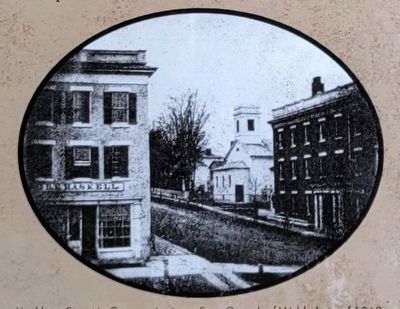
4. The Free Church photo from the Marker
Caption:
Lincklaen Street in Cazenovia, in an Ezra Greenleaf Weld photo of 1862, showing the Free Church, site of the proceedings of the Convention's first day (now replaced by the Catherine Cummings Theatre), and the still-operating Lincklaen House hotel to the right.
Image courtesy of Lorenzo State Historic Site.
Lincklaen Street in Cazenovia, in an Ezra Greenleaf Weld photo of 1862, showing the Free Church, site of the proceedings of the Convention's first day (now replaced by the Catherine Cummings Theatre), and the still-operating Lincklaen House hotel to the right.
Image courtesy of Lorenzo State Historic Site.
Also see . . . Cazenovia celebrates its role hosting 1850 slave law convention. An article about the then planned dedication of this marker. (Submitted on May 17, 2024, by Kevin W. of Stafford, Virginia.)
Photographed by Kevin W.
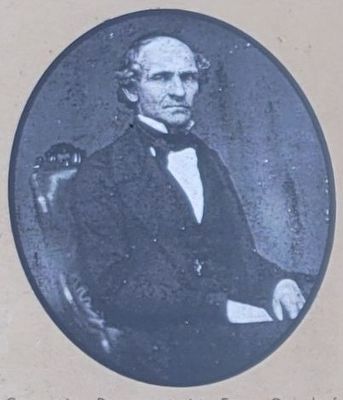
5. Ezra Greenleaf Weld photo from the Marker
Caption:
Cazenovia Daguerreotypist Ezra Greenleaf Weld, taken in the 1850s when he maintained a photographic studio in Cazenovia. Weld's brother, Theodore Dwight Weld, was a leader in the early formation of the abolitionist movement.
Image courtesy of the Ronald August family, descendants of E. G. Weld.
Cazenovia Daguerreotypist Ezra Greenleaf Weld, taken in the 1850s when he maintained a photographic studio in Cazenovia. Weld's brother, Theodore Dwight Weld, was a leader in the early formation of the abolitionist movement.
Image courtesy of the Ronald August family, descendants of E. G. Weld.
Credits. This page was last revised on May 17, 2024. It was originally submitted on May 16, 2024, by Kevin W. of Stafford, Virginia. This page has been viewed 732 times since then and 86 times this year. Photos: 1, 2, 3, 4, 5. submitted on May 16, 2024, by Kevin W. of Stafford, Virginia.
