Strathcona in Hamilton, Ontario — Central Canada (North America)
Dundurn Castle/Burlington Heights Château Dundurn/Burlington Heights
Photographed by Tim Boyd, May 19, 2024
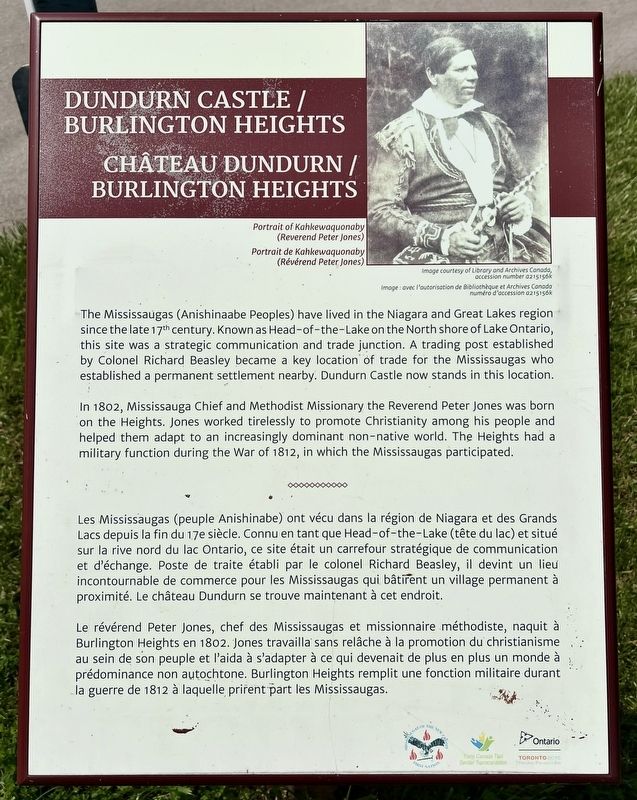
1. Dundurn Castle/Burlington Heights Château Dundurn/Burlington Heights Marker

In 1802, Mississauga Chief and Methodist Missionary the Reverend Peter Jones was born on the Heights. Jones worked tirelessly to promote Christianity among his people and helped them adapt to an increasingly dominant non-native world. The Heights had a military function during the War of 1812, in which the Mississaugas participated.
Les Mississaugas (peuple Anishinabe) ont vécu dans la région de Niagara et des Grands Lacs depuis la fin du 17e siècle. Connu en tant que Head-of-the-Lake (tête du lac) et situé sur la rive nord du lac Ontario, ce site était un carrefour stratégique de communication et d'échange. Poste de traite établi par le colonel Richard Beasley, il devint
this page online
Le réverend Peter Jones, chef des Mississaugas et missionnaire méthodiste, naquit à Burlington Heights en 1802. Jones travailla sans relâche à la promotion du christianisme au sein de son peuple et l'aida à s'adapter à ce qui devenait de plus en plus un monde à prédominance non autochtone. Burlington Heights remplit une fonction militaire durant la guerre de 1812 à laquelle prirent part les Mississaugas.
Erected by Mississaugas of the New Credit First Nation.
Topics. This historical marker is listed in these topic lists: Indigenous Peoples and Communities • Industry & Commerce • Religion & Religious Structures • Settlements & Settlers. A significant historical year for this entry is 1802.
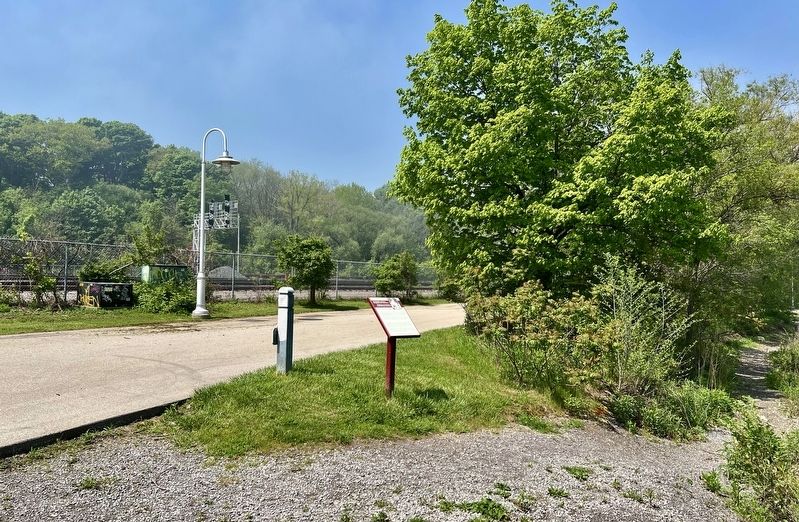
Location. 43° 16.272′ N, 79° 52.935′ W. Marker is in Hamilton, Ontario. It is in Strathcona. It is on Waterfront Trail, on the right when traveling west. The marker is approx. 900 metres along the Waterfront Trail from the Bayfront Park parking lot. Touch for map. Marker
Photographed by Tim Boyd, May 19, 2024
2. Dundurn Castle/Burlington Heights Château Dundurn/Burlington Heights Marker

Regionally, this marker is on the Golden Horseshoe, in the Hamilton-Halton-Brant Area, and specifically in the Toronto Metropolitan Area. It is also in Central Canada. Globally, it is in North America, on the Great Lakes, in the Western Hemisphere, in the Western World, and in the Anglosphere. Historically, it finds itself in what was once a British colony, the Viceroyalty of New France, the Haudenosaunee (Iroquois) Confederacy, and Rupert’s Land.
Other nearby markers. At least 8 other markers are within walking distance of this marker: The Great Western Railway (about 90 meters away, measured in a direct line); United Empire Loyalists (approx. 0.3 kilometers away); Sir John Harvey (approx. 0.3 kilometers away); Dundurn Castle (approx. 0.3 kilometers away); Burlington Heights 1813 - 1814 (approx. 0.3 kilometers away); First Line of Defense (approx. 0.3 kilometers away); Castle Doune (approx. 0.4 kilometers away); Cemetery Gatehouse (approx. 0.4 kilometers away). Touch for a list and map of all markers in
Photographed by Elizabeth Simcoe, 1796
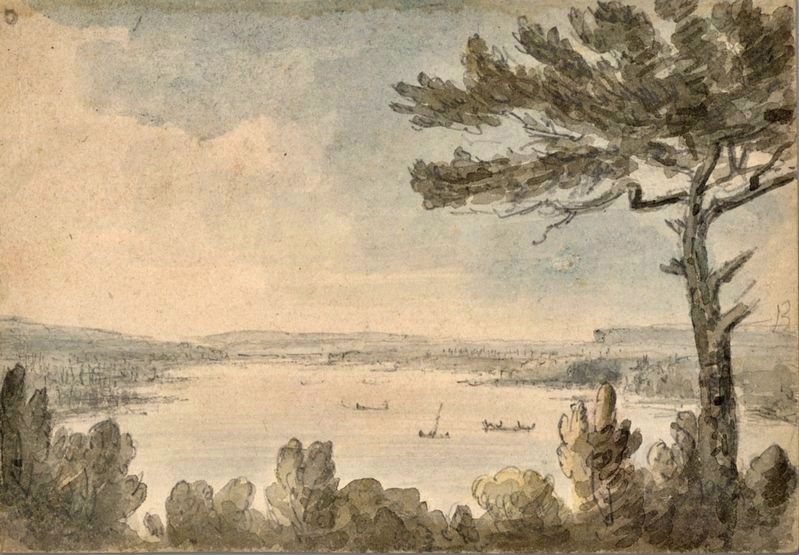
3. Cootes Paradise from Burlington Heights, 1796
Watercolour by Elizabeth Simcoe, 1796
(Source: Archives of Ontario)
Other markers no longer nearby. Sir Allan Napier MacNab (was approx. 0.3 kilometers away but has been confirmed missing); a different marker also named Dundurn Castle (was approx. 0.3 kilometers away but has been confirmed missing).
Also see . . .
1. Dictionary of Canadian Biography - Beasley, Richard.
In the early 1790s Beasley settled on the southeast end of Burlington Heights (then in Barton Township but now in Hamilton), where he built a house, stable, and barn. In spite of his improvements, the ownership of the land was disputed by another local family, the Lottridges. Situated between Burlington Bay and the marsh to the west, Coote’s Paradise, the property gave its occupant control of trans-shipping there. When on 11 June 1796 Lieutenant Governor John Graves Simcoe* and his wife were in the vicinity, they set out in a boat for Beasley’s. A commanding location with a beautiful view, the site was described by Elizabeth Posthuma Simcoe as “more fitt for the reception of Inhabitants than any part of the Province I have seen.”(Submitted on May 19, 2024, by Tim Boyd of Hamilton, Ontario.)
2. Wikipedia - Peter Jones (Kahkewāquonāby).
Photographed by Tim Boyd, March 6, 2022
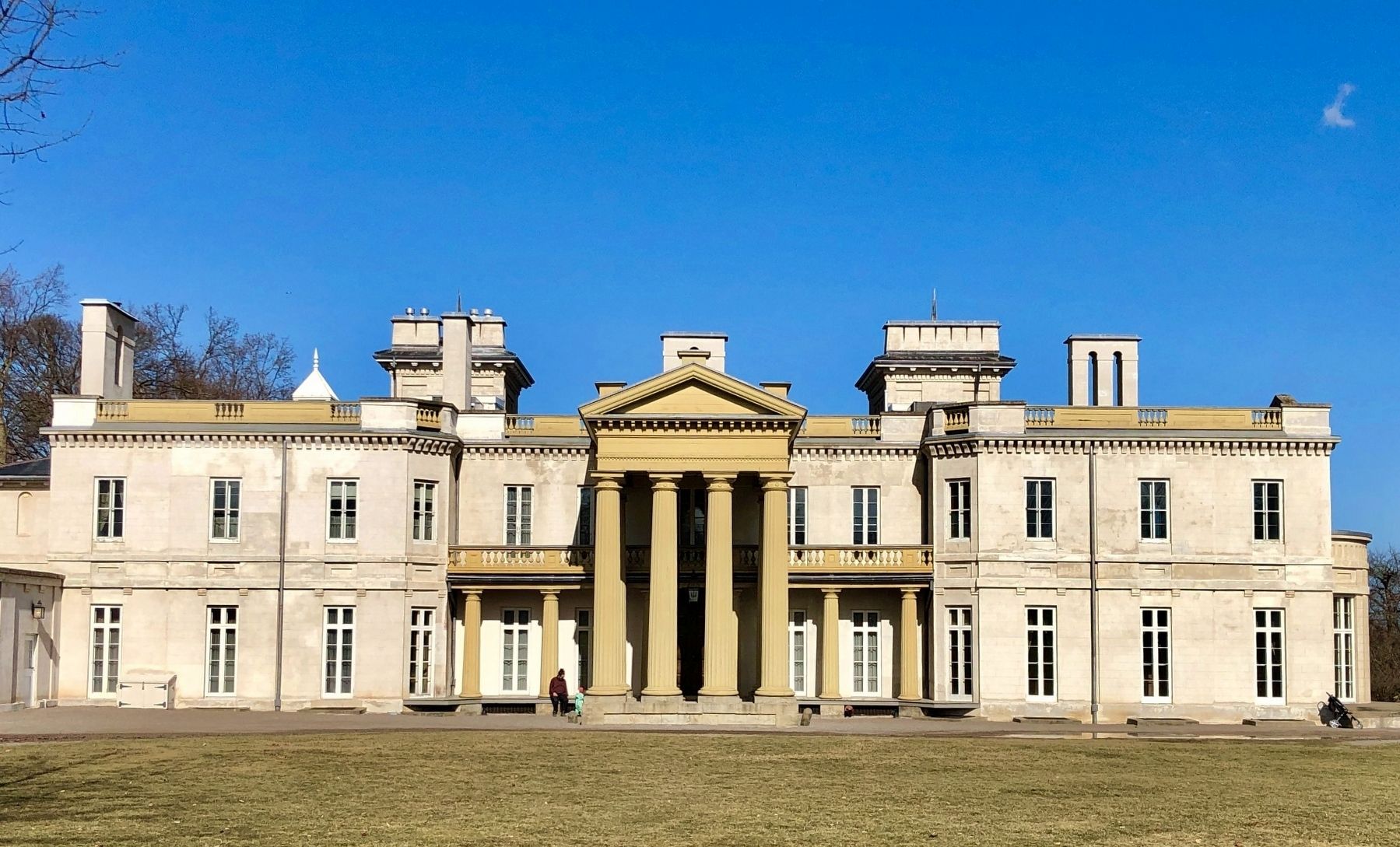
4. Dundurn Castle
Jones was raised by his mother Tuhbenahneequay in the traditional culture and religion of the Mississauga Ojibwas until the age of 14.[1] After that, he went to live with his father Augustus Jones, a Welsh-born United Empire Loyalist. There he learnt the customs and language of the white Christian settlers of Upper Canada and was taught how to farm. Jones converted to Methodism at age 21 after attending a camp-meeting with his half sister. Methodist leaders in Upper Canada recognised his potential as a bridge between the white and Indian communities and recruited him as a preacher.(Submitted on May 19, 2024, by Tim Boyd of Hamilton, Ontario.)
Credits. This page was last revised on May 20, 2024. It was originally submitted on May 19, 2024, by Tim Boyd of Hamilton, Ontario. This page has been viewed 307 times since then and 33 times this year. Photos: 1, 2, 3, 4. submitted on May 19, 2024, by Tim Boyd of Hamilton, Ontario. • Andrew Ruppenstein was the editor who published this page.
