Katonah in Westchester County, New York — The American Northeast (Mid-Atlantic)
The Organization of the Farm
John Jay Homestead
Photographed by Michael Herrick, November 10, 2009
1. The Organization of the Farm Marker
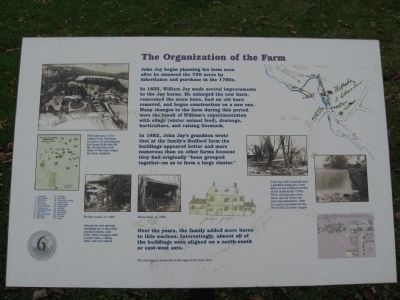
John Jay began planning his farm soon after he amassed the 750 acres by inheritance and purchase in the 1780s.
In 1832, William Jay made several improvements to the Jay farm. He enlarged the cow barn, renovated the main barn, had an old barn removed, and began construction on a new one. Many changes to the farm during this period were the result of William’s experimentation with silage (winter animal feed), drainage, horticulture, and raising livestock.
In 1862, John Jay’s grandson wrote that at the family’s Bedford farm the buildings appeared better and more numerous than on other farms because they had originally “been grouped together – so as to form a large cluster.”
Over the years, the family added more barns to this nucleus. Interestingly, almost all of the buildings were aligned on a north-south or east-west axis.
Erected by Friends of the Jay Homestead. (Marker Number 6.)
Topics. This historical marker is listed in these topic lists: Agriculture • Notable Places. A significant historical year for this entry is 1832.
Location. Marker has been reported missing. It was located near 41° 15.102′ N, 73° 39.521′ W.
this page online

Regionally, this marker was in the Hudson Valley and in the New York City Metropolitan Area. It was also in the American Northeast, in the Mid-Atlantic, and on the Eastern Seaboard. Globally, it was in the North Atlantic Region, North America, the Western Hemisphere, the Western World, and the Anglosphere. Historically, it found itself in what was once New Netherland and also one of the original Thirteen Colonies.
Other nearby markers. At least 8 other markers are within walking distance of this location: The Farm Manager’s Cottage (within shouting distance of this marker); The Stable Courtyard (within shouting distance of this marker); The Barn Complex (within shouting distance of this marker); The Brick Lot (within shouting distance of this marker);
Photographed by Michael Herrick, November 14, 2009
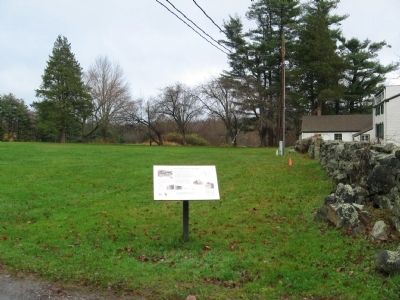
2. The Organization of the Farm Marker
Another marker is no longer nearby. The Sundial and Fountain Gardens (was about 300 feet away, measured in a direct line but has been confirmed missing).
Photographed by Michael Herrick, November 10, 2009
3. Sawmill and Gristmill
[ detail from the marker ]
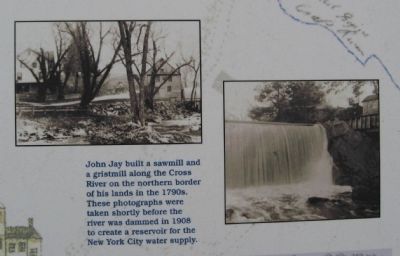
John Jay built a sawmill and gristmill along the Cross River on the northern border of his lands in the 1790s. These photographs were taken shortly before the river was dammed in 1908 to create a reservoir for the New York City water supply.
John Jay built a sawmill and gristmill along the Cross River on the northern border of his lands in the 1790s. These photographs were taken shortly before the river was dammed in 1908 to create a reservoir for the New York City water supply.
Photographed by Michael Herrick, November 10, 2009
4. Old Photographs
[ detail from the marker ]
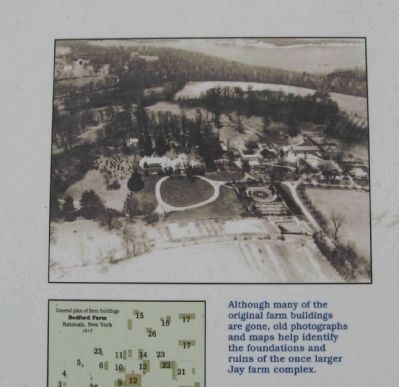
Although many of the original farm buildings are gone, old photographs and maps help identify the foundations and the ruins of the once large Jay farm complex.
Although many of the original farm buildings are gone, old photographs and maps help identify the foundations and the ruins of the once large Jay farm complex.
Photographed by Michael Herrick, November 10, 2009
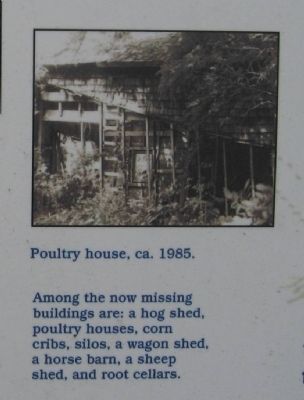
5. Poultry House, ca. 1985
[ detail from the marker ]
Among the now missing buildings are: a hog shed, poultry houses, corn cribs, silos, a wagon shed, a horse barn, a sheep shed, and root cellars.
Among the now missing buildings are: a hog shed, poultry houses, corn cribs, silos, a wagon shed, a horse barn, a sheep shed, and root cellars.
Credits. This page was last revised on August 4, 2023. It was originally submitted on November 21, 2009, by Michael Herrick of Southbury, Connecticut. This page has been viewed 943 times since then and 19 times this year. Photos: 1, 2, 3, 4, 5. submitted on November 21, 2009, by Michael Herrick of Southbury, Connecticut. • Syd Whittle was the editor who published this page.
