Katonah in Westchester County, New York — The American Northeast (Mid-Atlantic)
The North Lawn
John Jay Homestead
Photographed by Michael Herrick, November 10, 2009
1. The North Lawn Marker
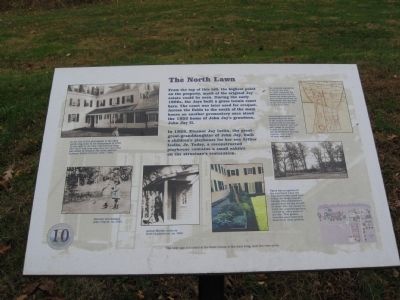
From the top of this hill, the highest point on the property, much of the original Jay estate could be seen. During the early 1900s, the jays built a grass tennis court here. The court was later used for croquet. Across the fields to the south of the main house on another promontory once stood the 1852 home of John Jay’s grandson, John Jay II.
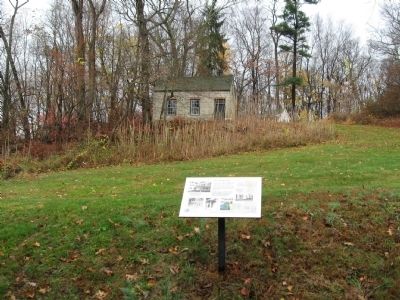
In 1925, Eleanor Jay Iselin, the great-great-granddaughter of John Jay built a children’s playhouse for her son Arthur Iselin, Jr. Today, a reconstructed playhouse contains a small exhibit on the structure’s restoration.
There was no garden in the courtyard when the Jays and Iselins lived here. Today, the Hopp Ground Garden Club maintains a garden here for the benefit of those who are unable to enjoy the unpaved gardens located in other areas of the site. This garden includes plant materials from these other gardens.
Erected by Friends of the Jay Homestead. (Marker Number 10.)
Topics. This historical marker is listed in these topic lists: Agriculture • Notable Places. A significant historical year for this entry is 1852.
Location. 41° 15.101′ N, 73° 39.632′ W. Marker
this page online

Regionally, this marker is in the Hudson Valley and in the New York City Metropolitan Area. It is also in the American Northeast, in the Mid-Atlantic, and on the Eastern Seaboard. Globally, it is in the North Atlantic Region, North America, the Western Hemisphere, the Western World, and the Anglosphere. Historically, it finds itself in what was once New Netherland and also one of the original Thirteen Colonies.
Other nearby markers. At least 8 other markers are within walking distance of this marker: The Terrace Garden (within shouting distance of this marker); The Carriage Drive and Roadways (within shouting distance of this marker); The Schoolhouse and Homestead Lawn (within shouting distance of this marker); Bedford House (about 300 feet away, measured in a
Photographed by Michael Herrick, November 14, 2009
2. The North Lawn Marker
The schoolhouse is behind the marker, and just visible, the reconstructed children’s playhouse.
Other markers no longer nearby. The Sundial and Fountain Gardens (was about 400 feet away but has been confirmed missing); Welcome to John Jay Homestead (was about 500 feet away but has been confirmed missing); The Organization of the Farm (was about 500 feet away but has been confirmed missing).
Photographed by Michael Herrick, November 10, 2009
3. The Main House
[ detail from the marker ]
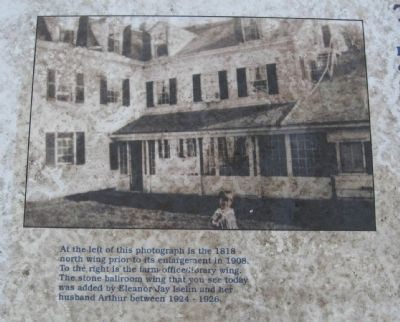
At the left of this photograph is the 1818 north wing prior to its enlargement in 1908. To the right is the farm office / library wing. The stone ballroom wing that you see today was added by Eleanor Jay Iselin and her husband Arthur between 1924 – 1926.
At the left of this photograph is the 1818 north wing prior to its enlargement in 1908. To the right is the farm office / library wing. The stone ballroom wing that you see today was added by Eleanor Jay Iselin and her husband Arthur between 1924 – 1926.
Photographed by Michael Herrick, November 10, 2009
4. The Main House
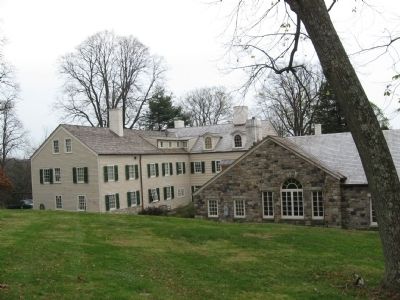
The stone ballroom wing was added by Eleanor Jay Iselin and her husband Arthur between 1924 – 1926.
Photographed by Michael Herrick, November 10, 2009
5. Homestead Map
[ detail from the marker ]
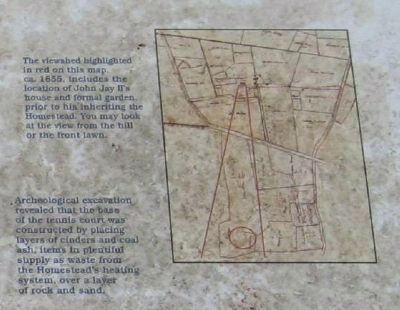
The views highlighted in red on this map, ca. 1855, includes the location of John Jay II’s house and formal garden prior to his inheriting the Homestead. You may look at the view from the hill or the front lawn.
Archeological excavation revealed that the base of the tennis court was constructed by placing layers of cinders and coal ash, item in plentiful supply as waste from the Homestead’s heating system, over a layer of rock and sand.
The views highlighted in red on this map, ca. 1855, includes the location of John Jay II’s house and formal garden prior to his inheriting the Homestead. You may look at the view from the hill or the front lawn.
Archeological excavation revealed that the base of the tennis court was constructed by placing layers of cinders and coal ash, item in plentiful supply as waste from the Homestead’s heating system, over a layer of rock and sand.
Credits. This page was last revised on June 16, 2016. It was originally submitted on November 21, 2009, by Michael Herrick of Southbury, Connecticut. This page has been viewed 833 times since then and 24 times this year. Photos: 1, 2, 3, 4, 5. submitted on November 21, 2009, by Michael Herrick of Southbury, Connecticut. • Syd Whittle was the editor who published this page.
