Boonville in Cooper County, Missouri — The American Midwest (Upper Plains)
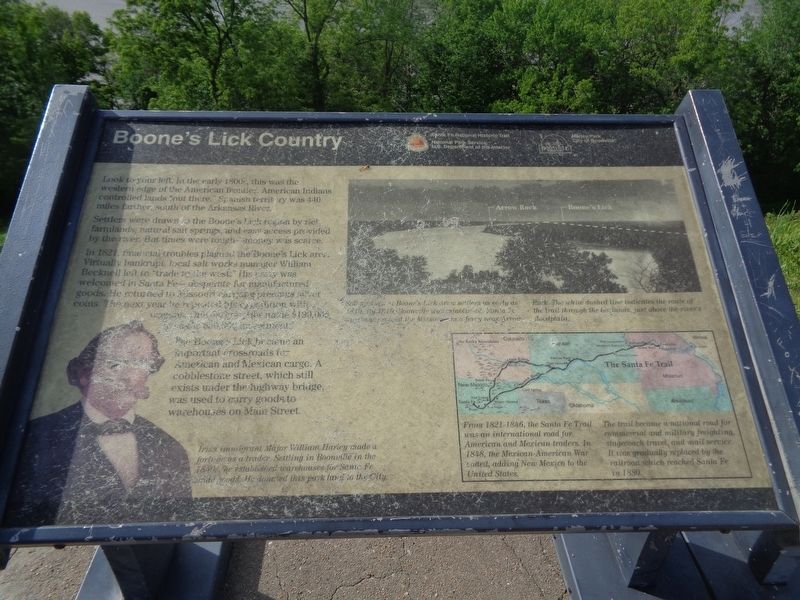
Boone's Lick Country
Santa Fe National Historic Trail
Photographed by Jason Voigt, May 14, 2024
1. Boone's Lick Country Marker
Settlers were drawn to the Boone's Lick region by rich farmlands, natural salt springs, and easy access provided by the river. But times were tough - money was scarce.
In 1821, financial troubles plagued the Boone's Lick area. Virtually bankrupt, local salt works manager William Becknell left to "trade to the west." His party was welcomed in Santa Fe - desperate for manufactured goods. He returned to Missouri carrying precious silver coins. The next year he repeated his expedition with wagons. One (unreadable) made $190,000 (unreadable) investment."
The Boone's Lick became an important crossroads for American and Mexican cargo. A cobblestone street, which still exists under the highway bridge, was used to carry goods to warehouses on Main Street.
(aside:)
From 1821-1846, the Santa Fe Trail was an international road for American and Mexican traders. In 1848, the Mexican-American War ended, adding New
this page online
The trail became a national road for commercial and military freighting, stagecoach travel, and mail service. It was gradually replaced by the railroad which reached Santa Fe in 1880.
(photo captions:)
·Irish immigrant Major William Harley made a fortune as a trader. Settling in Boonville in the 1840s, he established warehouses for Santa Fe (unreadable) goods. He donated this park land to the City.
·(most of the caption text is unreadable)
Erected by City of Boonville, Harley Park and National Park Service.
Topics and series. This historical marker is listed in these topic lists: Indigenous Peoples and Communities • Industry & Commerce • Roads & Vehicles • Settlements & Settlers. In addition, it is included in the Santa Fe Trail series list. A significant historical year for this entry is 1821.
Location. 38° 58.421′ N, 92° 45.666′ W. Marker is in Boonville, Missouri, in Cooper County. It is on Harley Drive west of Parkway Drive, on the right when traveling west. Marker is located in the Lover's Leap section of Harley Park. Touch for map. Marker is at or near this postal address:
Photographed by Jason Voigt, May 14, 2024
2. Boone's Lick Country Marker
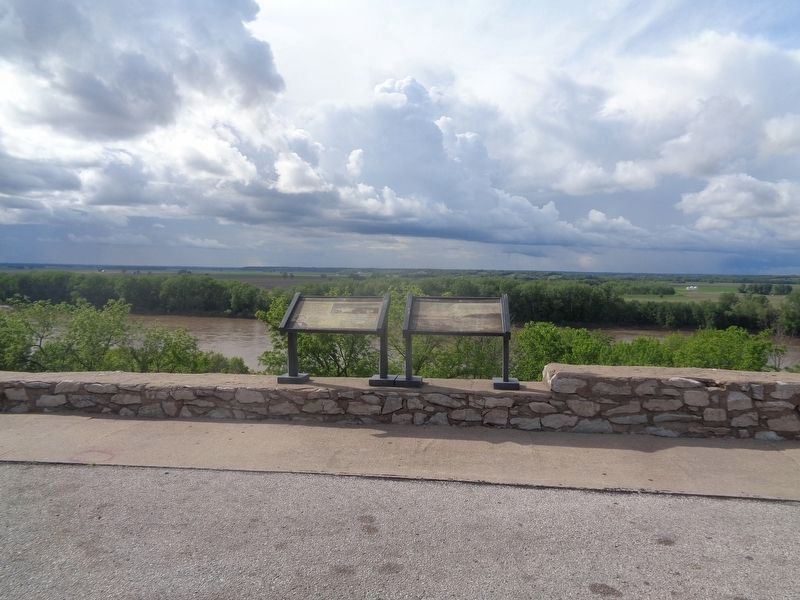
Marker is on the left, overlooking the Missouri River at Lovers Leap

Regionally, this marker is in the Missouri River Corridor. It is also in the American Midwest, in the Lewis & Clark Corridor, in the Corn Belt, and on the Santa Fe Trail Corridor. Globally, it is in North America, the Western Hemisphere, the Western World, and the Anglosphere. Historically, it finds itself in what was once the territory of the Mississippian Culture, the Louisiana Purchase, and the Antebellum South.
Other nearby markers. At least 8 other markers are within walking distance of this marker: Water Highway (here, next to this marker); The End of the Line (approx. 0.6 miles away); Boonville Depot (approx. 0.6 miles away); "Caboose #134" (approx. 0.6 miles away); Boonville to New Franklin (approx. 0.6 miles away); Boonville to Pilot Grove (approx. 0.6 miles away); History of Boonville (approx. 0.6 miles away); From Boone's Lick to Boonslick (approx. 0.6 miles away). Touch for a list and map of all markers in Boonville.
Credits. This page was last revised on May 25, 2024. It was originally submitted on May 25, 2024, by Jason Voigt of Glen Carbon, Illinois. This page has been viewed 184 times since then and 24 times this year. Photos: 1, 2. submitted on May 25, 2024, by Jason Voigt of Glen Carbon, Illinois.
