Greater East End in Houston in Harris County, Texas — The American South (West South Central)
Harrisburg-Jackson Cemetery
Photographed by James Hulse, May 21, 2024
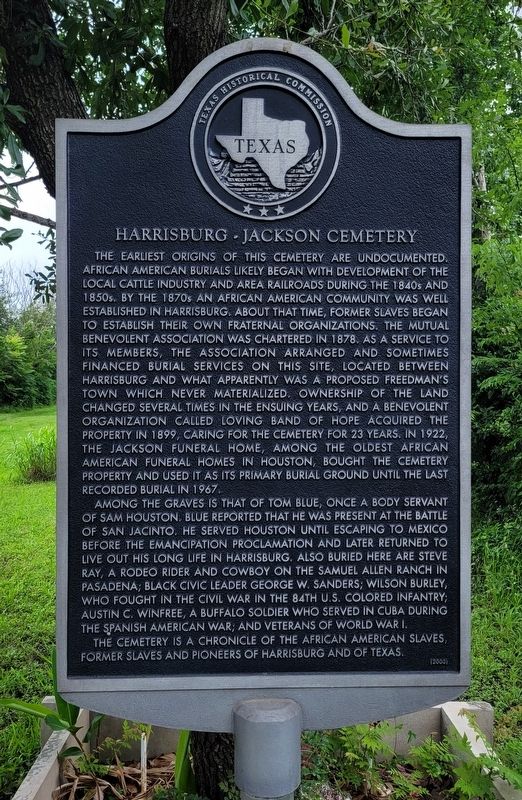
1. Harrisburg-Jackson Cemetery Marker
Among the graves is that of Tom Blue, once a body servant of Sam Houston, Blue reported that he was present at the Battle of San Jacinto. He served Houston until escaping to Mexico before the Emancipation Proclamation and later returned to live out his long life in Harrisburg. Also buried here are Steve Ray, a rodeo rider and cowboy on the Samuel Allen Ranch in Pasadena; Black civic leader George W. Sanders; Wilson Burley, who fought in the Civil War in the 84th U.S. Colored Infantry; Austin C. Winfree, a buffalo soldier who served in Cuba during the Spanish American War; and veterans of World War I.
The cemetery is a chronicle of the African American slaves, former slaves and pioneers of Harrisburg and of Texas.
Erected 2000 by Texas Historical Commission. (Marker Number 12325.)
Topics. This
this page online
Location. 29° 42.923′ N, 95° 16.934′ W. Marker is in Houston, Texas, in Harris County. It is in Greater East End. It is at the intersection of Bowie Street and Lawndale Street, on the right when traveling east on Bowie Street. The marker is located behind the main gate to the cemetery. Touch for map. Marker is at or near this postal address: 7710 Bowie St, Houston TX 77012, United States of America. Touch for directions.

Regionally, this marker is in the American South and on the Gulf Coast. Globally, it is in North America, a Gulf of Mexico state, the Western Hemisphere, the Western World, and the Anglosphere. Historically, it finds itself in what was once New Spain, the Republic of Texas, one of the Confederate States of America, and the Antebellum South.
Other nearby markers. At least 8 other markers are within 2 miles of this marker, measured as the crow flies: Old Harrisburg (approx. 0.3 miles away); a different marker also named
Photographed by James Hulse, May 21, 2024
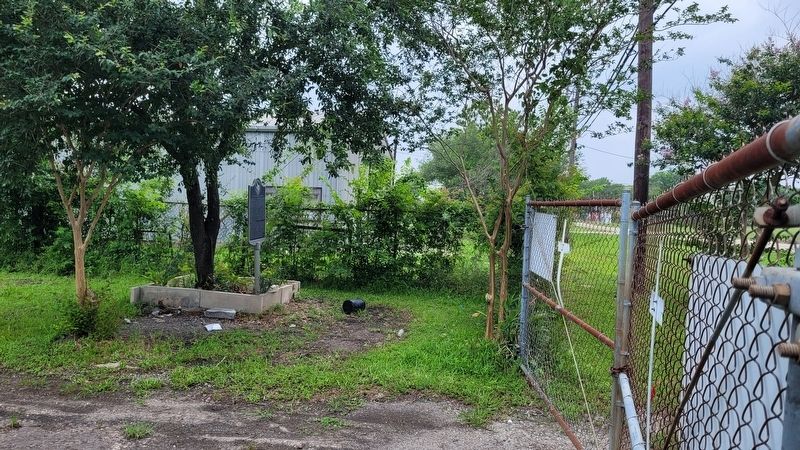
2. Harrisburg-Jackson Cemetery Marker
The marker is located just behind the gate to the cemetery.
Photographed by James Hulse, May 21, 2024
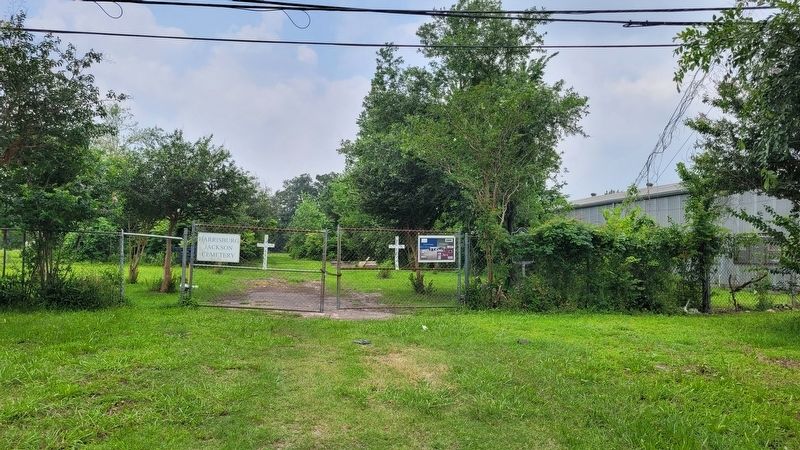
3. The entrance to the Harrisburg-Jackson Cemetery
Credits. This page was last revised on May 27, 2024. It was originally submitted on May 27, 2024, by James Hulse of Medina, Texas. This page has been viewed 1,822 times since then and 243 times this year. Photos: 1, 2, 3. submitted on May 27, 2024, by James Hulse of Medina, Texas.
