
Lincoln in Lincolnshire, England, United Kingdom — Northwestern Europe (the British Isles)
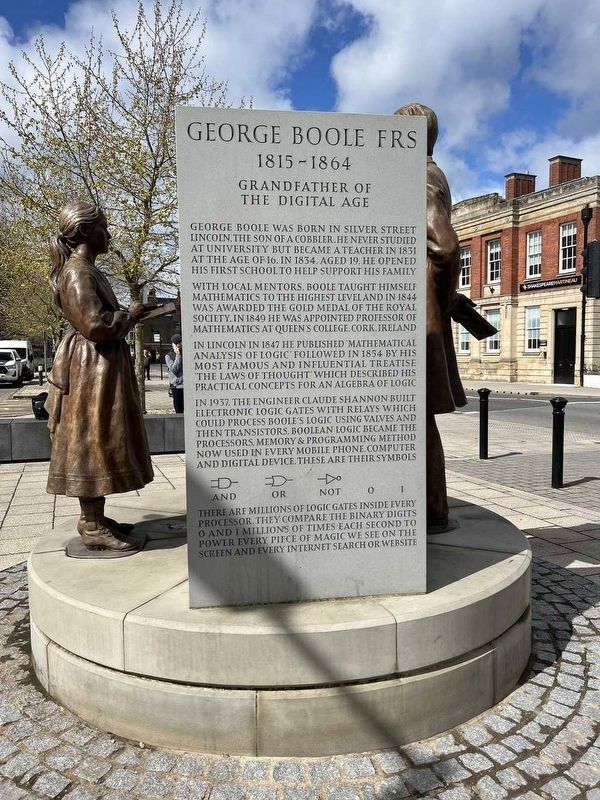
George Boole, FRS
1815-1864
| — | Grandfather of the Digital Age | — |

Photographed by Ray Gurganus, April 15, 2024
1. George Boole Marker
With local mentors, Boole taught himself mathematics to the highest level and in 1844 was awarded the Gold Medal of the Royal Society. In 1849 he was appointed professor of mathematics at Queen's College, Cork, Ireland.
In Lincoln in 1847 he published "Mathematical Analysis of Logic" followed in 1854 by his most famous and influential treatise "The Laws of Thought" which described his practical concepts for an algebra of logic.
In 1937, the engineer Claude Shannon built electronic logic gates with relays which could process Boole's logic using valves and then transistors, boolean logic became the processors. Memory & programming method now used in every mobile phone, computer and digital device. These are their symbols...
[and] [or] [not] 0 1
There are millions of logic gates inside every processor. They compare the binary digits 0 and 1 millions of times each second to power every piece of magic we see on the screen and every internet search or website.
Topics. This historical marker is listed in this topic list: Science & Medicine. A significant historical date for this entry is November 2, 1815.
Location. 53° 13.587′ N, 0° 32.36′ W. Marker is in Lincoln, England, in Lincolnshire. It is on Saint Mary's Street, on the right when traveling east. Touch for map. Marker is at or near this postal address: 19 St Mary's Street, Lincoln, England LN5 7EQ, United Kingdom. Touch for directions.

Regionally, this marker is in England’s Midlands. Globally, it is on the Atlantic Ocean, in the North Atlantic Region, in Europe, in Atlantic Europe, on one of the British
this page online
Other nearby markers. At least 8 other markers are within walking distance of this marker: From Friaries to Markets (approx. 0.6 kilometers away); Court House and College (approx. 0.6 kilometers away); The Roman Upper South Gate (approx. 0.8 kilometers away); Steep Hill Markets (approx. 0.8 kilometers away); Historic Lincoln (approx. 0.9 kilometers away); Welcome to the City of Lincoln (approx. 0.9 kilometers away); Lincoln's Character Quarters (approx. 0.9 kilometers away); Leigh-Pemberton House (approx. 0.9 kilometers away). Touch for a list and map of all markers in Lincoln.
Also see . . . George Boole (Wikipedia).
Overview: George Boole Jnr (2 November 1815 – 8 December 1864) was a largely self-taught English mathematician, philosopher, and logician, most of whose short career was spent as the first professor of mathematics at Queen's College, Cork in Ireland. He worked in the fields of differential equations and algebraic logic, and is best known as the author of The Laws of Thought (1854) which(Submitted on May 29, 2024.)contains Boolean algebra. Boolean logic is credited with laying the foundations for the Information Age alongside the work of Claude Shannon.Photographed by Ray Gurganus, April 15, 20242. George Boole Statue

Photographed by Ray Gurganus, April 15, 2024
3. George Boole Marker
Credits. This page was last revised on May 29, 2024. It was originally submitted on May 28, 2024, by Ray Gurganus of Washington, District of Columbia. This page has been viewed 186 times since then and 23 times this year. Photos: 1, 2, 3. submitted on May 28, 2024, by Ray Gurganus of Washington, District of Columbia. • Andrew Ruppenstein was the editor who published this page.
