Walnut Hills in Cincinnati in Hamilton County, Ohio — The American Midwest (Great Lakes)
Cincinnati Federation of Colored Women’s Clubs
⎯⎯⎯
Cincinnati Federation Clubhouse
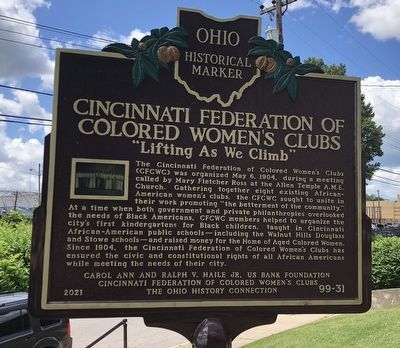
Photographed by Duane and Tracy Marsteller, May 28, 2024
1. Cincinnati Federation of Colored Women’s Clubs side of marker
“Lifting As We Climb”
this page online
Erected 2021 by Carol Ann and Ralph V. Haile Jr. US Bank Foundation • Cincinnati Federation of Colored Women's Clubs • The Ohio History Connection. (Marker Number 99-31.)
Topics and series. This historical marker is listed in these topic lists: African Americans • Charity & Public Work • Fraternal or Sororal Organizations • Women. In addition, it is included in the National Register of Historic Places (NRHP), and the Ohio Historical Society / The Ohio History Connection series lists. A significant historical date for this entry is May 6, 1904.
Location. 39° 7.871′ N,
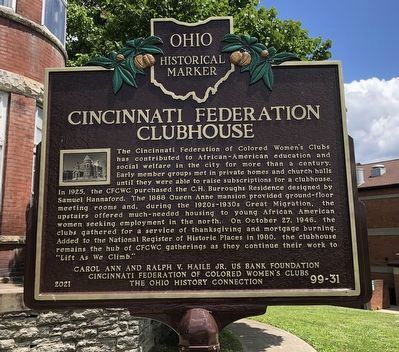
Photographed by Duane and Tracy Marsteller, May 28, 2024
2. Cincinnati Federation Clubhouse side of marker

Regionally, this marker is in the American Midwest and in the Ohio River Valley. Globally, it is in North America, the Western Hemisphere, the Western World, and the Anglosphere. Historically, it finds itself in what was once the Haudenosaunee (Iroquois) Confederacy, the territory of the Mississippian Culture, and the Northwest Territory.
Other nearby markers. At least 8 other markers are within walking distance of this marker: Manse Hotel and Annex / Horace Sudduth (within shouting distance of this marker); Votes for Women (about 500 feet away, measured in a direct line); Lane Theological Seminary / The Lane Seminary Debates (about 700 feet away); Harriet Beecher Stowe House (about 700 feet away); Harriet Beecher Stowe (about 800 feet away); Walnut Hill Salutes Black Inventors (approx. 0.2 miles
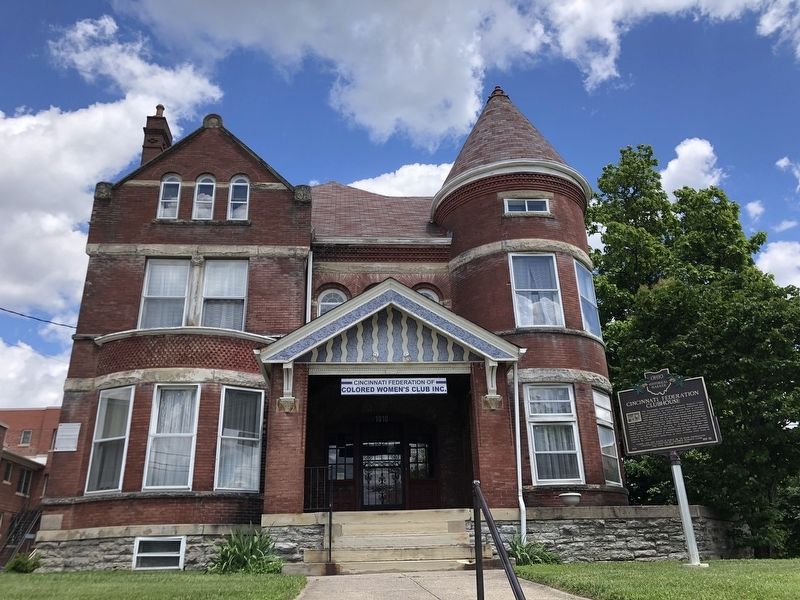
Photographed by Duane and Tracy Marsteller, May 28, 2024
3. Cincinnati Federation of Colored Women’s Clubs / Cincinnati Federation Clubhouse Marker
Also see . . .
1. Cincinnati Federation of Colored Women's Clubs. In 1904, eight local Black women’s organizations across Cincinnati came together to form the Cincinnati Federation of Colored Women’s Clubs (CFCWC). Their stated purpose was for “the betterment of the community and the race at large, by bringing together the various clubs for unity and action and exchange of ideas in the furthering of race progress." (Andrea Gutmann Fuentes and Sue Plummer, Clio: Your Guide to History, June 3, 2020) (Submitted on May 30, 2024, by Duane and Tracy Marsteller of Murfreesboro, Tennessee.)
2. C.H. Burroughs Residence (PDF). Ohio Historic Inventory form on the house, which was part of a group of Hannaford-related structures listed on the National Register in 1980. (via National Archives) (Submitted on May 30, 2024, by Duane and Tracy Marsteller of Murfreesboro, Tennessee.)
Credits. This page was last revised on October 11, 2024. It was originally submitted on May 29, 2024, by Duane and Tracy Marsteller of Murfreesboro, Tennessee. This page has been viewed 601 times since then and 61 times this year. Photos: 1, 2, 3. submitted on May 29, 2024, by Duane and Tracy Marsteller of Murfreesboro, Tennessee.
