Glen Echo in Montgomery County, Maryland — The American Northeast (Mid-Atlantic)
The Roller Coasters of Glen Echo Amusement Park
Photographed by Tom Fuchs, October 27, 2007
1. The Roller Coasters of Glen Echo Amusement Park Marker
Roller Coasters.
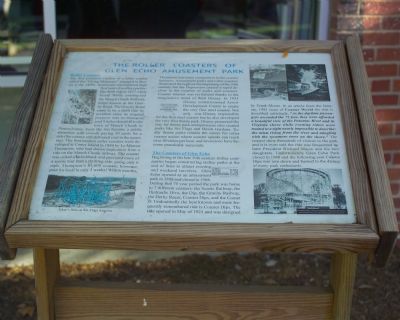
The first primitive version of a roller coaster called the “Flying Mountain” emerged in Russia in the 1400’s. Americans encountered their first taste of a roller coaster-like thrill ride in 1827 when Josiah White constructed the Mauch Chunk Railway, better known as the Gravity Road. The Gravity Road came to be a thrill ride by accident since its original purpose was to transport coal 9 miles downhill to the town of Mauch Chunk in Pennsylvania. Soon the run became a public attraction with crowds paying 50 cents for a ride (the coaster still delivered coal in the morning). The first modern roller coasters were developed at Coney Island in 1884 by Le Marcus Thompson, who had drawn inspiration from a ride on the Mauch Chunk railway. The coaster was called a switch back and provided more of a scenic tour than a thrilling ride, going only 6 mph. Thompson's $1,600 coaster, however, paid for itself in only 3 weeks! Within months, Thompson had many competitors in the coaster business. Amusement parks and roller coasters flourished throughout the beginning of the 20th century but the Depression caused a rapid
this page online
The Coasters of Glen Echo.
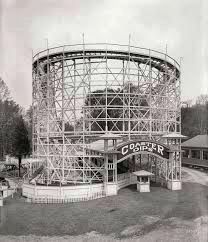
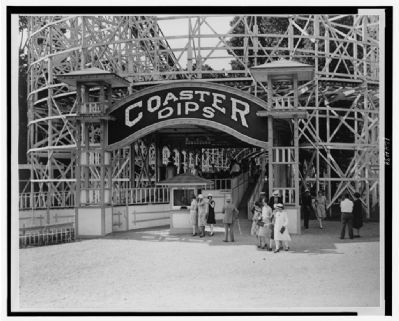
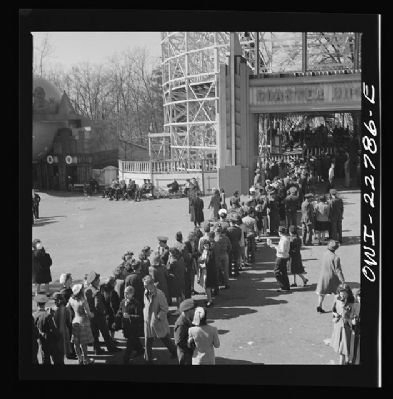
Beginning in the late 19th century trolley companies began constructing trolley parks at the end of lines to attract evening and weekend travelers. Glen Echo opened as an amusement park in 1898 and closed in 1968. During that 70 year period the park was home to 7 different coasters: the Scenic Railway, the Hydraulic Dive, the Dip, the Gravity Railway, the Derby Racer, Coaster Dips and the Comet Jr. Undoubtedly the best known and most frequently remembered ride is Coaster Dips. The ride opened in May of 1921
Photographed by National Photo Company
2. The "Coaster Dips" of Glen Echo
Erected by National Park Service, U.S. Department of the Interior.
Topics and series. This historical marker is listed in these topic lists: Entertainment • Parks & Recreational Areas • Railroads & Streetcars. In addition, it is included in the Former U.S. Presidents: #37 Richard M. Nixon series list. A significant historical month for this entry is January 1981.
Location. Marker has been permanently removed. It was located near 38° 57.981′ N, 77° 8.35′ W. Marker was in Glen Echo, Maryland, in Montgomery County. It was on Macarthur Boulevard ¼ mile Goldsboro Road. Touch for map. Marker was in this post office area: Glen Echo MD 20812, United States of America.
We have been informed that this marker is no longer there and will not be replaced. This page is an archival view of what was.
Regionally, this marker was in the Washington Metropolitan Area. It was also in the American Mid-Atlantic. Globally, it was in North America, the Western Hemisphere, the Western World, and the Anglosphere. Historically, it found itself in what was once one of the original Thirteen Colonies and also the Antebellum South.

Other nearby markers. At
Photographed by National Photo Company
3. Entrance to the "Coaster Dips" of Glen Echo
Other markers no longer nearby. 1921 (was here, next to this marker but has been permanently removed); The Changing Face of Glen Echo (was a few steps from this marker but has been permanently removed); Glen Echo Park’s Crystal Pool (was a few steps from this marker but has been permanently removed); Glen Echo From Past to Present (was within shouting distance of this marker but has been permanently removed); The Glen Echo Park Yurts (was within shouting distance of this marker but has been permanently removed); c. 1926 (was about 300 feet away, measured in a direct line but
Photographed by National Photo Company
4. Long lines at Roller Coasters of Glen Echo
Related markers. Click here for a list of markers that are related to this marker. To better understand the relationship, study each marker in the order shown.
Additional keywords. amusement parks

Photographed by Laura Edwards, May 31, 2024
5. The Roller Coasters of Glen Echo Amusement Park Marker Location
Credits. This page was last revised on June 1, 2024. It was originally submitted on October 30, 2007, by Tom Fuchs of Greenbelt, Maryland. This page has been viewed 8,424 times since then and 169 times this year. Last updated on May 31, 2024, by Laura Edwards of Bethesda, Maryland. Photos: 1. submitted on October 30, 2007, by Tom Fuchs of Greenbelt, Maryland. 2, 3, 4. submitted on February 21, 2015, by J. Makali Bruton of Washington, District of Columbia. 5. submitted on May 31, 2024, by Laura Edwards of Bethesda, Maryland. • Devry Becker Jones was the editor who published this page.
