Crieve Hall in Nashville in Davidson County, Tennessee — The American South (East South Central)
Travellers Rest
"The proudest moment of my life"
| — | Hood's Campaign | — |
Photographed by Don Morfe, April 18, 2014
1. Travellers Rest Marker
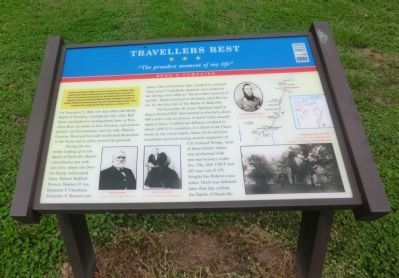
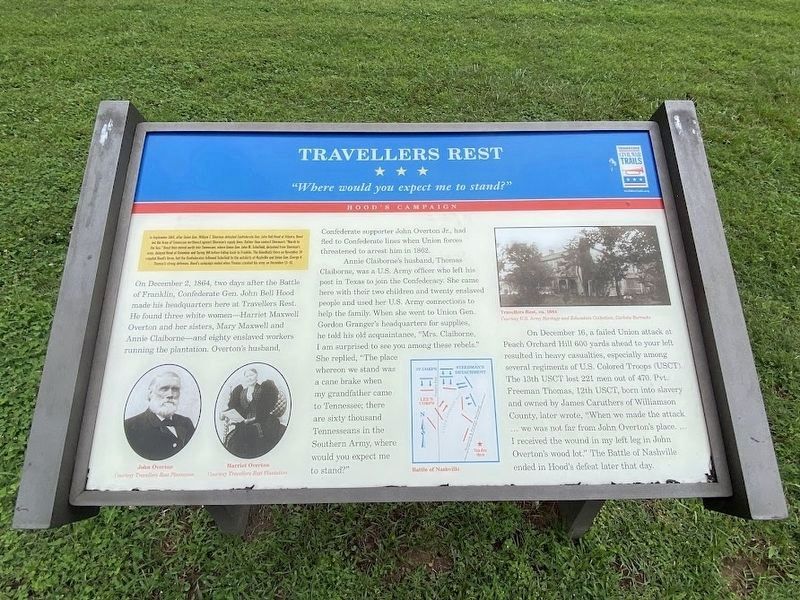
In September 1864, after Union Gen. William T. Sherman defeated Confederate Gen. John Bell Hood at Atlanta, Hood led the Army of Tennessee northwest against Sherman’s supply lines. Rather than contest Sherman’s “March to the Sea,” Hood moved north into Tennessee. Gen. John M. Schofield, detached from Sherman’s army, delayed Hood at Columbia and Spring Hill before falling back to Franklin. The bloodbath here on November 30 crippled the Confederates, but they followed Schofield to the outskirts of Nashville and Union Gen. George H. Thomas’s strong defenses. Hood’s campaign ended when Thomas crushed his army on December 15-16.
On December 2, 1864, two days after the bloody Battle of Franklin, Confederate Gen. John Bell Hood established his headquarters here at Travellers Rest, the home of John Overton, a prominent planter and businessman, and his wife, Harriet Overton. Hood and his staff established themselves in the house and in tents around the grounds.
During the two weeks leading up to the Battle of Nashville, Hood’s subordinates met with him here, where the Overton family entertained Gens. Nathan Bedford Forrest,
this page online
On December 16, heavy fighting raged at Peach Orchard Hill, then located on the farm about 600 yards to the northwest. A failed Union assault against heavy Confederate defenses resulted in about 1,000 U.S. casualties, or a third of the Union losses in the entire battle. Some of the heaviest casualties occurred among several regiments of U.S. Colored Troops, most of them former slaves, who performed with extreme bravery under fire. The 13th USCT lost 221 men out of 470. Despite the Federal casualties, Hood was defeated later that day, ending the Battle of Nashville.
Erected by Tennessee Civil War Trails.
Topics and series. This historical marker is listed in this topic list: War, US Civil. In addition, it is included in the Tennessee Civil War Trails series list. A significant historical month for this entry is September 1864.
Location. This marker has been replaced by another marker nearby.
Photographed by Don Morfe, April 18, 2014
2. Travellers Rest Marker

Regionally, this marker was in Middle Tennessee. It was also in the American South and specifically in the Upper South. Globally, it was in North America, the Western Hemisphere, the Western World, and the Anglosphere. Historically, it found itself in what was once the territory of the Mississippian Culture, one of the Confederate States of America, and the Antebellum South.
Other nearby markers. At least 8 other markers are within walking distance of this location: A different marker also named Travellers Rest (here, next to this marker); From Enslavement to Freedom (a few steps from this marker); Earliest Residents of Travellers Rest
Photographed by Darren Jefferson Clay, June 1, 2024
3. Travellers Rest Marker
Photographed by Darren Jefferson Clay, June 1, 2024
4. Travellers Rest Marker
Credits. This page was last revised on May 29, 2025. It was originally submitted on June 13, 2014, by Don Morfe of Baltimore, Maryland. This page has been viewed 1,172 times since then and 36 times this year. Last updated on June 2, 2024, by Darren Jefferson Clay of Duluth, Georgia. Photos: 1, 2. submitted on June 13, 2014, by Don Morfe of Baltimore, Maryland. 3, 4. submitted on June 2, 2024, by Darren Jefferson Clay of Duluth, Georgia. • Devry Becker Jones was the editor who published this page.
