
Valkenburg in Valkenburg aan de Geul, Limburg, Netherlands — Northwestern Europe
Gemeentegrot
⎯⎯⎯
Municipal Cave
| — | Rijksmonument | — |
Photographed by Andrew Ruppenstein, May 28, 2024
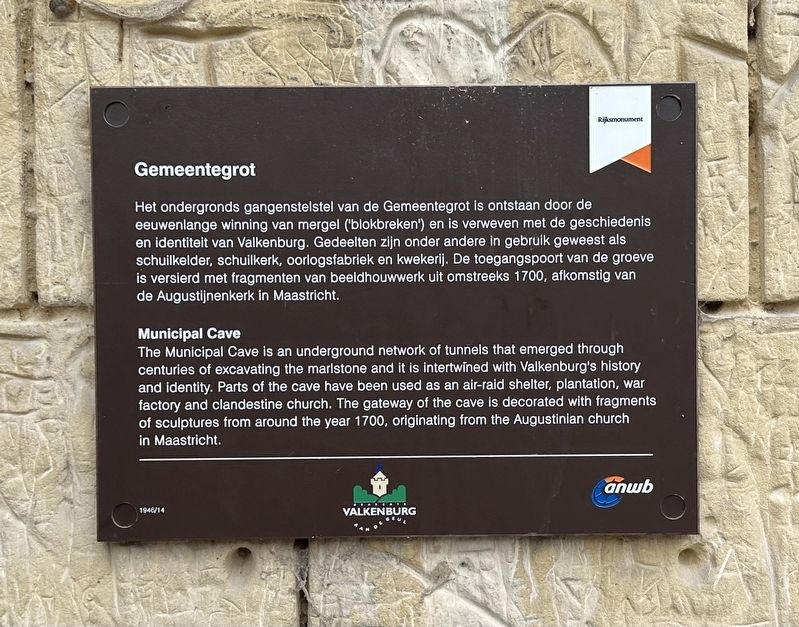
1. Gemeentegrot / Municipal Cave Marker

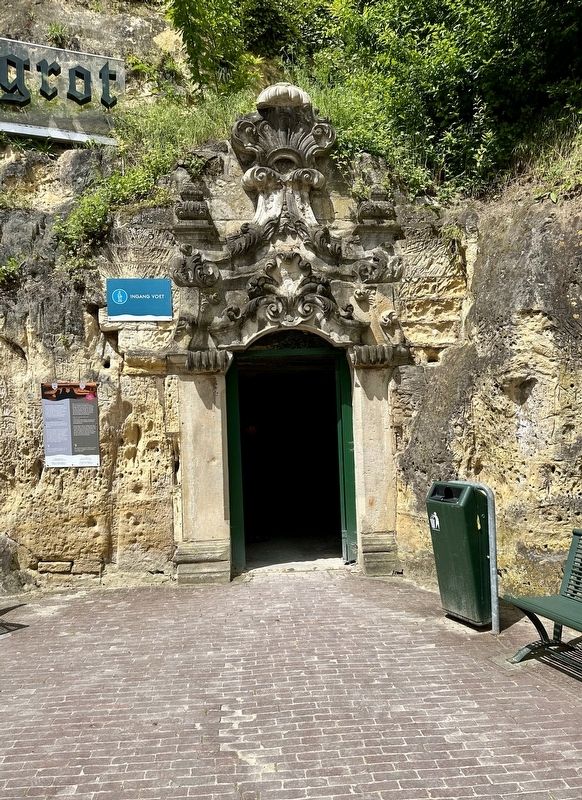
Het ondergronds gangenstelstel van de Gemeentegrot is ontstaan door de eeuwenlange winning van mergel ('blokbreken') en is verweven met de geschiedenis en identiteit van Valkenburg. Gedeelten zijn onder andere in gebruik geweest als schuilkelder, schuilkerk, oorlogsfabriek en kwekerij. De toegangspoort van de groeve is versierd met fragmenten van beeldhouwwerk uit omstreeks 1700, afkomstig van de Augustijnenkerk in Maastricht.
The Municipal Cave is an underground network of tunnels that emerged through centuries of excavating the marlstone and it is intertwined with Valkenburg's history and identity. Parts of the cave have been used as an air-raid shelter, plantation, war factory and clandestine church. The gateway of the cave is decorated with fragments of sculptures from around the year 1700, originating from the Augustinian church in Maastricht.
Erected by Gemeente Valkenburg aan de Geul, ANWB. (Marker Number 1946/14.)
Topics. This historical marker is listed in this topic list: Man-Made Features. A significant historical year for this entry is 1700.
Location. 50° 51.749′ N, 5° 49.726′ E. Marker is in Valkenburg, Limburg, in Valkenburg aan de Geul. It is on Cauberg, on the right when traveling
this page online

Regionally, it is in Europe, the European Union, Atlantic Europe, the Benelux Low Countries, the Schengen Area, Western Europe, and the Western World. Historically, it finds itself in what was once the Roman Empire and specifically also the Holy Roman Empire.
Other nearby markers. At least 8 other markers are within walking distance of this marker: Gemeentegrot als schuilplaats / Municipal Cave as Shelter (a few steps from this marker); Karel Cahn (about 90 meters away, measured in a direct line); Louis Cahn (about 90 meters away); 19e eeuws klooster / 19th Century Convent/Monastery (about 90 meters away); Kapsporen/ Cut Marks / Schlagspuren (about 90 meters away); Grendelpoort / Grendel Gate (about 120 meters away); Construction of the Valkenburg Castle / Opbouw Kasteel Valkenburg (about 120 meters away); Strijd om de bevrijding / Battle for Liberation (about 120 meters away). Touch for a list and map of all markers in Valkenburg.
Also see . . .
1. Gemeentegrot (Wikipedia, in Dutch).
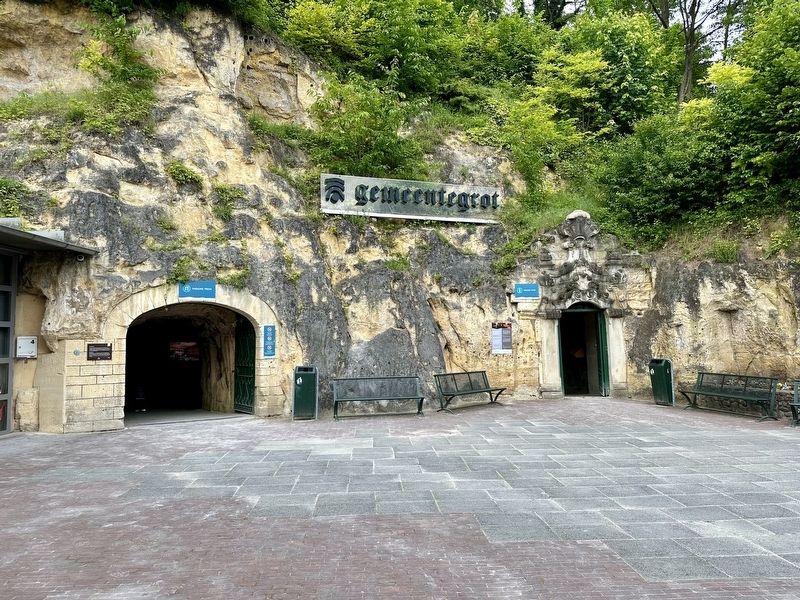
Excerpt - History (in translation): Around 1500, block breakers in the quarry first extracted marl and(Submitted on June 6, 2024.)this extraction continued until 1950. The extraction of the limestone did not take place according to a plan in the first centuries, until the second half of the 19th century, which resulted in, among other things, in roof construction and dangerous situations...Photographed by Andrew Ruppenstein, May 28, 20242. Gemeentegrot / Municipal Cave Marker - wide viewThe marker is visible here to the left of one of the two entrance into the Municipal Cave.
In addition, the quarry was used as a mushroom farm between 1936-1949, as an arms factory during the Second World War in 1943-1944, from about 1963 to 1970 there was a trout farm, in the period 1966-1974 cave cheese was ripened and in the period 1968-1983 mealworms were bred. In addition, the quarry was used as a shelter for the population during the Second World War and an atomic fallout shelter was set up in the Municipal Cave in the period 1975-1993.
2. Gemeentegrot (Visit Zuid-Limburg).
Excerpt: At the bottom of the Cauberg is the entrance to the Gemeentegrot, a marl quarry whose underground passages extend for more than 50 kilometers. The quarry was created during centuries of marl mining, which would have been started by the Romans.(Submitted on June 6, 2024.)
Over the centuries, the Municipal Cave has been used for all kinds of purposes, from air raid shelters to mushroom farms and from war factory to secret church.
The walls of the Municipal Cave are decoratedin places with carved reliefs, charcoal drawings and ancient inscriptions of cave visitors. The Gemeentegrot is the only cave that you can explore both on foot and by train.Photographed by Andrew Ruppenstein, May 28, 20243. Cave entrance decorated with remnants of a Maastricht church (mentioned on marker)
Credits. This page was last revised on June 6, 2024. It was originally submitted on June 6, 2024, by Andrew Ruppenstein of Lamorinda, California. This page has been viewed 181 times since then and 36 times this year. Photos: 1, 2, 3. submitted on June 6, 2024, by Andrew Ruppenstein of Lamorinda, California.
