Marshall Terrace in Minneapolis in Hennepin County, Minnesota — The American Midwest (Upper Plains)
Colossal Grain Elevators and a Macaroni Factory
Photographed by McGhiever, August 15, 2023
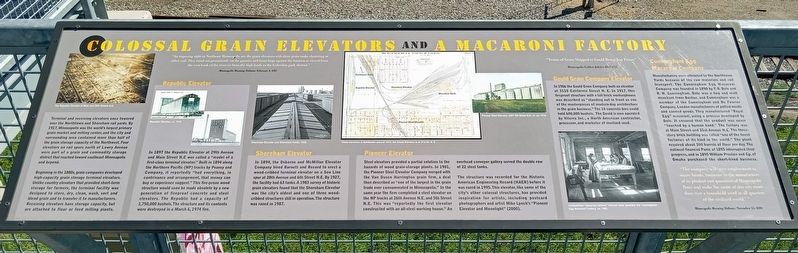
1. Colossal Grain Elevators and a Macaroni Factory Marker
"An imposing sight in Northeast Minneapolis are the grain elevators with their gran tanks clustering at either end. They stand out prominently on the prairies and loom large against the horizon as viewed from the west bank of the river or from the high lands in the Columbia park district."
Minneapolis Morning Tribune, February 4, 1917
The Republic Elevator at Main and 29th Streets N.E.
Terminal and receiving elevators once towered over the Northtown and Shoreham rail yards. By 1917, Minneapolis was the world's largest primary grain market and milling center, and the city and surrounding area contained more than half of the grain storage capacity of the Northwest. Four elevators on rail spurs north of Lowry Avenue were part of a grain and commodity storage district that reached toward southeast Minneapolis and beyond.
Beginning in the 1880s, grain companies developed high-capacity grain storage terminal elevators. Unlike country elevators that provided short-term storage for farmers, the terminal facility was designed to store, dry, clean, wash, sort and blend grain and to transfer it to manufacturers. Receiving
this page online
Republic Elevator
Republic Elevator, ca. 1910.
In 1897 the Republic Elevator at 29th Avenue and Main Street N.E. was called a "model of a first-class terminal elevator." Built in 1894 along the Northern Pacific (NP) tracks by Peavey and Company, it reportedly "had everything, in contrivance and arrangement, that money can buy or experience suggest." This fire-prone wood structure would soon be made obsolete by a new generation of fireproof concrete and steel elevators. The Republic had a capacity of 1,750,000 bushels. The structure and its contents were destroyed in a March 6, 1974 fire.
Shoreham Elevator and Shoreham Yards, 1952.
Shoreham Elevator
In 1894, the Osborne and McMillan Elevator Company hired Barnett and Record to erect a wood-cribbed terminal elevator on a Soo Line spur at 28th Avenue and 6th Street N.E. By 1927, the facility had 63 tanks. A 1983 survey of historic grain elevators found that the Shoreham Elevator was the city's oldest and one of three wood-cribbed structures still in operation. The structure was razed in
Photographed by McGhiever, August 15, 2023
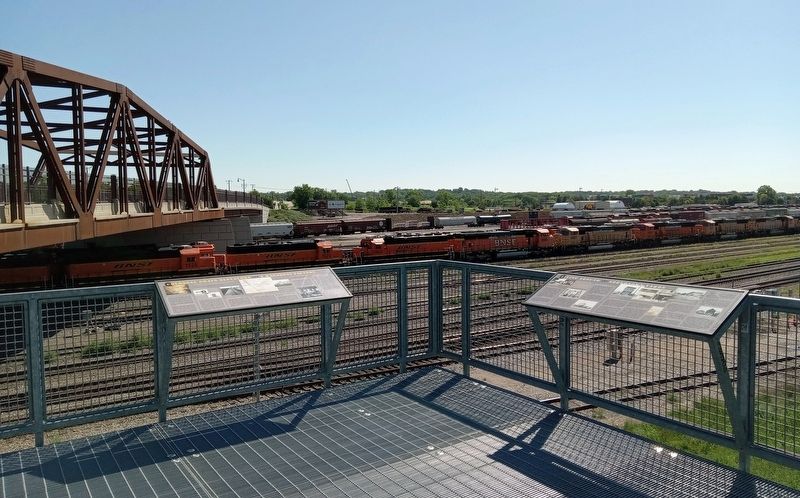
2. Colossal Grain Elevators and a Macaroni Factory Marker (left) at the Northtown Railyard Overlook
Three elevators in Northtown around 1914; the Gould Elevator is at 31st St. N.E.
Pioneer Steel Elevator, 2547 5th Street N.E., in ca. 1918.
Pioneer Elevator
Steel elevators provided a partial solution to the hazards of wood grain-storage plants. In 1901, the Pioneer Steel Elevator Company merged with the Van Dusen Harrington grain firm, a deal then described as "one of the largest in the grain trade ever consummated in Minneapolis." In the same year the firm completed a steel elevator on the NP tracks at 26th Avenue N.E. and 5th Street N.E. This was "reportedly the first elevator constructed with an all-steel working house." An overhead conveyor gallery served the double row of 22 steel tanks.
The structure was recorded for the Historic American Engineering Record (HAER) before it was razed in 1995. This elevator, like some of the city's other colossal structures, has provided inspiration for artists, including postcard photographers and artist Mike Lynch's "Pioneer Elevator and Moonlight" (2000).
"Trains of Grain Shipped to Gould Bring Top Prices"
Minneapolis Golden Jubilee 1867-1977
Gould Grain Company Elevator
In 1906 the Gould Grain Company built an elevator at 3110 California Street N.E. In 1917, this fireproof structure with a tall brick workinghouse was described as "standing out in front as one of the masterpieces of modern-day architecture in the grain business." The 18 concrete bins could hold 600,000 bushels. The Gould is now operated by Viterra Inc., a North American contractor, processor, and marketer of mustard seed.
Unidentified "macaroni factory" interior view, possibly the Cunningham Egg Macaroni Factory, ca. 1892.
Cunningham Egg Macaroni Company
Manufacturers were attracted to the Northtown Yards because of the raw materials and rail transport. The Cunningham Egg Macaroni Company was founded in 1890 by F.B. Dole and R.N. Cunningham. Dole was a hop and malt merchant from Boston, and Cunningham was a member of the Cunningham and De Fourier Company, London manufacturers of potted meats and canned goods. They manufactured "Royal Egg" macaroni, using a process developed by Dole. It ensured that the product was never "touched by a human hand." The factory was at Main Street and 31st Avenue N.E. The three-story brick building was called "one of the finest factories of its kind in the world." The plant required about 300 barrels of flour per day. The national financial Panic of 1893 interrupted their progress, and in 1895 William Preston and Cp. of Omaha purchased the short-lived business.
"The company will 'give employment to many hands, consume in the manufacture of its product vast quantities of Minneapolis flour and make the name of this city more than ever a household word in all quarters of the civilized world.'"
Minneapolis Morning Tribune, November 25, 1890
Topics. This historical marker is listed in these topic lists: Agriculture • Architecture • Industry & Commerce • Railroads & Streetcars. A significant historical year for this entry is 1880.
Location. 45° 1.643′ N, 93° 16.141′ W. Marker is in Minneapolis, Minnesota, in Hennepin County. It is in Marshall Terrace. It is on St. Anthony Parkway near California Street NE, on the right when traveling east. The marker is at the Northtown Railyard Overlook. Touch for map. Marker is in this post office area: Minneapolis MN 55418, United States of America. Touch for directions.

Regionally, this marker is in the Twin Cities Metropolitan Area. It is also in the American Midwest, in the Corn Belt, and in the Great River Road Region. Globally, it is in North America, the Western Hemisphere, the Western World, and the Anglosphere. Historically, it finds itself in what was once Rupert’s Land, the territory of the Mississippian Culture, and the Louisiana Purchase.
Other nearby markers. At least 8 other markers are within walking distance of this marker: Living Around the Northtown Yards (here, next to this marker); Park Planning and the Grand Rounds (here, next to this marker); Building a Community in Northtown (here, next to this marker); Columbia Park and Golf Course (here, next to this marker); The 1925 Bridge and the Warren Truss (a few steps from this marker); Northtown and the St. Anthony Parkway Bridge (a few steps from this marker); New Bridge Planning Process and Design (a few steps from this marker); River, Railroad and Industry (a few steps from this marker). Touch for a list and map of all markers in Minneapolis.
Credits. This page was last revised on June 7, 2024. It was originally submitted on June 7, 2024, by McGhiever of Minneapolis, Minnesota. This page has been viewed 1,007 times since then and 139 times this year. Photos: 1, 2. submitted on June 7, 2024, by McGhiever of Minneapolis, Minnesota.
