Fridley in Anoka County, Minnesota — The American Midwest (Upper Plains)
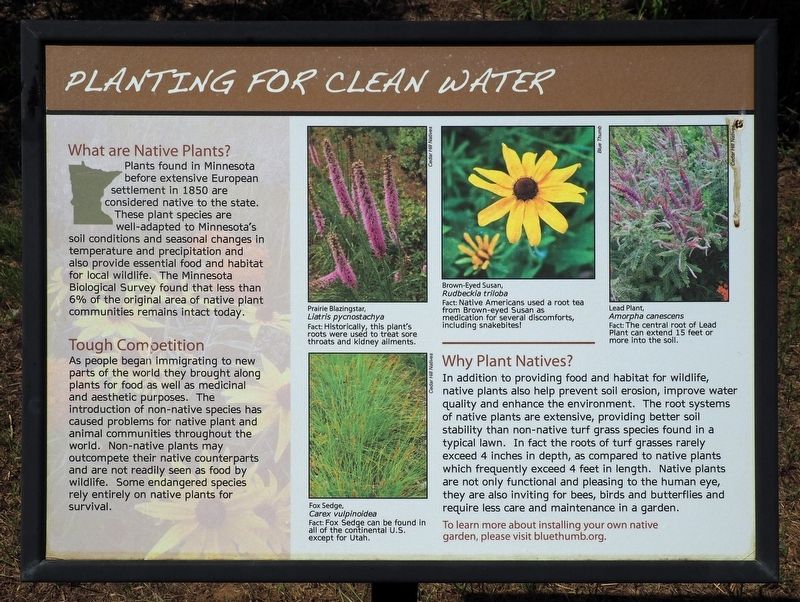
Planting for Clean Water
Photographed by McGhiever, June 7, 2024
1. Planting for Clean Water Marker
What are Native Plants?
Plants found in Minnesota before extensive European settlement in 1850 are considered native to the state. These plant species are well-adapted to Minnesota's soil conditions and seasonal changes in temperature and precipitation and also provide essential food and habitat for local wildlife. The Minnesota Biological Survey found that less than 6% of the original area of native plant communities remains intact today.
Tough Competition
As people began immigrating to new parts of the world they brought along plants for food as well as medicinal and aesthetic purposes. The introduction of non-native species had caused problems for native plant and animal communities throughout the world. Non-native plants may outcompete their native counterparts and are not readily seen as food by wildlife. Some endangered species rely entirely on native plants for survival.
Prairie Blazingstar,
Liatris pycnostachya
Fact: Historically, this plant's roots were used to treat sore throats and kidney ailments.
Brown-Eyed Susan,
Rudbeckia triloba
Fact: Native Americans used a root tea from Brown-eyed Susan as a medication for several discomforts, including snakebites!
Lead Plant,
Amorpha canescens
Fact: The central root of Lead Plant can extend 15 feet or more into the soil.
Fox Sedge,
Carex vulpinoidea
Fact: Fox Sedge can be found in all of the continental U.S. except for Utah.
Why Plant Natives?
In
this page online
To learn more about installing your own native garden, please visit bluethumb.org.
Topics. This historical marker is listed in this topic list: Environment.
Location. 45° 4.748′ N, 93° 15.03′ W. Marker is in Fridley, Minnesota, in Anoka County. It is at the intersection of W. Moore Lake Drive and 61st Avenue NE, on the right when traveling south on W. Moore Lake Drive. Touch for map. Marker is at or near this postal address: 6100 W Moore Lake Drive, Minneapolis MN 55432, United States
Photographed by McGhiever, June 7, 2024
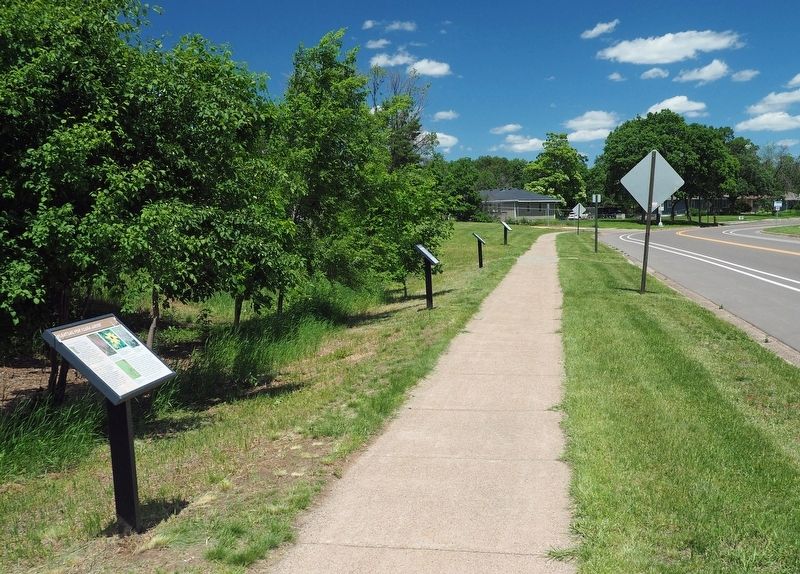
2. Planting for Clean Water Marker (left) along W. Moore Lake Drive

Regionally, this marker is in the Twin Cities Metropolitan Area. It is also in the American Midwest, in the Corn Belt, and in the Great River Road Region. Globally, it is in North America, the Western Hemisphere, the Western World, and the Anglosphere. Historically, it finds itself in what was once Rupert’s Land and also the territory of the Mississippian Culture.
Other nearby markers. At least 8 other markers are within 4 miles of this marker, measured as the crow flies: Moore Lake: A trip through time (a few steps from this marker); Anoka County Manomin* Park (approx. 1.4 miles away); Banfill-Locke Tavern / Manomin County Park (approx. 1½ miles away); Riedel Farmhouse (approx. 2 miles away); Earle Brown and the Brooklyn Farm (approx. 2.7 miles away); New Brighton World War I Memorial (approx. 3 miles away); Maple Leaf and Humboldt Heights (approx. 3.3 miles away); Mississippi Floodplain (approx. 3.7 miles away). Touch for a list and map of all markers in Fridley.
Credits. This page was last revised on June 8, 2024. It was originally submitted on June 8, 2024, by McGhiever of Minneapolis, Minnesota. This page has been viewed 154 times since then and 19 times this year. Photos: 1, 2. submitted on June 8, 2024, by McGhiever of Minneapolis, Minnesota.
