Edgemont in Dayton in Montgomery County, Ohio — The American Midwest (Great Lakes)
Old Greencastle Cemetery
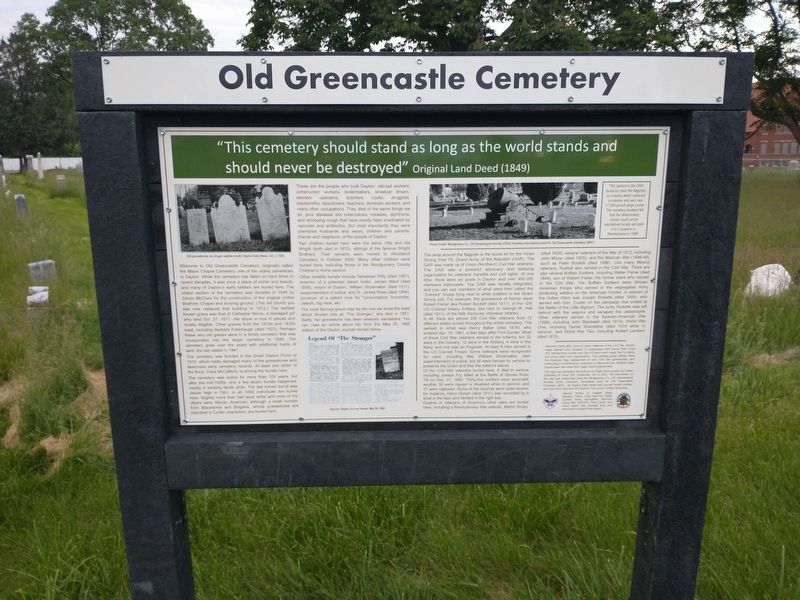
Photographed by Tom Bosse, May 16, 2024
1. Old Greencastle Cemetery Marker
“This cemetery should stand as long as the world stands and should never be destroyed”
Original Land Deed (1849)
Welcome to Old Greencastle Cemetery, originally called the Miami Chapel Cemetery, one of the oldest cemeteries in Dayton. While the cemetery has fallen on hard times in recent decades, it was once a place of honor and beauty, and many of Dayton’s early settlers are buried here. The oldest section of the cemetery was donated in 1849 by Simon McClure for the construction of the original United Brethren Chapel and burying ground. (The old church you see now replaced that building in 1912.) The earliest known grave was that of Catherine Norris, a teenaged girl who died Oct. 27, 1817. Her stone is now in pieces and mostly illegible. Other graves from the 1810s and 1820s exist, including Barbara Puterbaugh (died 1823). Perhaps these very old graves were in a family cemetery that was incorporated into the larger cemetery in 1849. The cemetery grew over the years with additional tracts of land, the last added in 1941.
The cemetery was flooded in the Great Dayton Flood of 1913, which badly damaged many of the
this page online
The cemetery was active for more than 100 years, but after the mid-1950s, only a few dozen burials happened, mostly in existing family plots. The last known burial was Jessie high in 1991. In all, 8362 individuals are buried here. Slightly more than half were white and most of the others were African American, although a small number from Macedonia and Bulgaria, whose gravestones are inscribed in Cyrillic characters, are buried here.
These are the people who build Dayton: railroad workers, construction workers, boilermakers, streetcar drivers, elevator operators, butchers, cooks, druggists, blacksmiths, beauticians, teachers, domestic workers, and many other occupations. They died of the same things we do, plus diseases like tuberculosis, measles, diphtheria, and whooping cough that have mostly been eradicated by vaccines and antibiotics. But most importantly they were cherished husbands and wives, children and parents, friends and neighbors, of the people of Dayton.
Two children buried here were the
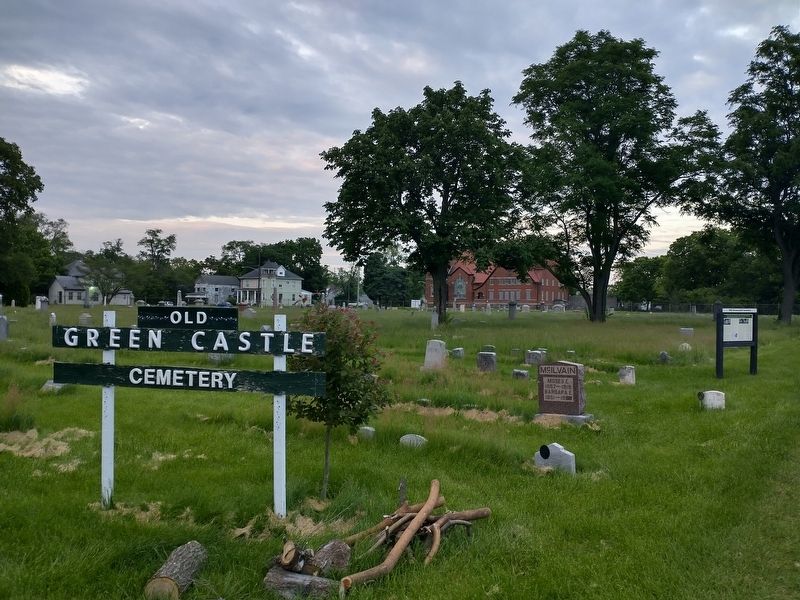
Photographed by Tom Bosse, May 16, 2024
2. Old Greencastle Cemetery Marker
Other notable burials include Sebastian Ritty (died 1891), inventor of a patented steam boiler, James Ward (died 1899), mayor of Dayton, William Shoemaker (died 1911), superintendent of police, and Dr. James Rose (died 18934), purveyor of a patent cure for “consumption, bronchitis, catarrh, big neck, etc.”.
The most famous grave may be the one we know the least about. Known only as “The Stranger”, she died in 1851. Sadly, here gravestone has been severely vandalized. You can read an article about her from the May 26, 1965 edition of the Dayton Journal Herald below.
The area around the flagpole is the burial lot for the Hiram Strong Post 79, Grand Army of the Republic (GAR). The GAR was made up of Union (Northern) Civil War veterans. The GAR was a powerful advocacy and lobbying organization for veterans’ benefits and civil rights. At one time, there were six posts in Dayton
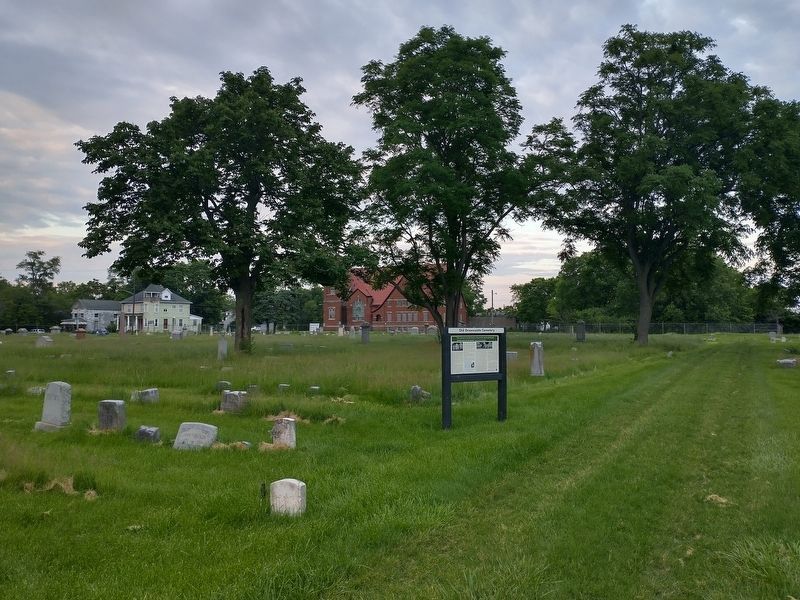
Photographed by Tom Bosse, May 16, 2024
3. Old Greencastle Cemetery Marker
In all, there are almost 200 Civil War veterans from 12 different states buried throughout the entire cemetery. The earliest to enlist was Henry Baker (died 1876), who enlisted Apr. 16, 1861, a few days after Fort Sumter. Most of these Civil War veterans served in the Infantry, but 32 were in the Cavalry, 12 were in the Artillery, 4 were in the Navy, and one was an Engineer. At least 9 men served in the US Colored Troops. Some veterans were recognized for valor, including Major William Shoemaker, later superintendent of police, but all were heroes for service to preserve the Union and free the nation’s slaves.
Of the Civil War veterans buried here, 8 died in service, including Joseph Fry, killed at the Battle of Stones River, TN
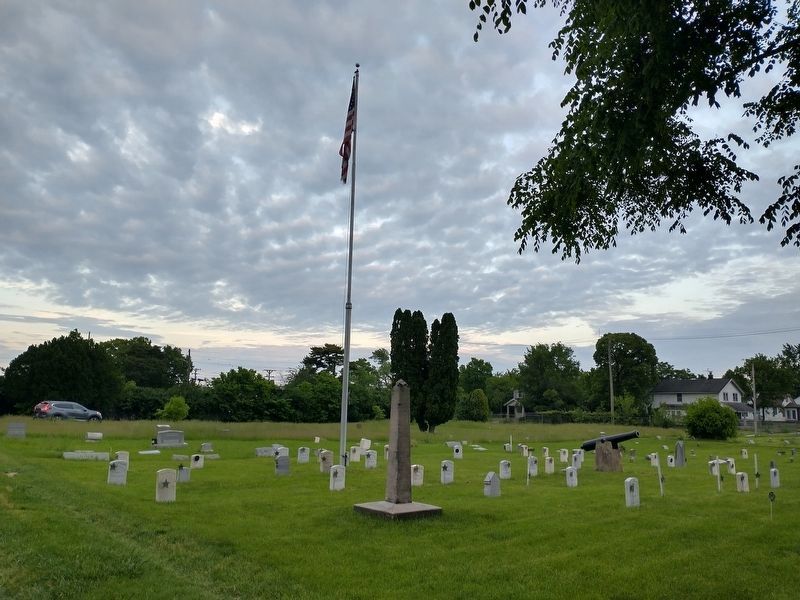
Photographed by Tom Bosse, May 16, 2024
4. Burial lot for the Hiram Strong Post 79, Grand Army of the Republic (GAR).
Dozens of veterans of America’s other wars are buried here, including a Revolutionary War veteran, Martin Shuey (died 1828), several veterans of the War of 1812, including John Moyer (died 1835), and the Mexican War (1846-48, such as Peter Rudisill (died 1896). Like many Mexico veterans. Rudisill also served in the Civil War. There are also several Buffalo Soldiers, including Walter Fisher (died 1894), sone of Robert Fisher, the former slave who served in the Civil War. The Buffalo Soldiers were African-American troops who served in the segregated Army protecting settlers on the American frontier. A veteran of the Indian Wars was Joseph Ricketts (died 1909), who served with Gen. Custer on the campaign that ended at the Battle of the Little Bighorn. The lucky Ricketts was left behind with the wagons and escaped the catastrophe. Other veterans served in the Spanish-American
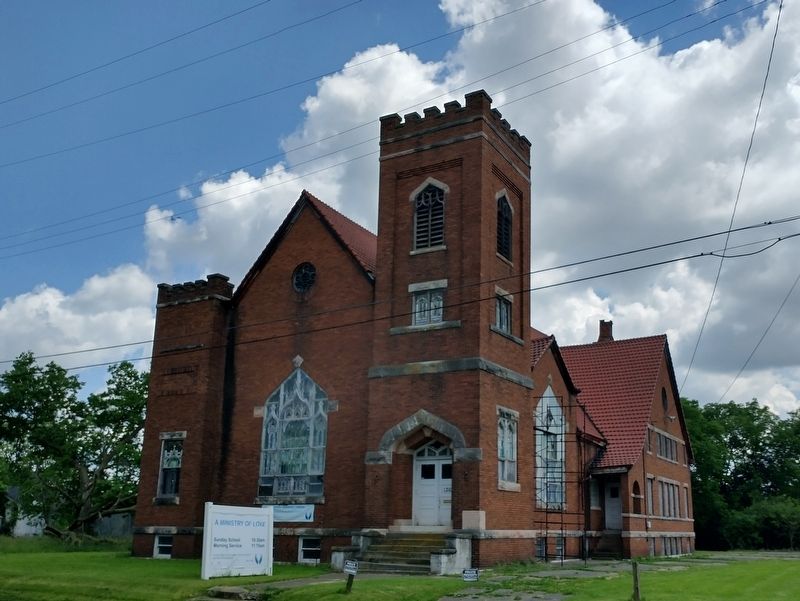
Photographed by Tom Bosse, May 18, 2024
5. The original United Brethren Chapel
Sherman Camp #93, Sons of Union Veterans of the Civil War, Dayton, helps maintain this cemetery in cooperation with Scouts BSA Troop 516, Montgomery County and City of Dayton work crews, the Fry family, and many other civic organizations. This includes grass cutting, flying the American flag, replacement of worn Civil War gravestones, and conducting a remembrance ceremony on Memorial Day. Multiple Eagle Scouts have also done their Eagle Scout projects here. This sign was designed and built as an Eagle Scout project by Rowan Spaulding of Troop 516, Centerville, OH in 2023. The information on this sign was researched using the Montgomery Co., OH Genealogical Society (OGS) Cemetery inscriptions book for Old Greencastle Cemetery (2001), old Dayton Daily News and Journal Herald articles, and input from historians Phil Brandt, Fred Lynch, & Mike Spaulding. Special thanks to Insignia Signs, Moraine, David Cook and the Plastic Lumber Store, Springfield, Sherman Camp #93, SUVCW, Trevor Bush, and many others who donated time and resources to support this project.
[Caption:]
The cannon in the GAR burial lot (near the flagpole) is a replica which replaced a massive and very rare 17,000-pound siege mortar. The cemetery trustees felt that the deteriorating mortar could not be refurbished locally and sold it to a museum in Pennsylvania in 1998. Photo Credit: Montgomery Co., OH Genealogical Society (OGS) Cemetery Inscriptions book for Old Greencastle Cemetery (2001).
Erected 2023

Photographed by Tom Bosse, May 16, 2024
6. Old Greencastle Cemetery, GAR burial lot, and original United Brethren Chapel.
Topics. This historical marker is listed in this topic list: Cemeteries & Burial Sites. A significant historical month for this entry is October 2000.
Location. 39° 44.227′ N, 84° 12.923′ W. Marker is in Dayton, Ohio, in Montgomery County. It is in Edgemont. It is at the intersection of South Broadway Street and Morris Avenue, on the right when traveling north on South Broadway Street. Touch for map. Marker is at or near this postal address: 1321 S Broadway St, Dayton OH 45417, United States of America. Touch for directions.

Regionally, this marker is in the Miami Valley. It is also in the American Midwest and in the Corn Belt. Globally, it is in North America, the Western Hemisphere, the Western World, and the Anglosphere. Historically, it finds itself in what was once the Haudenosaunee (Iroquois) Confederacy, the territory of the Mississippian Culture, and the Northwest Territory.
Other nearby markers. At least 8 other markers are within walking distance of this marker: The Story of Brethen Tower & The Callahan Building Clock (approx. 0.8 miles away); Morrison Iron Bridge (approx. 0.9 miles away); James F. Dicke Family Transportation Center (approx. 0.9 miles away); Canal Superintendent's Office (approx. 0.9 miles away); Miami and Erie Canal Lock No. 17 (approx. 0.9 miles away); Dayton Cyclery (approx. 0.9 miles away); Bowling Green Depot (approx. 0.9 miles away); Smith Covered Bridge (approx. 0.9 miles away). Touch for a list and map of all markers in Dayton.
Credits. This page was last revised on June 9, 2024. It was originally submitted on June 9, 2024, by Tom Bosse of Jefferson City, Tennessee. This page has been viewed 1,898 times since then and 266 times this year. Photos: 1, 2, 3, 4, 5, 6. submitted on June 9, 2024, by Tom Bosse of Jefferson City, Tennessee. • Devry Becker Jones was the editor who published this page.
