Bridgeport in Chicago in Cook County, Illinois — The American Midwest (Great Lakes)
Charles A. Comiskey
"The Old Roman"
| — | 1859-1931 | — |

Photographed by Sean Flynn, June 7, 2024
1. Charles A. Comiskey Marker
Player and Manager
Founder of the Chicago White Sox, 1900
Co-founder of the American League, 1901
Builder of Comiskey Park, 1910
American League Champions, 1901, 1906, 1917, 1919
World Champions, 1906, 1917
Member of Baseball Hall of Fame, 1939
Comiskey Family
Members of the Comiskey Family Owned and Served as Executives of the Chicago White Sox from 1900-1962
Charles A. Comiskey
J. Louis Comiskey
Grace Reidy Comiskey
Charlie Comiskey
Dorothy Comiskey Rigney
Gracie Lou Comiskey
Topics and series. This historical marker is listed in these topic lists: Charity & Public Work • Parks & Recreational Areas • Sports. In addition, it is included in the Baseball Hall of Famers series list. A significant historical year for this entry is 1900.
Location. 41° 49.753′ N, 87° 37.984′ W. Marker is in Chicago, Illinois, in Cook County.
this page online

Regionally, this marker is on Chicago’s South Side. It is also in the American Midwest. Globally, it is in North America, on the Great Lakes, in the Western Hemisphere, in the Western World, and in the Anglosphere. Historically, it finds itself in what was once the Viceroyalty of New France, the territory of the Mississippian Culture, and the Northwest Territory.
Other nearby markers. At least 8 other markers are within walking distance of this marker: Luis Aparicio (a few steps from this marker); Jacob Nelson "Nellie" Fox (a few steps from this
Photographed by Sean Flynn, June 7, 2024
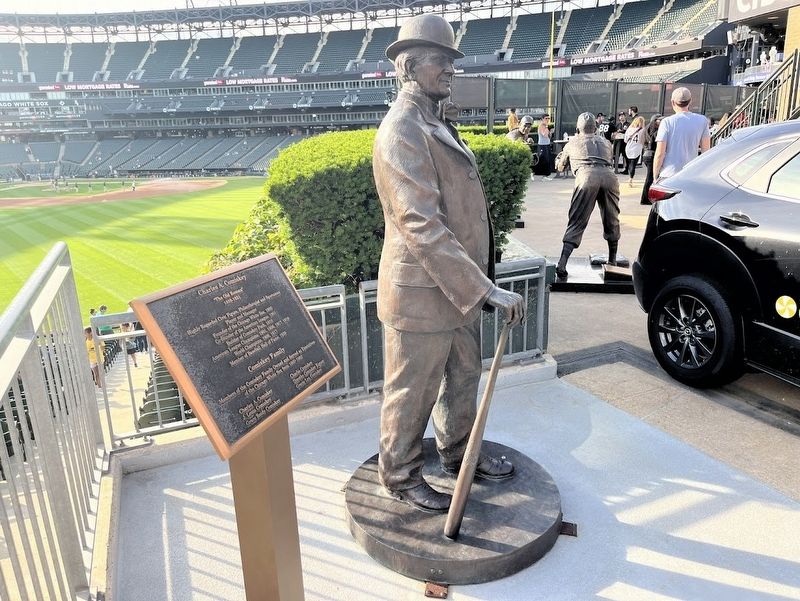
2. Charles A. Comiskey statue
More about this marker. Comiskey was the namesake of the White Sox's home stadium from 1910 until 1990, which was across the street. When this new stadium opened in 1991, it was also called Comiskey Park until 2003, when naming rights were sold to U.S. Cellular. The stadium was renamed Guaranteed Rate Field in 2016.
Regarding Charles A. Comiskey. Charles Comiskey grew up in Chicago the son of a politician and emerged as a distinguished baseball player and manager. Throughout

Photographed by Sean Flynn, June 7, 2024
3. Charles A. Comiskey statue
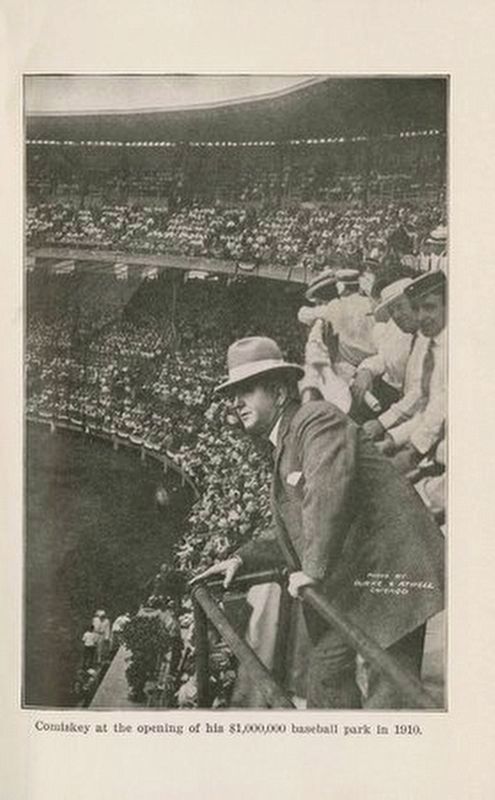
As an American League pioneer and Sox owner from 1900 until 1931, Comiskey oversaw five American League championship teams, and two World Series titles in 1906 (when they beat the National League's Chicago Cubs) and 1917. He also drove the building of his team's home stadium in 1910, originally called White Sox Park and soon thereafter Comiskey Park and known as "The Baseball Palace of the World." That stadium was replaced in 1991 by this one across the street.
Left unsaid

Chicago Daily News Collection, Chicago History Museum, 1912
4. Charles A. Comiskey (1859-1931)
Charles Comiskey stands (with a dog) on the field of his namesake baseball stadium, Comiskey Park. This spot on the right field line at the old park is maybe 800 feet from where his statue sits today in the current White Sox home stadium.
Comiskey died in 1931. His wife Grace maintained team control until her death in 1956, when her children took over. In 1958, they sold majority ownership to Bill Veeck, who built the "exploding scoreboard" (which is emulated at the new park)
Courtesy of Chicago History Museum (ICHi-068345); Burke & Atwell, photographer, 1910
5. Charles A. Comiskey at 1910 stadium opening
Also see . . .
1. Society of American Baseball Research (SABR): Charles Comiskey.
Excerpt: "One of the most influential figures in the history of the sport, Charles Comiskey had a 55-year odyssey through professional baseball that ran the gamut: captain of one of the greatest teams of the nineteenth century; league-jumper during the 1890 players’ rebellion; one of the chief architects of the American League’s emergence in 1901 as a major league; longtime owner of one of the league’s most successful franchises, the Chicago White Sox; and a central figure in the 1919 Black Sox Scandal."(Submitted on June 12, 2024, by Sean P. Flynn of Oak Park, Illinois.)
2. Charles "The Old Roman" Comiskey.
Excerpt from famous-trials.com: "Comiskey was called as a witness at the trial of the eight White Sox players. He revealed that he had heard possible rumors of the fix during the series. Comiskey was also questioned about the finances of the White Sox team during the years surrounding the scandal. He could not remember exact figures. The defense hit a nerve with Comiskey when they questioned him about possible contract jumping when he was a baseball player. He became irate and was dismissed from the stand. During his long association with the game, Comiskey was at various points regarded as a labor radical, a visionary executive, and a domineering patriarch who lavished money on his ballpark and the press while at the same time being accused of underpaying his best players. Baseball, Comiskey once wrote, 'is the only game that is complicated enough to be always interesting and yet simple enough to be always understood.' Ultimately, the same can be said of the Old Roman himself."(Submitted on June 12, 2024, by Sean P. Flynn of Oak Park, Illinois.)
Credits. This page was last revised on August 19, 2024. It was originally submitted on June 11, 2024, by Sean P. Flynn of Oak Park, Illinois. This page has been viewed 590 times since then and 96 times this year. Photos: 1. submitted on June 11, 2024, by Sean P. Flynn of Oak Park, Illinois. 2, 3, 4, 5. submitted on June 12, 2024, by Sean P. Flynn of Oak Park, Illinois.
