Herculaneum in Jefferson County, Missouri — The American Midwest (Upper Plains)
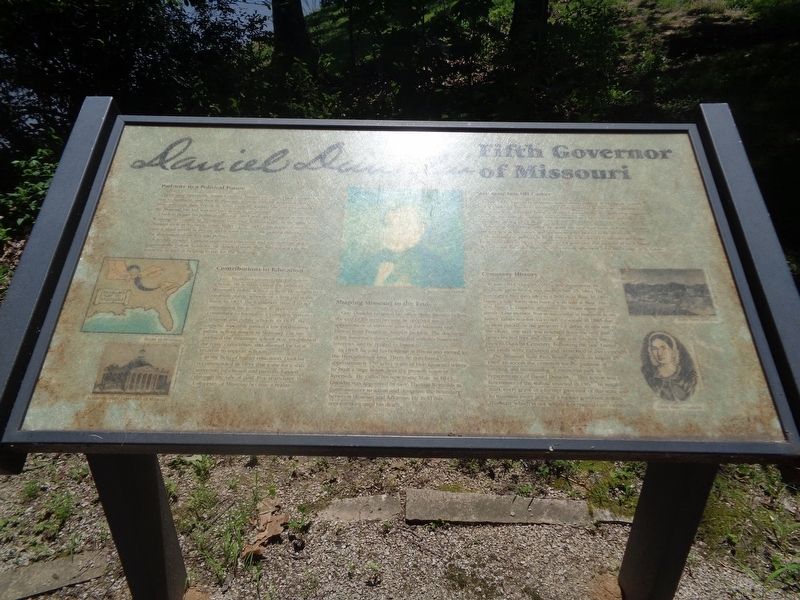
Daniel Dunklin
Fifth Governor of Missouri
Photographed by Jason Voigt, June 13, 2024
1. Daniel Dunklin Marker
Pathway to a Political Future
Born near Greenville, South Carolina, January 26, 1790, Daniel Dunklin moved first to Kentucky and then to Missouri, settling with his widowed mother at Mine-a-Breton, near Potosi, in 1810. Dunklin studied law and was admitted to the Missouri bar but was not very active as an attorney.
Dunklin began his political career in 1815 with appointment as sheriff for Washington County by Territorial Governor William Clark. In the same year Dunklin took as his bride, Emily Haley (1*9*-1851), his boyhood sweetheart. He built a small tavern in Potosi, and it soon became the general meeting place for discussion of society and politics.
A prolific reader, Dunklin supported education and was instrumental in founding the Potosi Academy. He donated more than 500 volumes to the academy as well as helping to pay for the buildings.
Contributions to Education
Gov. Dunklin's greatest interest was in schools. He is often called the father of Missouri's public school system. He sought to establish public schools on a firm and stable basis. In 1833, the legislature passed an act authorizing the governor
this page online
In the field of higher education, Dunklin recommended in 1834 that a site for a state university be chosen and partially funded through the sale of land. Five years later, the University of Missouri became a reality.
Shaping Missouri to the End
Gov. Dunklin resigned his office three months before the end of his term because he received the appointment of surveyor general for Missouri and Illinois from President Andrew Jackson. The discharge of his surveyor's duties conflicted with his business interests, and he retired to Potosi.
In 1840, he sold his holdings at Potosi and moved to the Herculaneum area. There he purchased approximately 570 acres north of Herculaneum where he built a large house near the present town of Riverside. He called his new home Maje. In 1843, Dunklin was appointed by Gov. Thomas Reynolds as commissioner
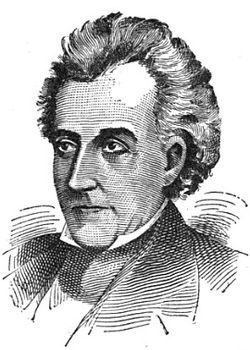
via Wikipedia
2. Daniel Dunklin
Stalemate Sets Off Career
In July 1822, a group of delegates from various parts of Washington County met at Dunklin's Tavern to nominate a representative to the state legislature. After a day long stalemate failed to produce a candidate, the gathering suggested Dunklin. Accordingly, Dunklin was nominated and later elected serving in the legislature during 1822-1824.
Following his term in office, he spent the next four years in Potosi. Dunklin had invested in the mines, and his investments proved to be profitable.
He returned to politics in 1828 when he was elected lieutenant governor. Four years later in 1832, Dunklin ran for governor. His support of rural issues helped carry the rural districts, overcoming opponent John Bull's edge in St. Louis.
Cemetery History
In July 1844, Dunklin contracted pneumonia. He gradually grew worse and died on July 25, 1844. He was buried two days later in a field near Maje. In 1851, Daniel's wife Emily was buried with him at Maje. His son, James L. Dunklin, inherited the estate upon the death of his mother. Not as successful in business as his father, James was forced to sell the estate in 1885 due to liens placed on the property for debts. In this sale of the estate, one acre was reserved from the only part James owned free and clear. This acre became the present Dunklin Cemetery. Following the sale, Daniel and Emily were exhumed and reinterred in this cemetery.
The Missouri State Park Board agreed on August 25, 1965 to accept the cemetery for the purpose of erecting and maintaining "a memorial park in remembrance of Daniel Dunklin…" This action was a forerunner of the statute enacted in 1967 "to suitably mark every grave of a former governor of this state

Photographed by Jason Voigt, June 13, 2024
3. Daniel Dunklin Marker
Marker is located at Gov. Daniel Dunklin's Grave State Historic Site.
Topics. This historical marker is listed in these topic lists: Cemeteries & Burial Sites • Education • Industry & Commerce • Settlements & Settlers. A significant historical date for this entry is January 26, 1790.
Location. 38° 16.825′ N, 90° 22.595′ W. Marker is in Herculaneum, Missouri, in Jefferson County. It can be reached from Dunklin Drive. Marker is located at Gov. Daniel Dunklin's Grave State Historic Site. Touch for map. Marker is at or near this postal address: 104 Dunklin Dr, Herculaneum MO 63048, United States of America. Touch for directions.

Regionally, this marker is in the Missouri River Corridor and in Greater St. Louis. It is also in the American Midwest, in the Lewis & Clark Corridor, in the Corn Belt, and in the Great River Road Region. Globally, it is in North America, the Western Hemisphere, the Western World, and the Anglosphere. Historically, it finds itself in what was once the territory of the Mississippian Culture, the Louisiana Purchase, and the Antebellum South.
Other nearby markers. At
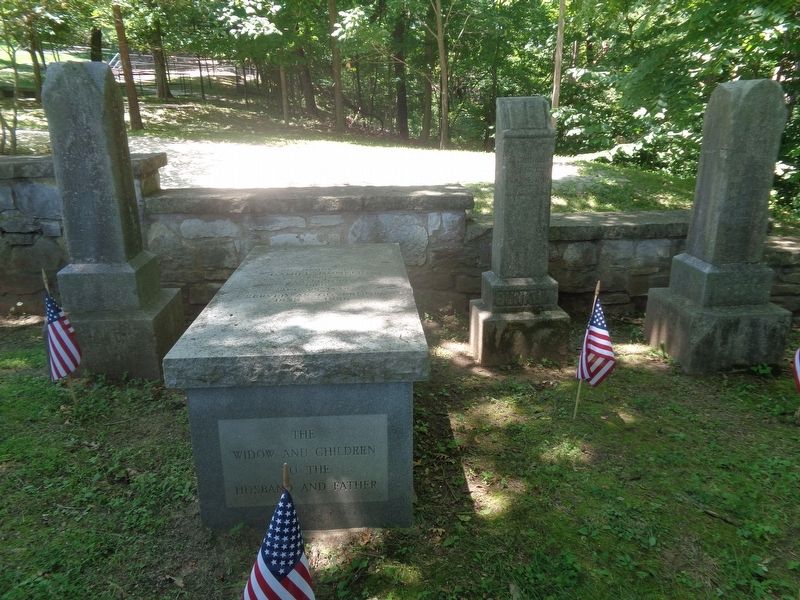
Photographed by Jason Voigt, June 13, 2024
4. Daniel Dunklin and his family's gravesite
Also see . . .
1. Daniel Dunklin. Wikipedia entry (Submitted on June 13, 2024, by Jason Voigt of Glen Carbon, Illinois.)
2. Gov. Daniel Dunklin's Grave State Historic Site. Missouri State Parks website entry (Submitted on June 13, 2024, by Jason Voigt of Glen Carbon, Illinois.)
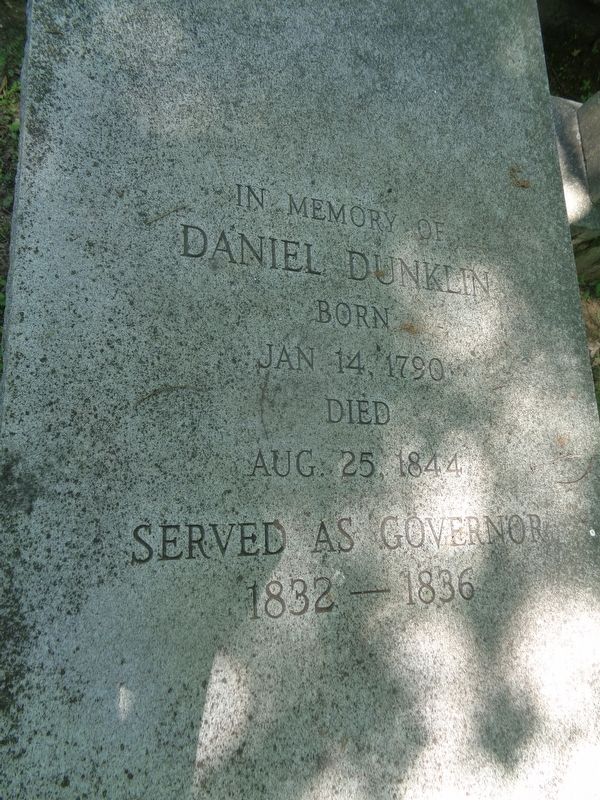
Photographed by Jason Voigt, June 13, 2024
5. Daniel Dunklin gravesite
Inscription on Dunklin's tomb
Credits. This page was last revised on December 23, 2025. It was originally submitted on June 13, 2024, by Jason Voigt of Glen Carbon, Illinois. This page has been viewed 264 times since then and 30 times this year. Photos: 1. submitted on June 13, 2024, by Jason Voigt of Glen Carbon, Illinois. 2. submitted on December 23, 2025, by Larry Gertner of New York, New York. 3, 4, 5. submitted on June 13, 2024, by Jason Voigt of Glen Carbon, Illinois.
