Carcross in Unorganized Yukon, Yukon — The Northern Territories (North America)
SS Tutshi Mechanical Equipment
| — | SS Tutshi Memorial | — |
Photographed by Sandra Hughes Tidwell, June 5, 2024
1. SS Tutshi Mechanical Equipment Marker
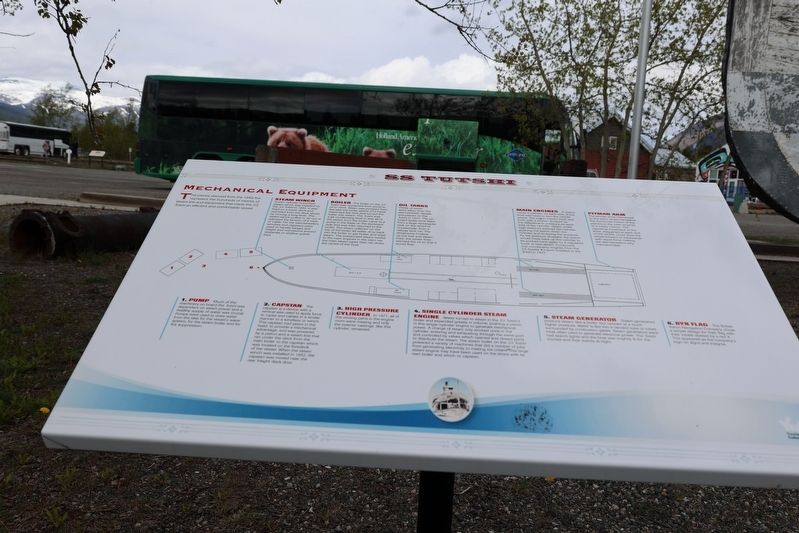
Steam Winch:
A twin-cylinder horizontal steam winch was installed on the SS Tutshi in 1952. It was fixed on a lower deck and operated from the deck above by moving a long lever. The steam winch pulled in, let out, or adjusted the tension of a rope or cable. on the sternwheelers, winches, and capstans were used to handle barges and freight and maneuver around obstacles or shallow gravel bars.
Boiler
The boiler on the SS Tutshi was converted from wood to oil in 1925. Water was pumped from the take to the boiler where 210 tubes dispersed the wheat that turned the water into steam. The Tutshi was a jet-condensing boat in that all of the steam from the boiler came to a pump in the bilge on the starboard side and was then returned to the boiler. The steam collector on the top of the boiler lets water drop back into the boiler to get hotter and dryer steam. The pressurized steam moved to the main engines in the stern via the main steam pipes and then ran down
this page online
Oil Tanks
These oil tanks were taken from the sternwheeler Aksala and placed on the Tutshi in 1925. The onboard tanks were filled from a large rectangular tank on the wharf or, occasionally, from a railway tank car. The deckhand hooked up the fuel and stem lines: the stem lines warmed the oil so that it would flow.
Main Engines
A piston inside a cylinder on each side of the boat was used to turn the paddle wheel. The piston moved back and forth with motion dictated by the difference in pressure on each side of the cylinder. Steam under high pressure entered the cylinder pushing the piston down the cylinder and dropping the pressure. As the pressure dropped the piston would move back up the cylinder to be pushed back again by a regulated burst of new stem. Compound non -condensing engines from the SS Seattle #3 were installed in the Tutshi in 1927.
Pitman Arm
The pitman arms connected to the stern wheel translated the horizontal motion of the pistons in the main engines to a rotary motion. The opposing movement of the arms. staggered at each end of the wheel could drive the wheel forward or backward

Photographed by Sandra Hughes Tidwell, June 5, 2024
2. SS Tutshi Mechanical Equipment Marker
1. Pump
Much of the machinery on board the Tutshi was dependent on steam power and a healthy supply of water was crucial. Pumps were used to draw water from the lake for the vessel's water system, for the steam boiler, and fire suppression.
2. Capstan
The capstan is a device with a vertical side used to apply force to ropes and cables in a similar manner to a windlass or winch. This capstan had gears in the head to provide a mechanical advantage and was powered by a piston and a stem line that ran under the deck from the main boiler to the capstan which was located on the foredeck of the vessel. When the steam winch was installed in 1952, the capstan was moved to the rear freight deck door.
3. High Pressure Cylinder
In 1971, all of the moving parts in the engine room were missing and only the exterior castings like this cylinder, remained.
4. Single Cylinder Steam Engine
Water turned to steam in the SS Tutshi's boiler and expanded greatly in volume, pushing a piston in the single-cylinder engine to generate mechanical power. A charge of steam only worked

Photographed by Sandra Hughes Tidwell, June 5, 2024
3. SS Tutshi Mechanical Equipment Marker
5. Steam Generator
Steam generators produced steam like a boiler, but operated at a much higher pressure. Water is led into a bender tube or tubes surrounded by combustion gases. Steam generators are most often used to generate electrical power. The Tutshi had searchlights and the boat was brightly lit for the tourist and their events at night.
6. BYN Flag
The British Yukon Navigation Company chose a simple design for their flag with their initials divided by a red X. This appeared as the company's logo on signs and insignia.
Topics. This historical marker is listed in this topic list: Waterways & Vessels. A significant historical year for this entry is 1990.
Location. 60° 9.903′ N, 134° 42.233′ W. Marker is in Carcross, Yukon, in Unorganized Yukon. It is on Yukon Road. Touch for map. Marker is at or near this postal address: 3141-3145 YT-2, Carcross YT Y0B 1B0, Canada. Touch for directions.

Regionally, this marker is in the Canadian North. Globally, it is in North America, on the Ring of Fire, in the Arctic, in the Western Hemisphere, and in the Western World. Historically, it finds itself in what was once a British colony.
Other nearby markers. At least 8 other markers are within walking distance of this marker: "Tutshi" Mechanics (here, next to this marker); Adapting to Changing Times (here, next to this marker); "The Crew of the "SS Tutshi" (here, next to this marker); Freighting on the Southern Lakes (a few steps from this marker); WP & YR and Carcross (a few steps from this marker); Boats of the Southern Lakes (a few steps from this marker); A Matter of Safety (a few steps from this marker); Restoration of the "SS Tutshi" (a few steps from this marker). Touch for a list and map of all markers in Carcross.
Credits. This page was last revised on July 6, 2024. It was originally submitted on June 14, 2024, by Sandra Hughes Tidwell of Killen, Alabama, USA. This page has been viewed 142 times since then and 23 times this year. Photos: 1, 2, 3. submitted on June 14, 2024, by Sandra Hughes Tidwell of Killen, Alabama, USA. • Bill Pfingsten was the editor who published this page.
