Near Petersburg in Howard County, Missouri — The American Midwest (Upper Plains)
Settlement History of the Spring

Photographed by Jason Voigt, May 15, 2024
1. Settlement History of the Spring Marker
1797 - James Mackay granted land including the salt spring by Spanish authorities in St. Louis.
1799 - Daniel Boone and his family arrive in Missouri and receive land grants in St. Charles County from the Spanish authorities.
1803 - The area known as Louisiana was purchased by the government of the United States from France
1804-1806 - Lewis and Clark Expedition journals refer to many salines or salt springs in the areas that were later organized as Howard, Cooper and Saline counties.
1804-1805 - Jesse and James Morrison leased the salt spring from James Mackay and began producing salt in partnership with Daniel Morgan and Nathan Boone.
1805 - Salt operations were raided; working oxen and livestock were killed by "a party of bad men."
1810-1812 - Daniel Morgan Boone and Nathan Boone sell their financial interests to James and Jesse Morrison.
1812-1815 - Indian raids during the War of 1812 forced the salt works to be shut down.
1816 - Howard County is organized and includes all the land north of the Osage River to the area that would become the Iowa Territory.
1815-1827 - James and Jesse Morrison
this page online
1820=1830 - The General Assembly of the state of Missouri passed a number of acts that set aside as many as 12 salt springs in different areas of the state for use of the state to that profits for leasing them produced revenue for the state.
1831 - James Morrison advertised "Boons Salt Works for sale"
1831-1850 - Salt works ownership was taken by John Ainslie and leased to Lindsay P. Marshall, but it is not known if either of them actually operated the salt works.
1833 - James Morrison's son fell into boiling kettle, scalded horribly and died several days later. U.S. government confirms Mackay's survey to heir
1869 - The Boone's Lick Salt Manufacturing Co. was organized; bores a 1,001-foot deep well and finds no commercially valuable brine.
1872 - Unable to produce salt profitably, the company cut and sold timber for use as railroad ties.
1900 - The "Oyster Plan" -production of "salt-water fish and mollusks," was abandoned for lack of fresh water.
1913 - The Missouri Society Daughters of the American Revolution placed pioneer trail red granite
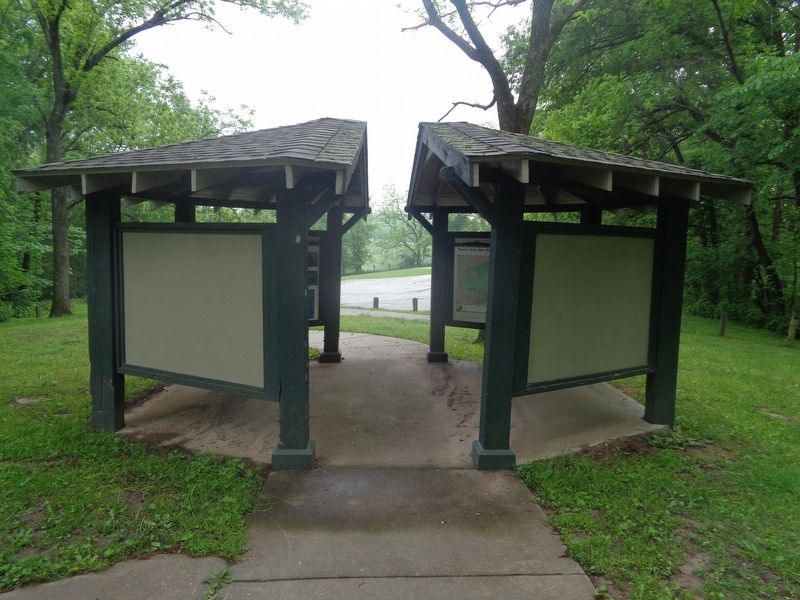
Photographed by Jason Voigt, May 15, 2024
2. Settlement History of the Spring Marker
Marker is with other markers at Boone's Lick State Historic Site.
1960 - Mr. and Mrs. J.R. Clinkscales and Horace Mulsday donate 17 acres of land to the State Park Board, including the historic salt lick.
1961 - Archaeological survey identifies the existence of a furnace, an 1869 well, a wooden box and partially buried timbers.
1969 - This site is placed on the National Register of Historic Places.
1986 - Archaeological investigation uncovers remains of six furnaces, well casings, two log cabins and a brine elevating system.
1990 - Archaeological investigation finds remains of four more furnaces to (unreadable) of these artifacts are on exhibit at Arrow Rock State Historic Site visitor center.
Erected by Missouri State Parks.
Topics. This historical marker is listed in these topic lists: Agriculture • Industry & Commerce • Settlements & Settlers. A significant historical year for this entry is 1797.
Location. 39° 4.916′ N, 92° 52.746′ W. Marker is near Petersburg, Missouri, in Howard County. It can be reached from Missouri Route 187. Marker is at Boone's Lick State Historic Site. It is located off a road from Missouri 187 (where it ends). Touch for map. Marker is at or near this postal address: 1091 MO-187, Franklin MO 65250, United States of America. Touch for directions.

Regionally, this marker is in Little Dixie and in the Missouri River Corridor. It is also in the American Midwest, in the Lewis & Clark Corridor, in the Corn Belt, and on the Santa Fe Trail Corridor. Globally, it is in North America, the Western Hemisphere, the Western World, and the Anglosphere. Historically, it finds itself in what was once the territory of the Mississippian Culture, the Louisiana Purchase, and the Antebellum South.
Other nearby markers. At least 8 other markers are within 4 miles of this marker, measured as the crow flies: Boone's Lick Today (here, next to this marker); Salt Springs In This Area (here, next to this marker); History in Boone's Lick Country (here, next to this marker); The Boone's Lick Country (here, next to this marker); Operation of the Spring (here, next to this marker); People of the Spring (a few steps from this marker); Boone's Lick (a few steps from this marker); The Lewis and Clark Expedition Across Missouri (approx. 3½ miles away). Touch for a list and map of all markers in Petersburg.
Also see . . . Boone's Lick State Historic Site. Missouri State Parks website entry (Submitted on June 15, 2024, by Jason Voigt of Glen Carbon, Illinois.)
Credits. This page was last revised on December 25, 2025. It was originally submitted on June 15, 2024, by Jason Voigt of Glen Carbon, Illinois. This page has been viewed 159 times since then and 17 times this year. Photos: 1, 2. submitted on June 15, 2024, by Jason Voigt of Glen Carbon, Illinois.
