
La Cambe in Calvados, Normandy, France — Western Europe
German War Cemetery
La Cambe
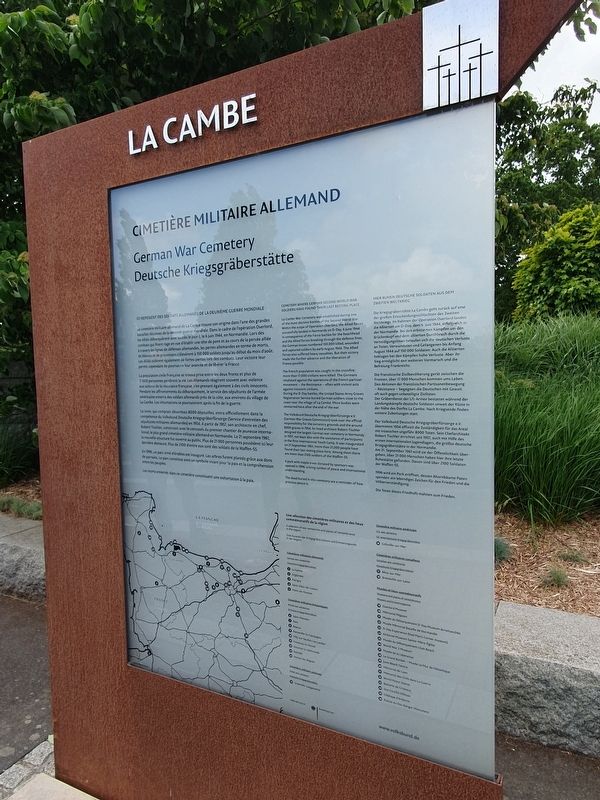
Photographed by J. Makali Bruton, June 5, 2024
1. German War Cemetery Marker

Cimetière Militaire Allemand
Ici reposent des soldats allemands de la deuxième guerre mondiale
Le cimetière militaire allemand de La Cambe trouve son origine dans l'une des grandes batailles décisives de la seconde guerre mondiale. Dans le cadre de l'opération Overlord, les Alliés débarquèrent avec succès le jour-), le 6 juin 1944, en Normandie. Lors des combats qui firent rage en vue d'établir une tête de pont et au cours de la percée alliée à travers les lignes de défenses allemandes, les pertes allemandes en terme de morts, de blessés et de prisonniers s'élevèrent à 150 000 soldats jusqu'au début du mois d'août. Les Alliés subirent également de fortes pertes lors des combats. Leur victoire leur permit cependant de poursuivre leur avancée et de libérer la France.
La population civile française se trouva prise entre les deux fronts et plus de 17 000 personnes perdirent la vie. Les Allemands réagirent souvent avec violence aux actions de la résistance française, s'en prenant également à des civils innocents. Pendant les affrontements du débarquement, le service des sépultures de l'armée américaine
this page online
La zone, qui comptait désormais 8000 dépouilles, entra officiellement dans la compétence du Volksbund Deutsche Kriegsgräberfürsorge (Service d'entretien des sépultures militaires allemandes) en 1954. A partir de 1957, son architecte en chef, Robert Tischler, construisit avec le concours du premier chantier de jeunesse international, le plus grand cimetière militaire allemand en Normandie. Le 21 septembre 1961, la nouvelle structure fut ouverte au public. Plus de 21 000 personnes possèdent ici leur dernière demeure. Plus de 2100 d'entre eux sont des soldats de la Waffen-SS.
En 1996, un parc orné d'érables est inauguré. Les arbres furent plantés grâce aux dons de parrains. Le parc constitue ainsi un symbole vivant pour la paix et la compréhension entre les peuples.
Les morts enterrés dans ce cimetière constituent une exhortation à la paix.
Cemetery where German Second World War soldiers have found their last resting place
La Cambe War Cemetery was established
Photographed by J. Makali Bruton, June 5, 2024
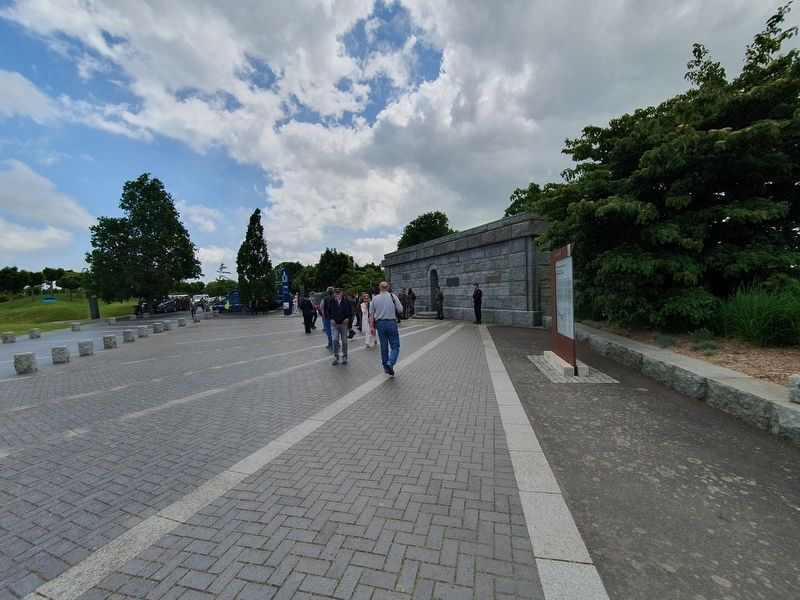
2. German War Cemetery Marker
The marker is towards the right of the La Cambe German War Cemetery entrance.
The French population was caught in the crossfire; more than 17,000 civilians were killed. The Germans retaliated against the operations of the French partisan movement - the Resistance - often with violent acts against innocent civilians.
During the D-Day battles, the United States Army Graves Registration Service buried German soldiers close to the coast near the village of La Cambe. More bodies were reinterred here after the end of the war.
The Volksbund Deutsche Kriegsgräberfürsorge e.V. (German War Graves Commission) took over the official responsibility for the cemetery grounds and the around 8000
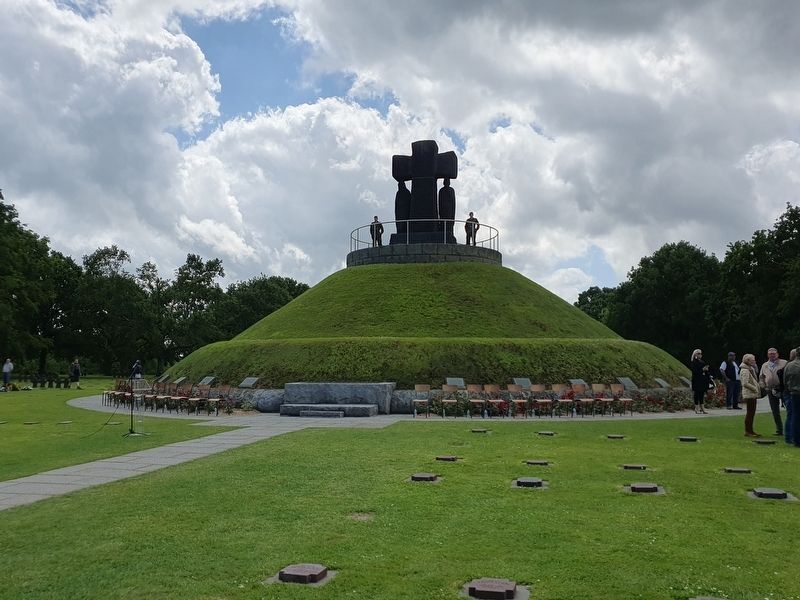
Photographed by J. Makali Bruton, June 5, 2024
3. La Cambe German War Cemetery
A park with maple trees donated by sponsors was opened in 1996: a living symbol of peace and international understanding.
The dead buried in this cemetery are a reminder of how precious peace is.
Hier ruhen Deutsche soldaten aus dem Zweiten Weltkrieg
Die Kriegsgräberstätte La Cambe geht zurück auf eine der großen Entscheidungsschlachten des Zweiten Weltkriegs. Im Rahmen der Operation Overlord landen die Alliierten am D-Day, dem 6. Juni 1944, erfolgreich in der Normandie. Bei den erbitterten Kämpfen um den Brückenkopf und dem alliierten Durchbruch durch die Verteidigungslinien belaufen sich die deutschen Verluste an Toten, Verwundeten und Gefangenen bis Anfang August 1944 auf 150 000 Soldaten. Auch die Alliierten beklagen
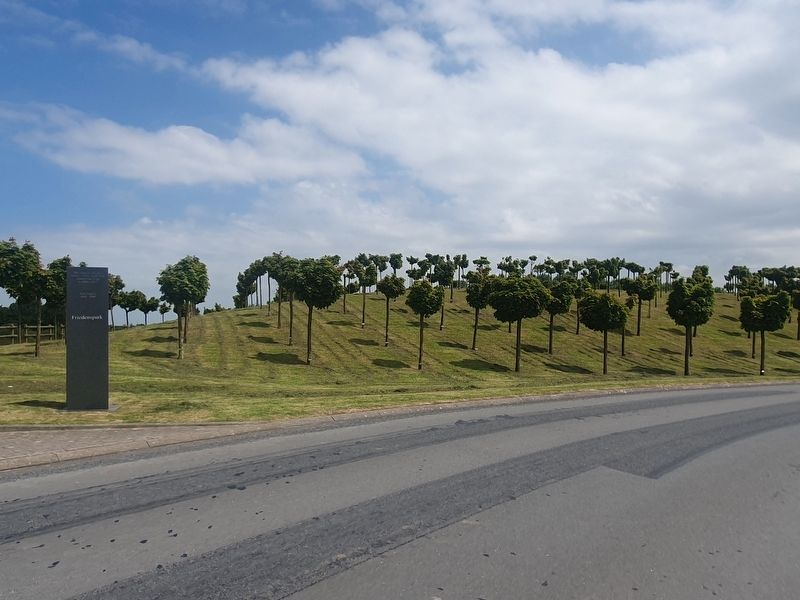
Photographed by J. Makali Bruton, June 5, 2024
4. A view of the nearby Peace Park made of donated maples, as mentioned in the marker text
Die französische Zivilbevölkerung gerät zwischen die Fronten, über 17 000 Menschen kommen ums Leben. Den Aktionen der französischen Partisanenbewegung Résistance - begegnen die Deutschen mit Gewalt oft auch gegen unbeteiligte Zivilisten. Der Gräberdienst der US-Armee bestattet während der Landungskämpfe deutsche Soldaten unweit der Küste in der Nähe des Dorfes La Cambe. Nach Kriegsende finden weitere Zubettungen statt.
Der Volksbund Deutsche Kriegsgräberfürsorge e.V. übernimmt 1954 offiziell die Zuständigkeit für das Areal mit inzwischen ungefähr 8000 Toten. Sein Chefarchitekt Robert Tischler errichtet seit 1957, auch mit Hilfe des ersten internationalen Jugendlagers, die größte deutsche Kriegsgräberstätte in der Normandie. Am 21. September 1961 wird sie der Öffentlichkeit über- geben, über 21 000 Menschen haben hier ihre letzte Ruhestätte gefunden. Davon sind über 2100 Soldaten der Waffen-SS.
1996 wird ein Park eröffnet, dessen Ahornbäume Paten spenden: ein lebendiges Zeichen für den Frieden und die Völkerverständigung.
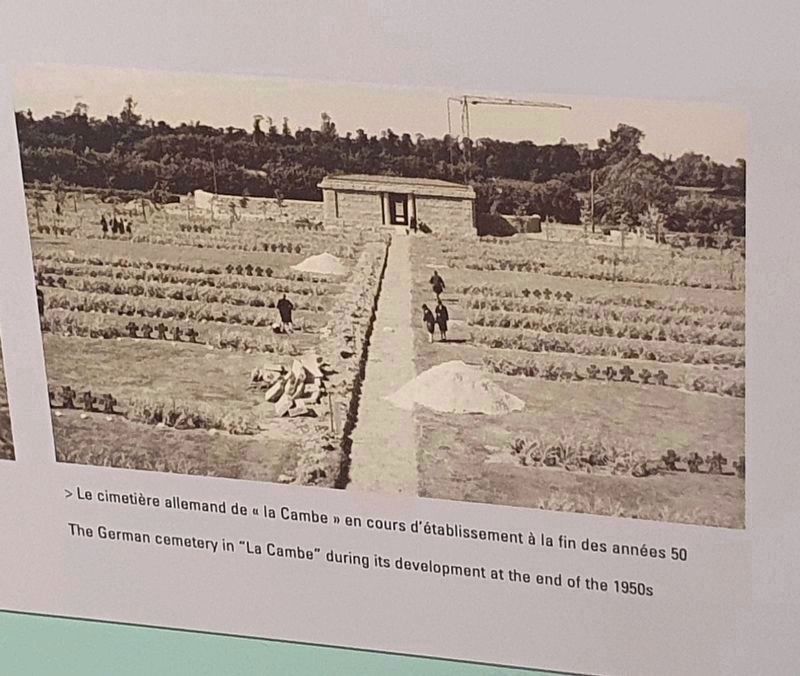
Photographed by J. Makali Bruton, June 5, 2024
5. The German cemetery in "La Cambe" during its development at the end of the 1950s
This photograph was taken at the Battle of Normandy Memorial Museum in Bayeux.
Die Toten dieses Friedhofs mahnen zum Frieden.
Topics. This memorial is listed in these topic lists: Cemeteries & Burial Sites • War, World II. A significant historical date for this entry is June 6, 1944.
Location. 49° 20.58′ N, 1° 1.608′ W. Memorial is in La Cambe, Normandie (Normandy), in Calvados. It is on Route de Turgis west of Route D113, on the right when traveling west. Touch for map. Memorial is at or near this postal address: 1505 Turgis, La Cambe, Normandie 14230, France. Touch for directions.

Regionally, it is in the North Atlantic Region, Europe, the European Union, Atlantic Europe, the Schengen Area, Western Europe, a coastal Mediterranean country, and the Western World. Historically, it finds itself in what was once a French colony and also the Roman Empire.
Other nearby markers. At least 8 other markers are within 6 kilometers of this marker, measured as the crow flies: German Military Cemetery (a few steps from this marker); The German Cemetery at La Cambe: In the same soil of France (a few steps from this marker); Liberation of La Cambe (approx. 1.5 kilometers away); Morts pour la France de La Cambe (approx. 1.5 kilometers away); Les marais volés / The stolen marshes (approx. 1.7 kilometers away); Le village / The village (approx. 4.2 kilometers away); Les belles demeures / The beautiful houses (approx. 4.2 kilometers away); The Pointe-du-Hoc: the Feat of the 2nd Ranger Battalion (approx. 6.2 kilometers away). Touch for a list and map of all markers in La Cambe.
Regarding German War Cemetery. The marker also includes a large map and list of World War II cemeteries and commemorative sites.
Credits. This page was last revised on June 29, 2024. It was originally submitted on June 22, 2024, by J. Makali Bruton of Washington, District of Columbia. This page has been viewed 207 times since then and 38 times this year. Photos: 1, 2, 3, 4. submitted on June 22, 2024, by J. Makali Bruton of Washington, District of Columbia. 5. submitted on June 23, 2024, by J. Makali Bruton of Washington, District of Columbia.
