
La Cambe in Calvados, Normandy, France — Western Europe
German Military Cemetery
La Cambe
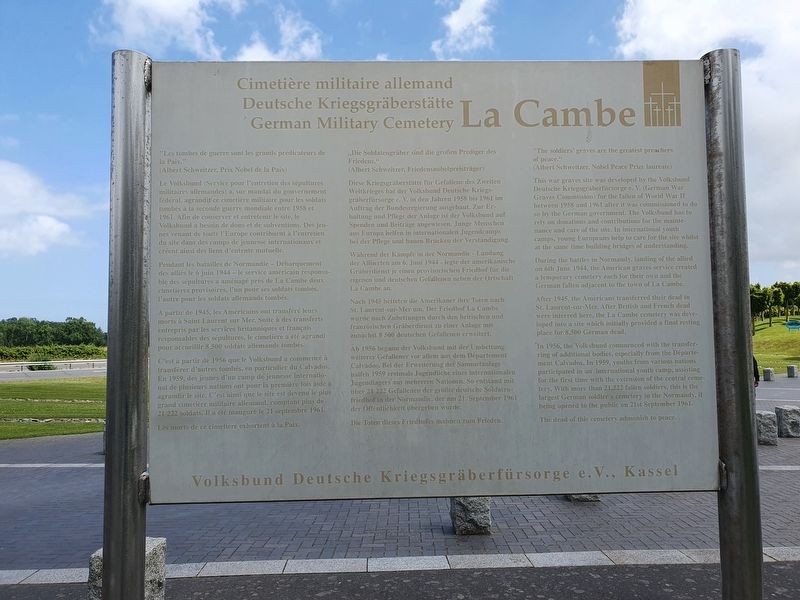
Photographed by J. Makali Bruton, June 5, 2024
1. German Military Cemetery Marker

Cimetière militaire allemand
"Les tombes de guerre sont les grands prédicateurs de la Paix."
(Albert Schweitzer, Prix Nobel de la Paix)
Le Volksbund (Service pour l'entretien des sépultures militaires allemandes) a, sur mandat du gouvernement fédéral, agrandit ce cimetière militaire pour les soldats tombés à la seconde guerre mondiale entre 1958 et 1961. Afin de conserver et entretenir le site, le Volksbund a besoin de dons et de subventions. Des jeunes venant de toute l'Europe contribuent à l'entretien du site dans des camps de jeunesse internationaux et créent ainsi des liens d'entente mutuelle.
Pendant les batailles de Normandie – Débarquement des alliés le 6 juin 1944 - le service américain responsable des sépultures a aménagé près de La Cambe deux cimetières provisoires, l'un pour ses soldats tombés, l'autre pour les soldats allemands tombés.
A partir de 1945, les Américains ont transféré leurs morts à Saint Laurent sur Mer. Suite à des transferts entrepris par les services britanniques et français responsables des sépultures, le cimetière a été agrandi pour accueillir 8 500 soldats allemands
this page online
C'est à partir de 1956 que le Volksbund a commencé à transférer d'autres tombés, en particulier du Calvados. En 1959, des jeunes d'un camp de jeunesse international de plusieurs nations ont pour la première fois aidé à agrandir le site. C'est ainsi que le site est devenu le plus grand cimetière militaire allemand, comptant plus de 21 222 soldats. Il a été inauguré le 21 septembre 1961.
Les morts de ce cimetière exhortent à la Paix.
,,Die Soldatengräber sind die großen Prediger des Friedens."
(Albert Schweitzer, Friedensnobelpreisträger)
Diese Kriegsgräberstätte für Gefallene des Zweiten Weltkrieges hat der Volksbund Deutsche Kriegsgräberfürsorge e. V. in den Jahren 1958 bis 1961 im Auftrag der Bundesregierung ausgebaut. Zur Erhaltung und Pflege der Anlage ist der Volksbund auf Spenden und Beiträge angewiesen. Junge Menschen aus Europa helfen in internationalen Jugendcamps bei der Pflege und bauen Brücken der Verständigung.
Während der Kämpfe in der Normandie - Landung der Alliierten am 6. Juni 1944 - legte der amerikanische Gräberdienst je einen provisorischen Friedhof für die eigenen
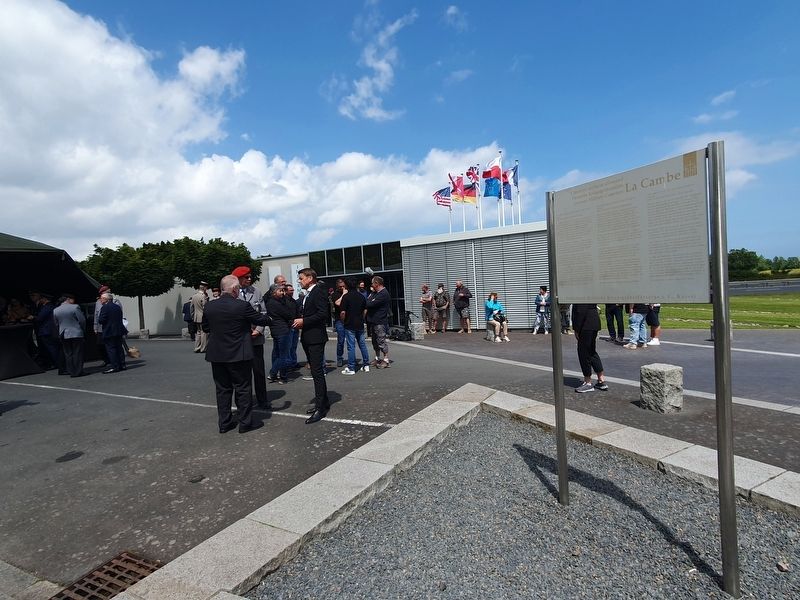
Photographed by J. Makali Bruton, June 5, 2024
2. German Military Cemetery Marker
The marker is blank on its reverse so can be easy to miss when walking from the visitors center, seen here to the left in the distance.
Nach 1945 betteten die Amerikaner ihre Toten nach St. Laurent-sur-Mer um. Der Friedhof La Cambe wurde nach Zubettungen durch den britischen und französischen Gräberdienst zu einer Anlage mit zunächst 8 500 deutschen Gefallenen erweitert.
Ab 1956 begann der Volksbund mit der Umbettung weiterer Gefallener vor allem aus dem Département Calvados. Bei der Erweiterung der Sammelanlage : halfen 1959 erstmals Jugendliche eines internationalen Jugendlagers aus mehreren Nationen. So entstand mit über 21 222 Gefallenen der größte deutsche Soldatenfriedhof in der Normandie, der am 21. September 1961 der Öffentlichkeit übergeben wurde.
Die Toten dieses Friedhofes mahnen zum Frieden.
"The soldiers' graves are the greatest preachers of peace."
(Albert Schweitzer, Nobel Peace Prize laureate)
This war graves site was developed by the Volksbund Deutsche Kriegsgräberfürsorge e. V. (German War Graves Commission) for the fallen of World War II between 1958 and 1961 after it was commissioned to do so by the German government. The Volksbund has to rely
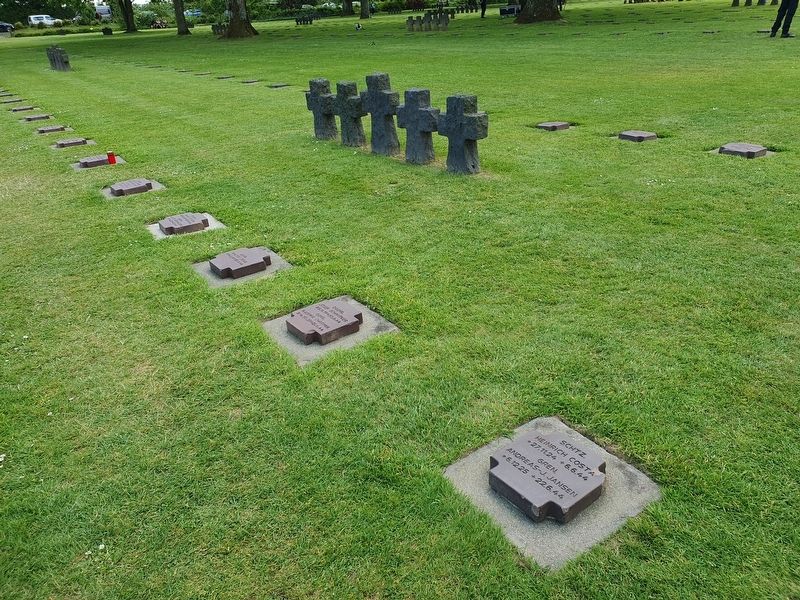
Photographed by J. Makali Bruton, June 5, 2024
3. German Military Graves at La Cambe Cemetery
During the battles in Normandy, landing of the allied on 6th June 1944, the American graves service created a temporary cemetery each for their own and the German fallen adjacent to the town of La Cambe.
After 1945, the Americans transferred their dead to St. Laurent-sur-Mer. After British and French dead were interred here, the La Cambe cemetery was developed into a site which initially provided a final resting place for 8,500 German dead.
'In 1956, the Volksbund commenced with the transferring of additional bodies, especially from the Département Calvados. In 1959, youths from various nations participated in an international youth camp, assisting for the first time with the extension of the central cemetery. With more than 21,222 fallen soldiers, this is the largest German soldier's cemetery in the Normandy, it being opened to the public on 21st September 1961.
The dead of this cemetery admonish to peace.
Topics. This memorial is listed in these topic lists: Cemeteries & Burial Sites • War, World II. A significant historical date for this entry is June 6, 1944.
Location. 49° 20.582′ N, 1° 1.62′ W. Memorial is in La Cambe, Normandie (Normandy), in Calvados. It is on Route de Turgis west of Route D113, on the left when traveling west. Touch for map. Memorial is at or near this postal address: 1505 Turgis, La Cambe, Normandie 14230, France. Touch for directions.

Regionally, it is in the North Atlantic Region, Europe, the European Union, Atlantic Europe, the Schengen Area, Western Europe, a coastal Mediterranean country, and the Western World. Historically, it finds itself in what was once a French colony and also the Roman Empire.
Other nearby markers. At least 8 other markers are within 6 kilometers of this marker, measured as the crow flies: German War Cemetery (a few steps from this marker); The German Cemetery at La Cambe: In the same soil of France (within shouting distance of this marker); Liberation of La Cambe (approx. 1.5 kilometers away); Morts pour la France de La Cambe (approx. 1.5 kilometers away); Les marais volés / The stolen marshes (approx. 1.7 kilometers away); Le village / The village (approx. 4.2 kilometers away); Les belles demeures / The beautiful houses (approx. 4.2 kilometers away); The Pointe-du-Hoc: the Feat of the 2nd Ranger Battalion (approx. 6.2 kilometers away). Touch for a list and map of all markers in La Cambe.
Credits. This page was last revised on June 22, 2024. It was originally submitted on June 22, 2024, by J. Makali Bruton of Washington, District of Columbia. This page has been viewed 186 times since then and 41 times this year. Photos: 1, 2, 3. submitted on June 22, 2024, by J. Makali Bruton of Washington, District of Columbia.
