
Formigny in Formigny La Bataille in Calvados, Normandy, France — Western Europe
Formigny: Le Monument d'Arthur Le Duc
| — | Mon village se raconte - My village tells its story | — |

Photographed by J. Makali Bruton, June 5, 2024
1. Formigny: Le Monument d'Arthur Le Duc Marker

Formigny: Le Monument d'Arthur Le Duc
Ce monument, inscrit à l'Inventaire des Monuments Historiques, du sculpteur normand Arthur Le Duc, a été inauguré en 1903. Il commémore la Bataille du 15 avril 1450, appelée communément la Bataille de Formigny. Ce groupe sculpté est constitué d'un socle en granit rose, agrémenté d'un bas-relief et surmonté de trois statues en bronze : à gauche Jean de Bourbon, Comte de Clermont, à droite, Arthur de Bretagne, Comte de Bretagne et au-dessus d'eux la France pointant son épée vers l'Angleterre. C'est le symbole de la victoire de la France sur l'Angleterre. Cette bataille ne mit pas fin à la guerre de Cent Ans mais en accéléra le cours. Grâce à cette victoire, la reconquête de la Normandie se trouva définitivement terminée à l'été 1450.
On doit à Arthur Le Duc des œuvres telles que La Laitière statue à Saint-Lô fondue en 1942 par les Allemands, Le Connétable du Guesclin, statue équestre sur la place Saint-Martin à Caen.
Le Monument commémoratif
Le 500 anniversaire de la Bataille de Formigny en 1950
Le monument d'Arthur Leduc au début du XX siècle
La partie supérieure de la statue: une femme représentant la France
Question panneau 2:
Qu'appelle-t-on un bas-relief?
Réponse panneau 1:
La Guerre de Cent Ans (1337-1451) opposa la France et l'Angleterre. Le Roi Edouard III d'Angleterre revendiquait le trône de France détenu par Philippe VI dont il contestait la légitimité.
Avec la participation des habitants de Formigny
Realisation de l’ADTL - Fabrication: Self Signal
Formigny: Arthur Le Duc’s Monument
This monument by the Norman sculptor Arthur Le Duc, which is listed in the Inventory of Historic Monuments, was inaugurated in 1903. It commemorates the Battle of 15 April 1450, commonly known as the Battle of Formigny. This group sculpture consists of a pink granite plinth, embellished with a bas relief and topped by three bronze statues: on the left Jean de Bourbon, Count of Clermont, on the right, Arthur de Bretagne, Count of Brittany, and above them, France pointing its sword at England. It symbolises France's victory over England. This battle did not end the Hundred Years' War, but brought it to a more rapid conclusion. Thanks to this victory, the reconquest of Normandy was finally achieved in the summer of 1450.
Arthur Le Duc also sculpted La Laitière (The Dairywoman), a statue in Saint-Lô, melted down in 1942 by the Germans, and Le Connétable du Guesclin (The Constable du Guesclin), an equestrian statue on the Place Saint Martin in Caen.
The commemorative monument
The 500th anniversary of the Battle of Formigny in 1950
Arthur Le Duc's monument at the beginning of the twentieth century
The upper part of the statue: a woman representing France
Panel question 2:
What is a bas-relief?
Answer panel 1:
The Hundred Years' War (1337-1451) was fought between France and England. King Edward III of England claimed the throne of France held by Philip VI whose legitimacy he contested.
this page online
Topics. This historical marker is listed in these topic lists: Arts, Letters, Music • Wars, Non-US. A significant historical date for this entry is April 15, 1450.
Location. 49° 19.98′ N, 0° 54.018′ W. Marker is in Formigny La Bataille, Normandie (Normandy), in Calvados. It is in Formigny. It is at the intersection of Route D613 and Route D517, on the right when traveling west on Route D613. Touch for map. Marker is at or near this postal address: 1 Pl Michel Lamy, Formigny La Bataille, Normandie 14710, France. Touch for directions.

Regionally, it is in the North Atlantic Region, Europe, the European Union, Atlantic Europe, the Schengen Area, Western Europe, a coastal Mediterranean country, and the Western World. Historically, it finds itself in what was once a French colony and also the Roman Empire.
Other nearby markers. At least 8 other markers are within 5 kilometers of this marker, measured as the crow flies: Battle of Formigny Memorial (a few steps from this marker); Morts pour la Patrie / Fallen for the Fatherland (approx. 4.1 kilometers away); Bernard Anquetil (approx. 4.2 kilometers away); À la mémoire de Bernard Anquetil / In memory of Bernard Anquetil

Photographed by J. Makali Bruton, June 5, 2024
2. Formigny: Le Monument d'Arthur Le Duc Marker
Also see . . . Battle of Formigny at Wikipedia. (Submitted on June 22, 2024.)
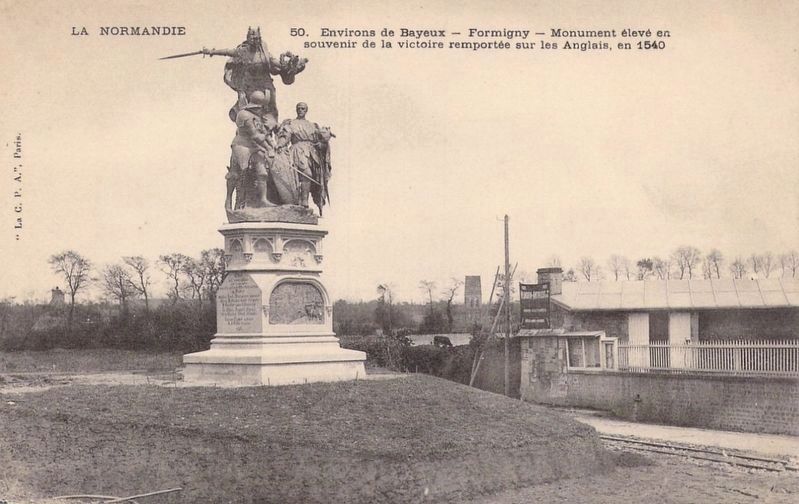
Photographed by “La G.P.A.”, Paris, circa 1904
3. Formigny - Le Monument d'Arthur Le Duc
Credits. This page was last revised on June 23, 2024. It was originally submitted on June 22, 2024, by J. Makali Bruton of Washington, District of Columbia. This page has been viewed 105 times since then and 7 times this year. Photos: 1, 2. submitted on June 22, 2024, by J. Makali Bruton of Washington, District of Columbia. 3. submitted on June 23, 2024.
