Ibapah in Tooele County, Utah — The American Mountains (Southwest)
Eyewitness Accounts
Photographed by Jeremy Snow, June 23, 2024
1. Eyewitness Accounts Marker
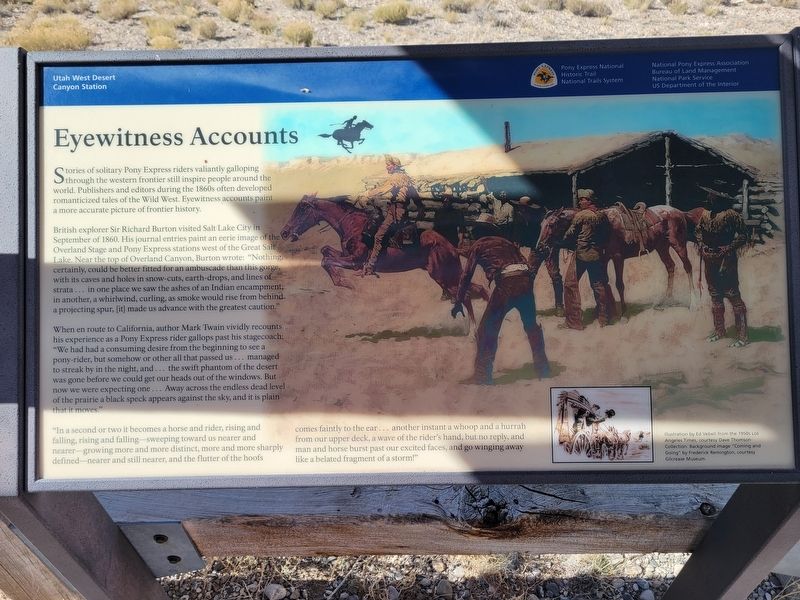
Stories of solitary Pony Express riders valiantly galloping through the western frontier still inspire people around the world. Publishers and editors during the 1860s often developed romanticized tales of the Wild West. Eyewitness accounts paint a more accurate picture of frontier history.
British explorer Sir Richard Burton visited Salt Lake City in September of 1860. His journal entries paint an eerie image of the Overland Stage and Pony Express stations west of the Great Sal Lake. Near the top of Overland Canyon, Burton wrote: "Nothing certainly, could be better fitted for an ambuscade than this gorge, with its caves and holes in snow-cuts, earth-drops, and lines of strata... in one place we saw the ashes of an Indian encampment, in another, a whirlwind, curling, as smoke would rise from behind. a projecting spur, [it] made us advance with the greatest caution."
When en route to California, author Mark Twain vividly recounts his experience as a Pony Express rider gallops past his stagecoach "We had had a consuming desire from the beginning to see a pony-rider, but somehow or other all that passed us... managed
this page online
"In a second or two it becomes a horse and rider, rising and falling, rising and falling-sweeping toward us nearer and nearer-growing more and more distinct, more and more sharply defined nearer and still nearer, and the flutter of the hoofs comes faintly to the ear... another instant a whoop and a hurrah from our upper deck, a wave of the rider's hand, but no reply, and man and horse burst past our excited faces, and go winging away like a belated fragment of a storm!"
[Caption:]
Illustration by Ed Vebell from the 1950s Los Angeles Times, courtesy Dave Thomson Collection. Background image "Coming and Going" by Frederick Remington, courtesy Gilcrease Museum.
Erected by National Pony Express Association.
Topics. This historical marker is listed in this topic list: Roads & Vehicles. A significant historical year for this entry is 1860.
Location. 40° 2.682′ N, 113° 48.249′ W.
Photographed by Jeremy Snow, June 23, 2024
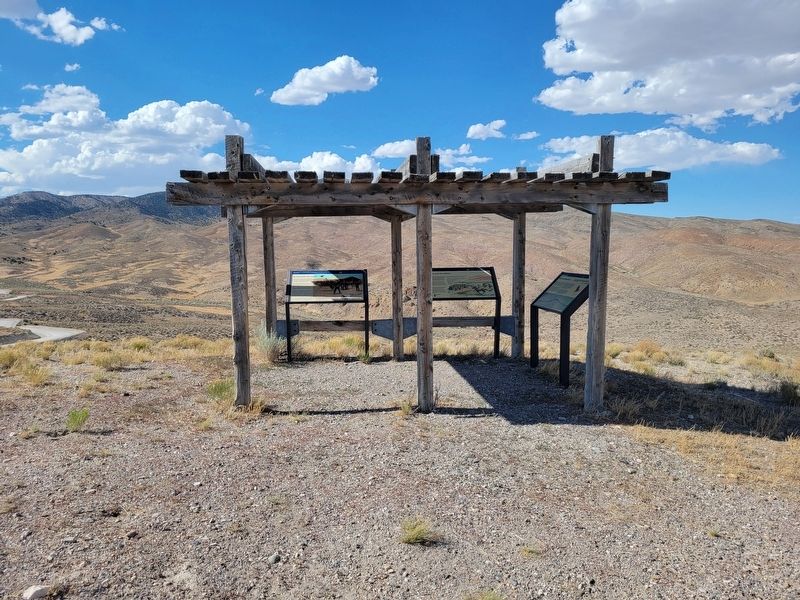
2. Eyewitness Accounts Marker

Regionally, this marker is in the Wasatch Front, in the West Desert, and in Greater Salt Lake. It is also in the American Mountain West and on the Colorado Plateau. Globally, it is in North America, the Rocky Mountains, the Western Hemisphere, the Western World, and the Anglosphere. Historically, it finds itself in what was once New Spain and also Mexico’s Alta California.
Other nearby markers. At least 8 other markers are within 10 miles of this marker, measured as the crow flies: The Crowds Cheered On... (a few steps from this marker); Atrocities and Hostilities (a few steps from this marker); Burnt Station (approx. 3.1 miles away); Central Overland Trail - Deep Creek Summit (approx. 5½ miles away); Deep Creek Station (approx. 9½ miles away); Early Settlers of Ibapah (approx. 9½ miles away); The Lincoln Highway (approx. 9½ miles away); Goshute Tribe (approx. 9½ miles away). Touch for a list and map
Photographed by Jeremy Snow, June 23, 2024
3. Canyon Station
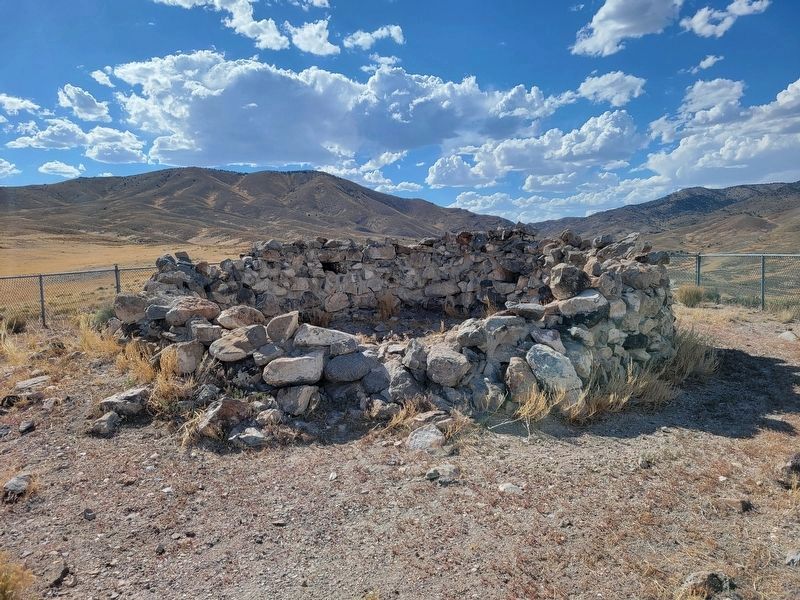
Remnants of the Pony Express Canyon Station can be seen next to the marker.
Credits. This page was last revised on December 30, 2024. It was originally submitted on June 24, 2024, by Jeremy Snow of Cedar City, Utah. This page has been viewed 367 times since then and 18 times this year. Photos: 1, 2, 3. submitted on June 24, 2024, by Jeremy Snow of Cedar City, Utah. • J. Makali Bruton was the editor who published this page.
