Greenhaven in Juab County, Utah — The American Mountains (Southwest)
With Speed Came Limits
Photographed by Jeremy Snow, June 23, 2024
1. With Speed Came Limits Marker
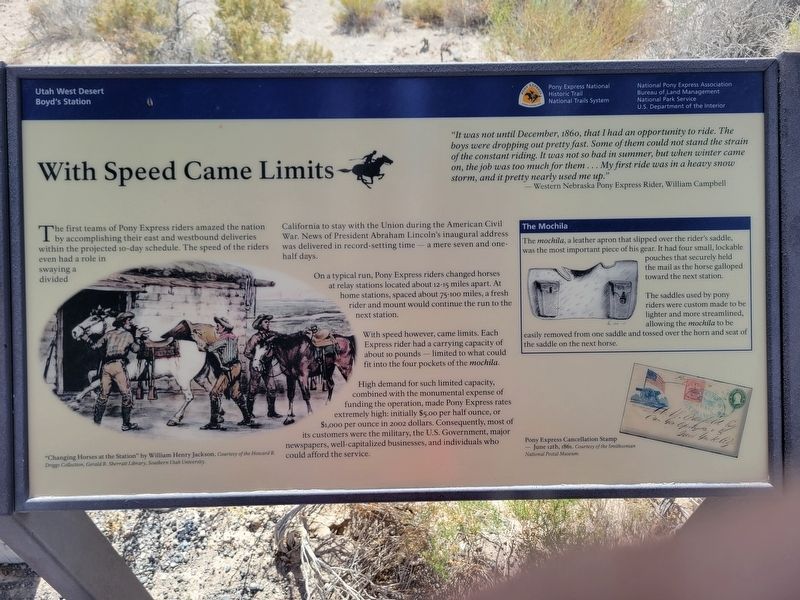
The first teams of Pony Express riders amazed the nation by accomplishing their east and westbound deliveries within the projected 10-day schedule. The speed of the riders even had a role in swaying a divided California to stay with the Union during the American Civil War. News of President Abraham Lincoln's inaugural address was delivered in record-setting time a mere seven and one-half days.
On a typical run, Pony Express riders changed horses at relay stations located about 12-15 miles apart. At home stations, spaced about 75-100 miles, a fresh rider and mount would continue the run to the next station.
With speed however, came limits. Each Express rider had a carrying capacity of about 10 pounds - limited to what could fit into the four pockets of the mochila.
High demand for such limited capacity, combined with the monumental expense of funding the operation, made Pony Express rates extremely high: initially $5.00 per half ounce, or $1,000 per ounce in 2002 dollars. Consequently, most of its customers were the military, the U.S. Government, major newspapers, well-capitalized businesses, and individuals who
this page online
The Mochila
The mochila, a leather apron that slipped over the rider's saddle, was the most important piece of his gear. It had four small, lockable pouches that securely held the mail as the horse galloped toward the next station.
The saddles used by pony riders were custom made to be lighter and more streamlined, allowing the mochila to be easily removed from one saddle and tossed over the horn and seat of the saddle on the next horse.
"It was not until December, 1860, that I had an opportunity to ride. The boys were dropping out pretty fast. Some of them could not stand the strain of the constant riding. It was not so bad in summer, but when winter came on, the job was too much for them... My first ride was in a heavy snow storm, and it pretty nearly used me up." - Western Nebraska Pony Express Rider, William Campbell
Captions
"Changing Horses at the Station" by William Henry Jackson Courtesy of the Howard R. Driggs Collection, Gerald R. Sherrat Library, Southern Utah University
Pony Express Cancellation Stamp - June 12th, 1861. Courtesy of the Smithsonian National Postal Museum.
Erected by National

Photographed by Jeremy Snow, June 23, 2024
2. With Speed Came Limits Marker
Topics. This historical marker is listed in these topic lists: Industry & Commerce • Roads & Vehicles. A significant historical year for this entry is 1860.
Location. 39° 50.628′ N, 113° 33.199′ W. Marker is in Greenhaven, Utah, in Juab County. It is on East Pony Express Road, on the right when traveling west. Touch for map. Marker is in this post office area: Wendover UT 84083, United States of America. Touch for directions.

Regionally, this marker is in the Central Utah Valleys and in the West Desert. It is also in the American Mountain West and on the Colorado Plateau. Globally, it is in North America, the Rocky Mountains, the Western Hemisphere, the Western World, and the Anglosphere. Historically, it finds itself in what was once New Spain and also Mexico’s Alta California.
Other nearby markers. At least 8 other markers are within 10 miles of this marker, measured as the crow flies: The Crowds Cheered On... (here, next to this marker); Unsung Heros (here, next to this marker); Central Overland Trail - Boyd Station (a few steps from this marker); Central Overland Trail - Fish Springs Mountain (approx. 6.8 miles away); Fish Springs Station (approx. 7.6 miles away); Central Overland Trail - Fish Springs (approx. 8.4 miles away); Central Overland Trail - Willow Springs (Callao) (approx. 9.4 miles away); Willow Springs Pony Express Station (approx. 9.4 miles away). Touch for a list and map of all markers in Greenhaven.
Credits. This page was last revised on July 7, 2024. It was originally submitted on June 28, 2024, by Jeremy Snow of Cedar City, Utah. This page has been viewed 129 times since then and 15 times this year. Photos: 1, 2. submitted on June 28, 2024, by Jeremy Snow of Cedar City, Utah. • J. Makali Bruton was the editor who published this page.
