Otterville in Oxford County, Ontario — Central Canada (North America)
Otterville African Methodist Episcopal Church and Cemetery
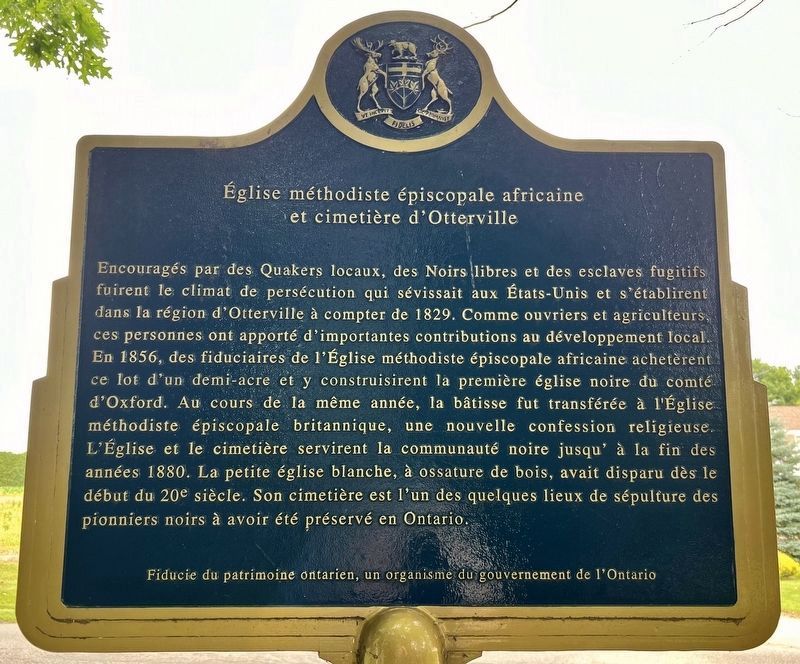
Église méthodiste épiscopale africaine et cimetière d’Otterville

Photographed by Tim Boyd, June 28, 2024
1. Otterville African Methodist Episcopal Church and Cemetery Marker

Encouraged by local Quakers, free Blacks and escaped slaves fled persecution in the United States and found homes in the Otterville area beginning in 1829. As skilled tradespeople and farmers, these people made significant contributions to local development. In 1856, trustees of the African Methodist Episcopal Church purchased this half-acre lot and built the first Black church in Oxford County. Later that year, the church was transferred to the newly established British Methodist Episcopal denomination. The church and cemetery served the local Black community until the late 1880s. The small white-painted frame church had disappeared by the early 20 century. Its cemetery is one of the few preserved Black pioneer burial grounds in Ontario.
Ontario Heritage Trust, an agency of the Government of Ontario
Encouragés par des Quakers locaux, des Noirs libres et des esclaves fugitifs fuirent le climat de persécution qui sévissait aux États-Unis et s'établirent dans la région d'Otterville
this page online
Fiducie du patrimoine ontarien, un organisme du gouvernement de l'Ontario
Erected by Ontario Heritage Trust.
Topics and series. This historical marker is listed in these topic lists: African Americans • Cemeteries & Burial Sites • Religion & Religious Structures • Settlements & Settlers. In addition, it is included in the Canada, Ontario Heritage Trust series list. A significant historical year for this entry is 1829.
Location. 42° 55.89′ N,
Photographed by Tim Boyd, June 28, 2024
2. Église méthodiste épiscopale africaine et cimetière d’Otterville marker

Regionally, this marker is in the Southwest Ontario Area and in Southwestern Ontario. It is also in Central Canada. Globally, it is in North America, the Western Hemisphere, the Western World, and the Anglosphere. Historically, it finds itself in what was once a British colony, the Viceroyalty of New France, the Haudenosaunee (Iroquois) Confederacy, and Rupert’s Land.
Other nearby markers. At least 8 other markers are within 8 kilometers of this marker, measured as the crow flies: Black Settlement in Norwich Township (here, next to this marker); The War of 1812 (approx. 0.6 kilometers away); Harold Adam Innis 1894-1952 (approx. 4.1 kilometers away); The Establishment of Free Rural Mail Delivery (approx. 5.6 kilometers away); Emily Howard Jennings Stowe, M.D. 1831-1903 / Emily Howard Jennings Stowe, Médicin 1831-1903

Photographed by Tim Boyd, June 28, 2024
3. Otterville African Methodist Episcopal Church and Cemetery / Église méthodiste épiscopale africaine
Also see . . . Pioneering Pride in Otterville.
The candle is a fitting symbol of hope and has an especially poignant connection to Otterville. Many of the former slaves who settled here would have been guided to Canada by flickering candle lights in the windows of the Underground Railroad's "stations", private homes of Quakers and other abolitionists who provided shelter and assistance.(Submitted on June 30, 2024, by Tim Boyd of Hamilton, Ontario.)

Photographed by Tim Boyd, June 28, 2024
4. Candles marking the location of graves in Otterville African Methodist Episcopal Cemetery
Credits. This page was last revised on July 1, 2024. It was originally submitted on June 30, 2024, by Tim Boyd of Hamilton, Ontario. This page has been viewed 231 times since then and 27 times this year. Photos: 1, 2, 3, 4. submitted on June 30, 2024, by Tim Boyd of Hamilton, Ontario. • Andrew Ruppenstein was the editor who published this page.
