Near Tucson in Pima County, Arizona — The American Mountains (Southwest)
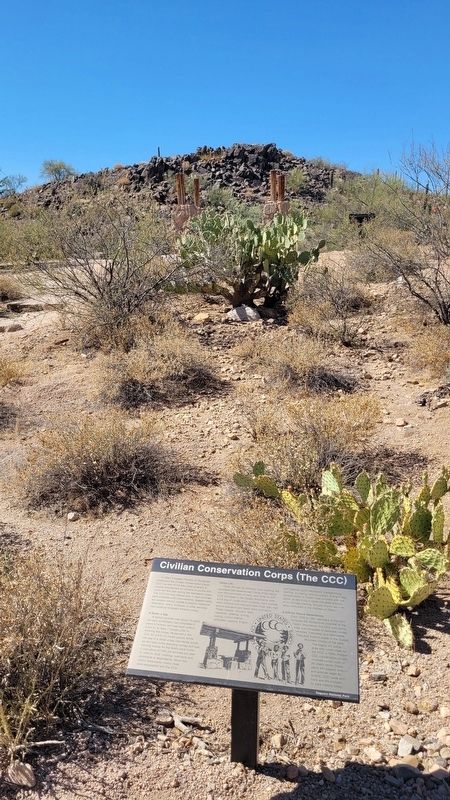
Civilian Conservation Corps (The CCC)
Saguaro National Park

Photographed by James Hulse, June 17, 2024
1. Civilian Conservation Corps (The CCC) Marker
In 1933, President Franklin D. Roosevelt established the Civilian Conservation Corps (CCC) as part of his New Deal program to provide employment for millions of youths who could not find jobs during the depression years. The CCC not only offered jobs, it also provided park protection and improvements, disaster relief, soil erosion control, wildlife protection, historical restoration, and a multitude of other services that continue to benefit America today.
A Dollar a Day
A typical enrollee was about 19 years old upon enlistment, had completed 8 years of school, and had been without a job for at least 7 months prior to entering the Corps. He served in the CCC for a 9 to 12 month period. While the pay of a dollar a day was hardly lavish, he did have some spending money and was earning money for the family back home. It cost about $1,000 per enrollee per year in 1940 for food, clothing, overhead, and allotments to dependents. About four million Americans, mostly male, were associated with the CCC.
Camp Life
Camp life was far different from anything the enrollees had experienced. Camp Pima, about one mile northwest
this page online
A Gift for Future Generations
From 1933 to 1941 members of the CCC improved the recreational potential of the Tucson Mountains. The CCC built picnic sites that consisted of ramadas, tables, benches, fireplaces, and bathrooms. They built 5 picnic areas in the Tucson Mountain District of the park. The Signal Hill picnic area was constructed by the CCC in 1934. Another CCC conservation project involved construction of 26 check dams. These dams still prevent erosion and provide water for wildlife. CCC roads and trails are still enjoyed by park
Photographed by James Hulse, June 17, 2024
2. Civilian Conservation Corps (The CCC) Marker
Erected by National Park Service, U.S. Department of the Interior.
Topics. This historical marker is listed in these topic lists: Charity & Public Work • Industry & Commerce • Parks & Recreational Areas. A significant historical year for this entry is 1933.
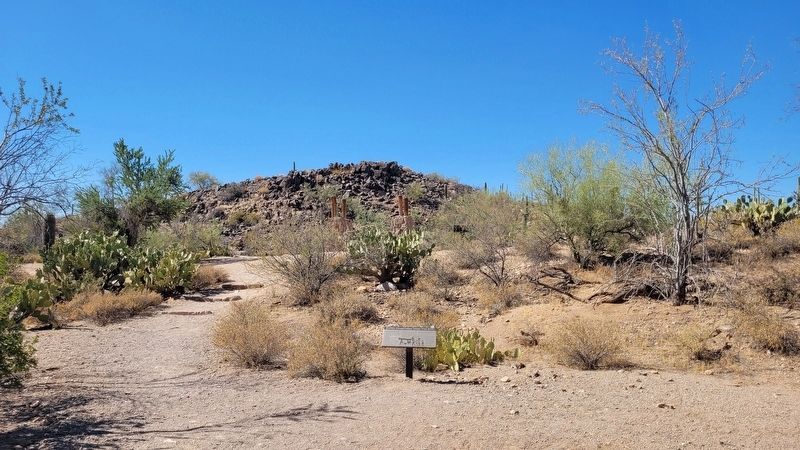
Location. 32° 17.416′ N, 111° 12.493′ W. Marker is near Tucson, Arizona, in Pima County. It is on Signal Hill Trail north of Signal Hill Road, on the right when traveling north. The marker is located along the Signal Hill hiking trail in Saguaro National Park West. Touch for map. Marker is in this post office area: Tucson AZ 85743, United States of America. Touch for directions.

Regionally, this marker is in the Sky Islands, in the Sonoran Desert, and in the Phoenix Metropolitan Area. It is also in the American Borderlands and in the Southwest. Globally, it is in North America, the Western Hemisphere, the Western World, and the Anglosphere. Historically, it finds itself in what was once New Spain and also the Gadsden Purchase.
Other nearby markers. At least 8 other markers are within 18 miles of this marker, measured as the crow flies: Prehistoric Rock Art (within shouting distance of this marker); Prehistoric People (about 300 feet away, measured in a direct line); Historic Period (about 300 feet away); World of the Wash (approx. 2.6 miles away); Desert Life (approx. 2.6 miles away); Seed to Sentinel (approx. 2.6 miles away); Mission San Xavier del Bac (approx. 17.3 miles away); a different marker also named Mission San Xavier del Bac (approx. 17.3 miles away). Touch for a list and map of all markers in Tucson.
Also see . . . The Civilian Conservation Corps. National Park Service
As part of the New Deal Program, to help lift the United States out of the Great Depression, Franklin D. Roosevelt established the(Submitted on July 2, 2024, by James Hulse of Medina, Texas.)Civilian Conservation Corps in 1933. The CCC or C’s as it was sometimes known, allowed single men between the ages of 18 and 25 to enlist in work programs to improve America’s public lands, forests, and parks.Photographed by James Hulse, June 17, 20243. Civilian Conservation Corps (The CCC) Marker
Credits. This page was last revised on February 16, 2026. It was originally submitted on July 1, 2024, by James Hulse of Medina, Texas. This page has been viewed 285 times since then and 43 times this year. Photos: 1, 2, 3. submitted on July 2, 2024, by James Hulse of Medina, Texas.
