Near Tucson in Pima County, Arizona — The American Mountains (Southwest)
Prehistoric Rock Art
Photographed by James Hulse, June 17, 2024
1. Prehistoric Rock Art Marker
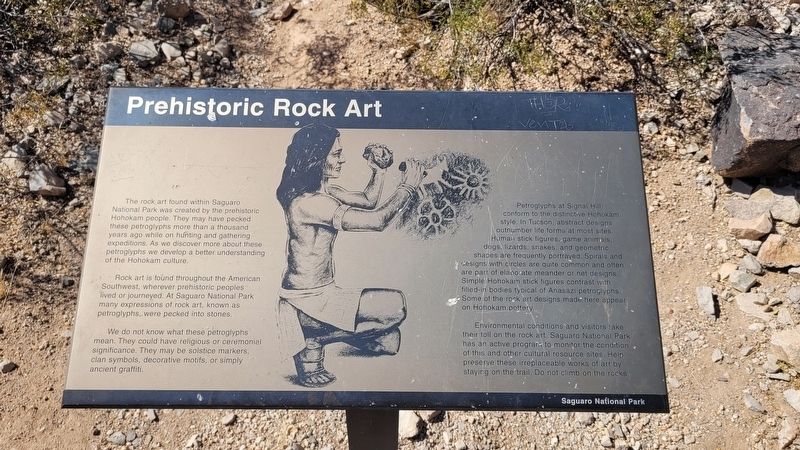
Rock art is found throughout the American Southwest, wherever prehistoric peoples lived or journeyed. At Saguaro National Park many expressions of rock art, known as petroglyphs, were pecked into stones.
We do not know what these petroglyphs mean. They could have religious or ceremonial significance. They may be solstice markers, clan symbols, decorative motifs, or simply ancient graffiti.
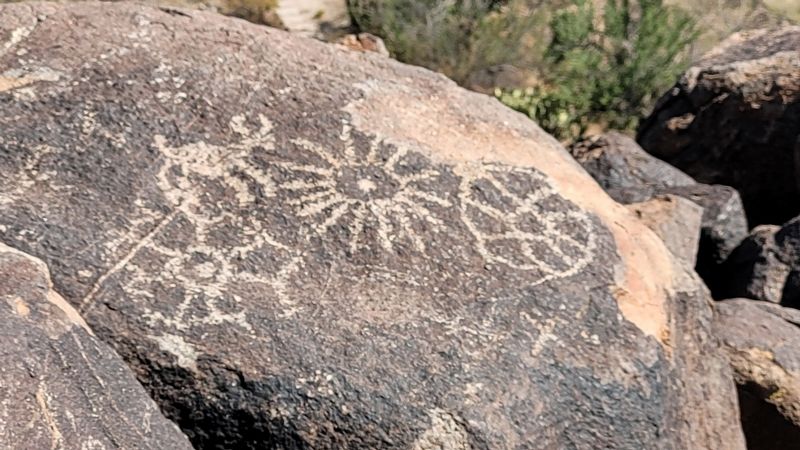
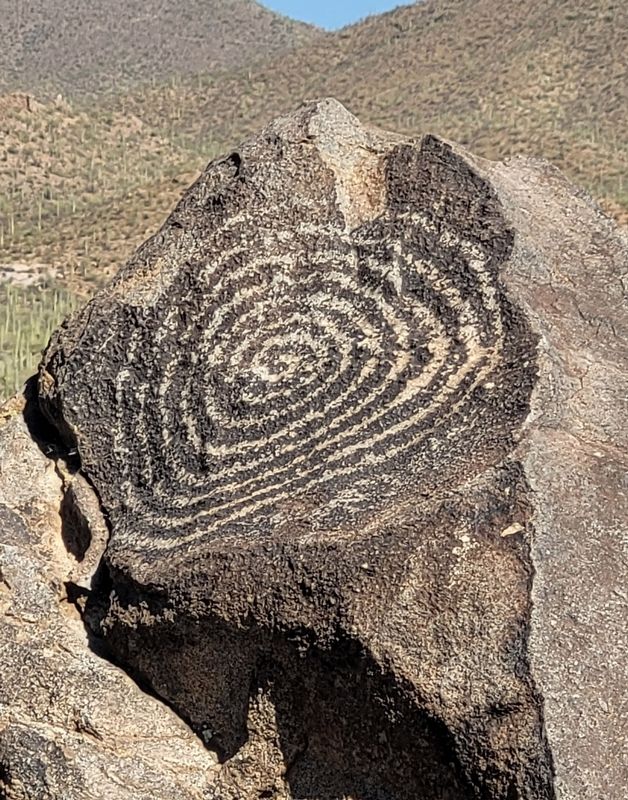
Petroglyphs at Signal Hill conform to the distinctive Hohokam style. In Tucson, abstract designs outnumber life forms at most sites. Human stick figures, game animals, dogs, lizards, snakes, and geometric shapes are frequently portrayed. Spirals and designs with circles are quite common and often are part of elaborate meander or net designs. Simple Hohokam stick figures contrast with filled-in bodies typical of Anasazi petroglyphs.
this page online
Environmental conditions and visitors take their toll on the rock art. Saguaro National Park has an active programs to monitor the condition of this and other cultural resource sites. Help preserve these irreplaceable works of art by staying on the trail. Do not climb on the rocks.
Erected by Saguaro National Park.
Topics. This historical marker is listed in these topic lists: Arts, Letters, Music • Indigenous Peoples and Communities.
Location. 32° 17.447′ N, 111° 12.498′ W. Marker is near Tucson, Arizona, in Pima County. It is at the intersection of Signal Hill Road and Golden Gate Road on Signal Hill Road. The marker is located along the Signal Hill Picnic Area hiking trail in Saguaro National Park West. Touch for map. Marker is in this post office area: Tucson AZ 85743, United States of America. Touch for directions.

Regionally, this marker is in the Sky Islands, in the Sonoran Desert, and in the Phoenix Metropolitan Area. It is also in the American Borderlands and in the Southwest. Globally,
Photographed by James Hulse, June 17, 2024
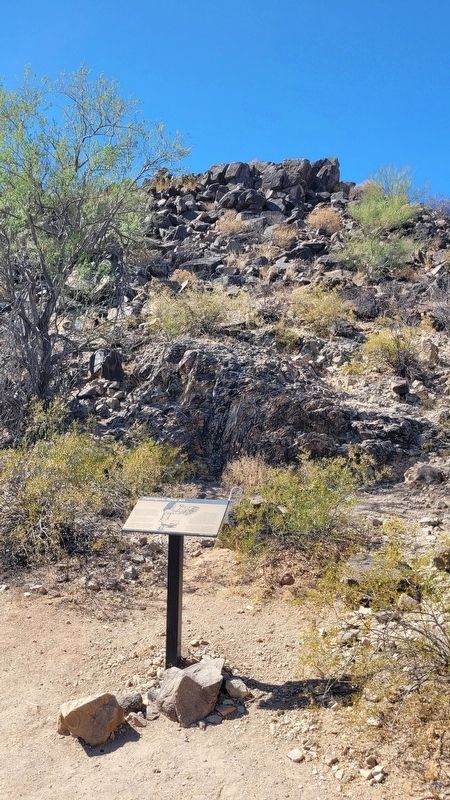
2. Prehistoric Rock Art Marker and Signal Hill
Other nearby markers. At least 8 other markers are within 18 miles of this marker, measured as the crow flies: Prehistoric People (within shouting distance of this marker); Historic Period (within shouting distance of this marker); Civilian Conservation Corps (The CCC) (within shouting distance of this marker); World of the Wash (approx. 2.6 miles away); Desert Life (approx. 2.6 miles away); Seed to Sentinel (approx. 2.6 miles away); Mission San Xavier del Bac (approx. 17.3 miles away); a different marker also named Mission San Xavier del Bac (approx. 17.3 miles away). Touch for a list and map of all markers in Tucson.
Also see . . .
1. Signal Hill Petroglyphs. National Park Service
Just north of the Signal Hill picnic area is the largest petroglyph site in the Tucson Mountain District of Saguaro National Park (SNP). The Signal Hill Petroglyph Site occupies a small but very distinct rocky hill (Figure 1) that is about 200 feet in diameter at its base and 40 feet high.(Submitted on July 1, 2024, by James Hulse of Medina, Texas.)
The site consists of over 200 prehistoric Native American petroglyphs many of which can be viewed from the visitor trail that ascends the hill. These petroglyphs were created from between about 550 to 1550 years ago.
Petroglyphs, which fall under the common, all-inclusive term “rock art," are a global phenomenon. The oldest known rock art are cave paintings found in Europe, Australia, Asia, and Africa that date from the Upper Paleolithic period, 35,000 to 40,000 years ago.
2. The Hohokam. Arizona Museum of Natural History
The Hohokam seemed to appear in Arizona quite suddenly with the(Submitted on July 3, 2024, by James Hulse of Medina, Texas.)ability to build sophisticated irrigation system to water their crops. Early archaeologists proposed that Hohokam culture developed in Mexico and moved into what is now Arizona.Photographed by James Hulse, June 17, 20243. Prehistoric Rock Art Marker
Photographed by James Hulse, June 17, 2024
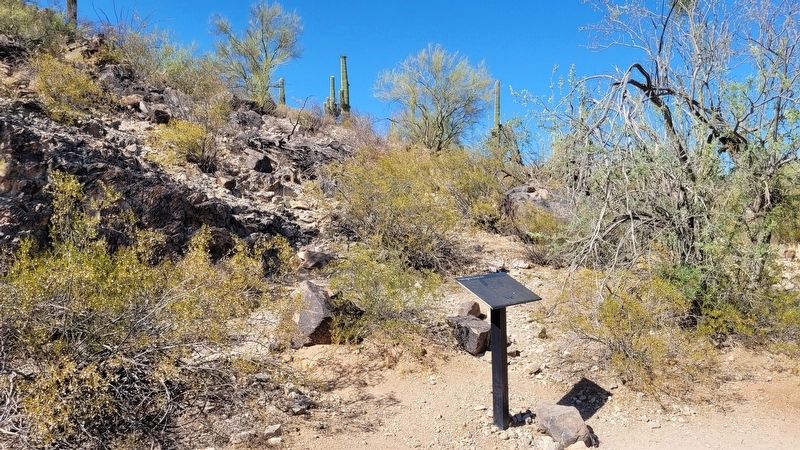
4. Prehistoric Rock Art
Photographed by James Hulse, June 17, 2024
5. Spiral Petroglyph
Credits. This page was last revised on July 3, 2024. It was originally submitted on July 1, 2024, by James Hulse of Medina, Texas. This page has been viewed 546 times since then and 173 times this year. Photos: 1, 2, 3. submitted on July 2, 2024, by James Hulse of Medina, Texas. 4, 5. submitted on July 3, 2024, by James Hulse of Medina, Texas.
