
Hurricane in Washington County, Utah — The American Mountains (Southwest)
Threshing Machine
Photographed by Jeremy Snow, June 28, 2024
1. Threshing Machine Marker
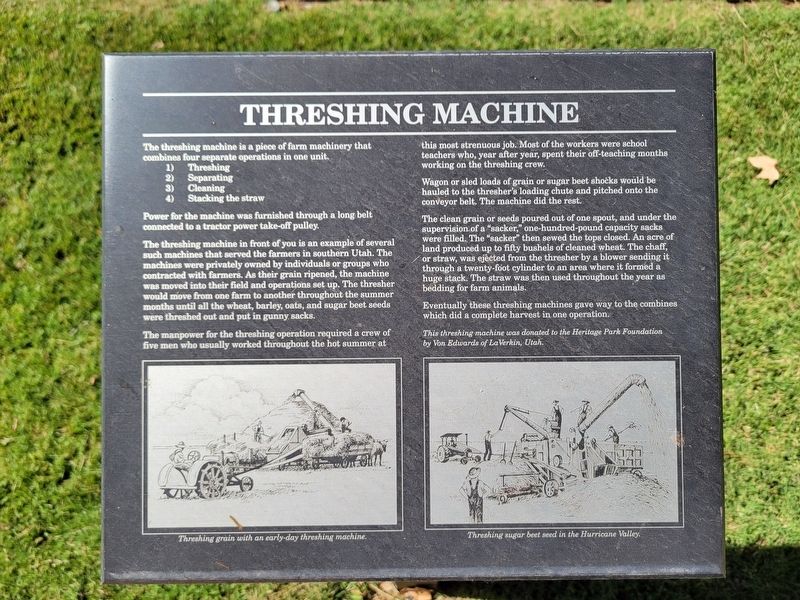
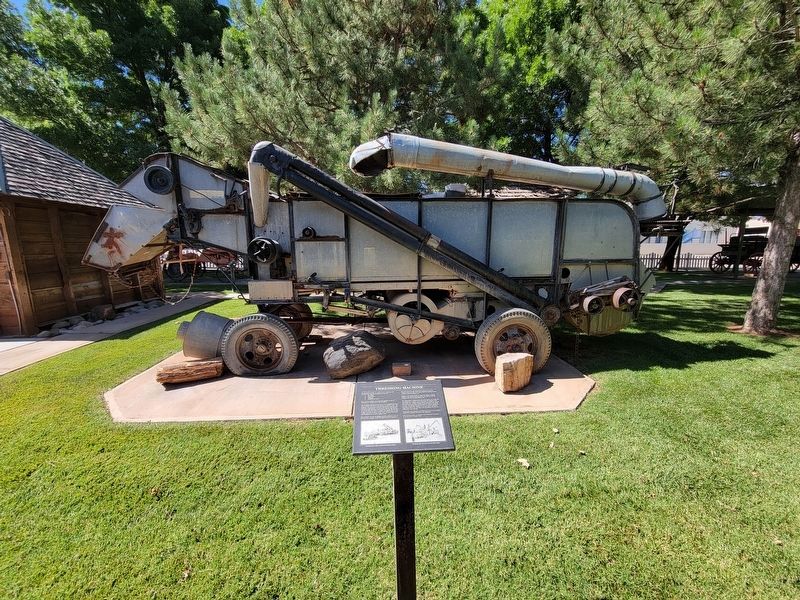
The threshing machine is a piece of farm machinery that combines four separate operations in one unit.
1) Threshing
2) Separating
3) Cleaning
4) Stacking the straw
Power for the machine was furnished through a long belt connected to a tractor power take-off pulley.
The threshing machine in front of you is an example of several such machines that served the farmers in southern Utah. The machines were privately owned by individuals or groups who contracted with farmers. As their grain ripened, the machine was moved into their field and operations set up. The thresher would move from one farm to another throughout the summer months until all the wheat, barley, oats, and sugar beet seeds were threshed out and put in gunny sacks.
The manpower for the threshing operation required a crew of five men who usually worked throughout the hot summer at this most strenuous job. Most of the workers were school teachers who, year after year, spent their off-teaching months working on the threshing crew.
Wagon or sled loads of grain or sugar beet shocks would be hauled to the thresher's loading chute and pitched onto the
this page online
The clean grain or seeds poured out of one spout, and under the supervision of a "sacker," one-hundred-pound capacity sacks were filled. The "sacker" then sewed the tops closed. An acre of land produced up to fifty bushels of cleaned wheat. The chaff, or straw, was ejected from the thresher by a blower sending it through a twenty-foot cylinder to an area where it formed a huge stack. The straw was then used throughout the year as bedding for farm animals.
Eventually these threshing machines gave way to the combines which did a complete harvest in one operation.
This threshing machine was donated to the Heritage Park Foundation by Von Edwards of LaVerkin, Utah.
(photo caption) Threshing grain with an early-day threshing machine.
(photo caption) Threshing sugar beet seed in the Hurricane Valley.
Topics. This historical marker is listed in this topic list: Agriculture.
Location. 37° 10.532′ N, 113° 17.258′ W. Marker is in Hurricane, Utah, in Washington County. It can be reached from Main Street. Touch for map. Marker is at or
Photographed by Jeremy Snow, June 28, 2024
2. Threshing Machine and Marker

Regionally, this marker is in Utah’s Color Country. It is also in the American Southwest, in the Mountain West, and in Colorado Plateau. Globally, it is in North America, the Rocky Mountains, the Western Hemisphere, the Western World, and the Anglosphere. Historically, it finds itself in what was once New Spain and also Mexico’s Alta California.
Other nearby markers. At least 8 other markers are within walking distance of this marker: Pioneer Hay Barn, Manger, and Corral (here, next to this marker); Grain Reaper (a few steps from this marker); Shetlar Wagon (within shouting distance of this marker); Spencer and Helen Isom "Home" (within shouting distance of this marker); Dixie Sorghum (Molasses) Mill (within shouting distance of this marker); Pioneer Doctor's Office (within shouting distance of this marker); Early Pioneer Granary and Home (within shouting distance of this marker); Heritage Home & Pioneer Corner (within shouting distance of this marker). Touch for a list and map of all markers in Hurricane.
Credits. This page was last revised on July 3, 2024. It was originally submitted on July 2, 2024, by Jeremy Snow of Cedar City, Utah. This page has been viewed 172 times since then and 18 times this year. Photos: 1, 2. submitted on July 2, 2024, by Jeremy Snow of Cedar City, Utah. • Andrew Ruppenstein was the editor who published this page.
