Near Munfordville in Hart County, Kentucky — The American South (East South Central)
Battle of Rowletts Station
December 17, 1861
Photographed by Duane Hall, July 31, 2016
1. Battle of Rowletts Station Marker
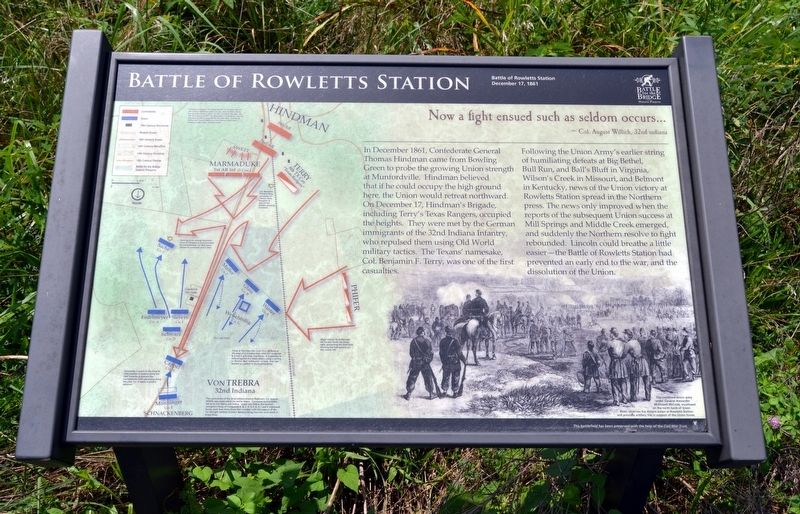
Now a fight ensued such as seldom occurs…In December 1861, Confederate General Thomas Hindman came from Bowling Green to probe the growing Union strength at Munfordville. Hindman believed that if he could occupy the high ground here, the Union would retreat northward. On December 17, Hindman’s Brigade, including Terry’s Texas Rangers, occupied the heights. They were met by the German immigrants of the 32nd Indiana Infantry, who repulsed them using Old World military tactics. The Texans’ namesake, Col. Benjamin F. Terry, was one of the first casualties.
- Colonel August Willich, 32nd Indiana
Following the Union Army’s earlier string of humiliating defeats at Big Bethel, Bull Run, and Ball’s Bluff in Virginia, Wilson’s Creek in Missouri, and Belmont in Kentucky, news of the Union victory at Rowletts Station spread in the Northern press. The news only improved when the reports of the subsequent Union success at Mill Springs and Middle Creek emerged, and suddenly the Northern resolve to fight rebounded. Lincoln could breathe a little easier—the Battle of Rowletts Station had prevented an early end to the war, and the
this page online
(captions)
The combined Union army under General Alexander McDowell McCook, encamped on the north bank of Green River, observes the distant action at Rowletts Station and provides artillery fire in support of the Union forces.
“Hindman’s Legion” included the 8th TX Cavalry, the 1st AR Infantry Battalion under Lt. Col. John S. Marmaduke, the 2nd AR Infantry under Lt. Col. Joseph W. Bocage, the 6th AR Infantry under Col. Alexander T. Hawthorn, the 6th Battalion of AR Cavalry (Phifer’s) under Maj. Charles W. Phifer, and Swett’s Battery of the Warren (MS) Light Artillery under Capt. Charles Swett.
Col. Benjamin Franklin Terry, namesake of “Terry’s Texas Rangers” is slain in the battle’s opening moments.
Seeking cover among haystacks, 32nd IN Company C is surrounded by Confederates. Lt. Max Sachs refuses to surrender and is slain.
Major Charles W. Phifer’s 6th AR Cavalry flanks the Union right, preventing the 32nd from reaching the high ground on Mrs. Lewis’ Hill.
Firing at first from the cover of a rail fence at the edge of a wooded field, 32nd IN Companies B,F, and K pull back, leaving Co. G in position to defend against the rebel cavalry using a carrere, or “Roman Box” maneuver–a tactic they had learned as soldiers in the Prussian army.
Companies E and H of the 32nd IN hold position in reserve along the L&N Turnpike to prevent the Confederates from advancing along the pike. Co. H repels a cavalry advance.
The commander of the 32nd Indiana Infantry Regiment, Col. August Willich, was away when the battle began. Command during battle fell to Lt. Col. Henry von Trebra. Under von Trebra, the German immigrant forces of Companies A, B, C, D, E, F, G, H, I, and K withstood forces more than three times their number, with the support of the 1st OH Light Artillery (Cotter’s Battery) firing from the north bank of the Green River.
Erected by Battle
Photographed by Duane Hall, July 31, 2016
2. Western Part of Battlefield
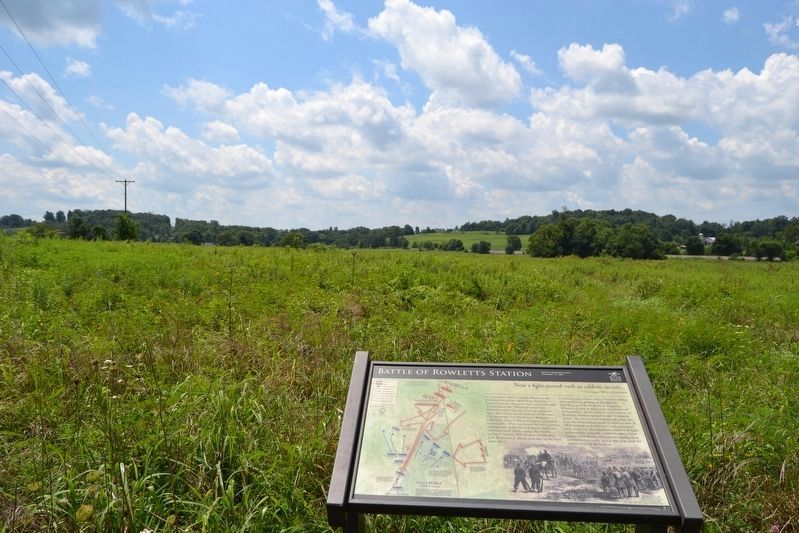
For reference purposes, the railroad tracks are visible to the right, and the location of the marker is noted as “You are here” on the marker’s battlefield map.
Topics. This historical marker is listed in this topic list: War, US Civil. A significant historical date for this entry is December 17, 1861.
Location. 37° 15.058′ N, 85° 53.459′ W. Marker is near Munfordville, Kentucky, in Hart County. It can be reached from South Dixie Highway (U.S. 31W) 0.2 miles south of Charlie Dowling Road, on the right when traveling south. This marker is no longer accessible.. Touch for map. Marker is at or near this postal address: 1695 S Dixie Hwy, Munfordville KY 42765, United States of America. Touch for directions.

Regionally, this marker is in Mammoth Cave Country and in the Pennyroyal Region. It is also in the American South and specifically in the Upper South. Globally, it is in North America, the Western Hemisphere, the Western World, and the Anglosphere. Historically, it finds itself in what was once the territory of the Mississippian Culture and also the Antebellum South.
Other nearby markers. At least 8 other markers are within walking distance of this marker: A different marker also named Battle of Rowletts Station (about 600 feet away, measured in a direct line);
Photographed by Duane Hall, July 31, 2016
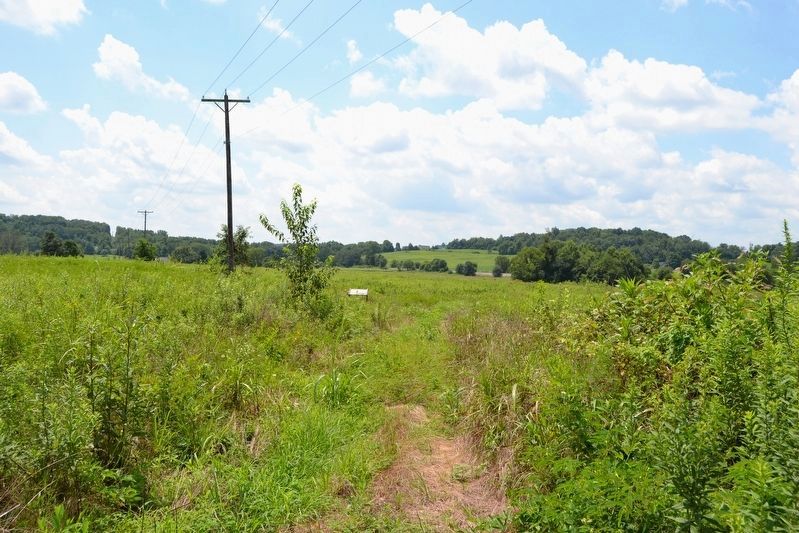
3. Marker on Rowletts Station Trail
More about this marker. This marker is no longer accessible. It is on private property. Please do not attempt to access it without permission of the property owner. According to a Google Review by Patrica Chapman, "We drove out to the site and all that was there were signs saying 'trails closed'. The stands where you would normally find information and maps were empty and behind a fence with a 'no trespassing' sign."
Regarding Battle of Rowletts Station. The marker and the surrounding site was part of the Battle for the Bridge Historic Preserve, and the battlefield had been preserved with the help of the Civil War Trust.
Also see . . .
1. Battle of Rowlett's Station - Wikipedia entry. (Submitted on August 13, 2016.)
2. Battle for the Bridge Historic Preserve.
Photographed by Duane Hall, July 31, 2016
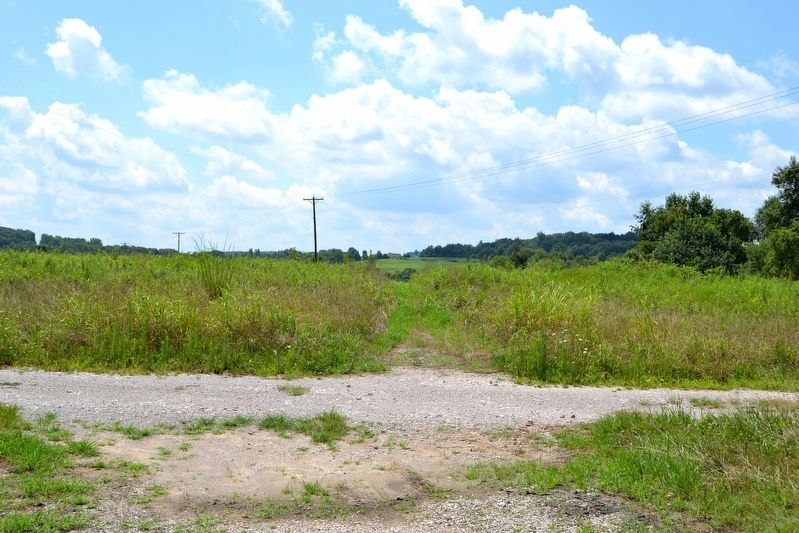
4. Trail Leading to Battle of Rowletts Station Marker
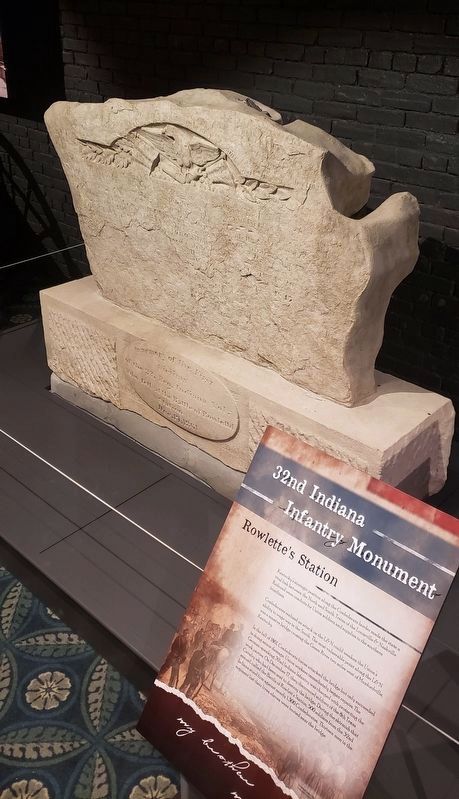
Photographed by Bradley Owen, October 12, 2019
5. 32nd Indiana Volunteer Infantry Regiment Monument
Although it is no longer in its original location, the 32nd Indiana Monument is generally considered to be the oldest surviving memorial to the American Civil War. It is now located at the Frazier History Museum, 829 West Main Street, Louisville, KY.
Credits. This page was last revised on July 4, 2024. It was originally submitted on August 13, 2016, by Duane Hall of Abilene, Texas. This page has been viewed 2,109 times since then and 228 times this year. Last updated on July 3, 2024. Photos: 1, 2, 3, 4. submitted on August 13, 2016, by Duane Hall of Abilene, Texas. 5. submitted on March 31, 2021, by Bradley Owen of Morgantown, West Virginia. • Bernard Fisher was the editor who published this page.
