Downtown Los Angeles in Los Angeles County, California — The American West (Pacific Coastal)
Land of the Tongva
Yaanga, the First Los Angeles
| — | Demise of a Proud People | — |

Photographed by Craig Baker, September 10, 2023
1. Land of the Tongva Marker
The original inhabitants of what is now Los Angeles were members of the Tongva (People of the Earth). When the first Spanish-colonial explorers and settlers arrived in the 18th century, it is estimated that there were 5,000 Tonvga living in the Los Angeles basin. The pueblo of Los Angeles was founded next to the Tongva village of Yaanga. The Tongva were a Shoshonean-speaking, hunter-gathering society that co-existed well with other local tribes. Tongva settlements were based near the life source of what is now known as the Los Angeles River, which provided a floorplan of fertile soil for hunting and gathering.
Yaanga, the First Los Angeles
The native village of Yaanga thrived thanks to the plentiful water source of the nearby El Río de Nuestra Señora la Reina de Los Ángeles de Porciúncula as the Spanish named what is now the Los Angeles River. Tongva families lived in domed thatch huts made of tule or reeds thatched together and known as Ki or Ki'sh. They developed tools and weapons that included various traps and hooks used for fishing, as well as ti'aats (canoes) used to navigate
this page online
Demise of a Proud People
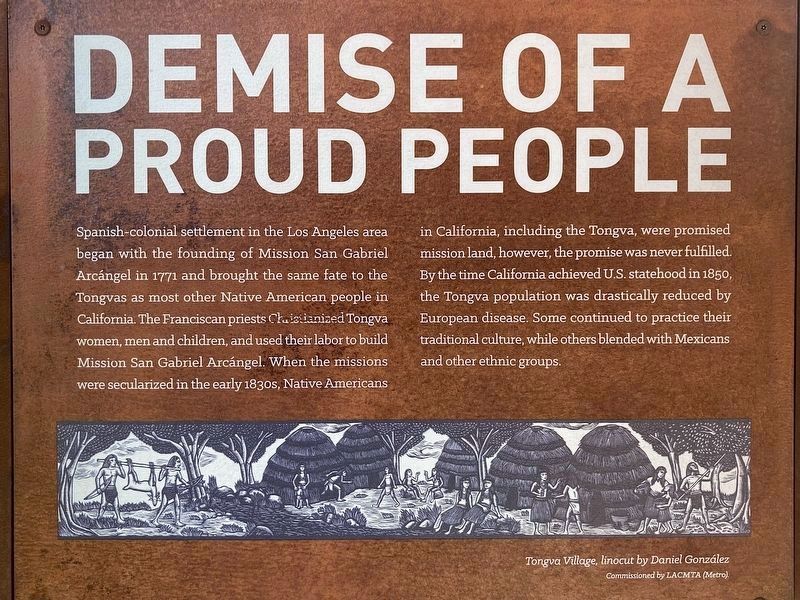
Spanish-colonial settlement in the Los Angeles area began with the founding of Mission San Gabriel Arcángel in 1771 and brought the same fate to the Tongvas as most other Native American people in California. The Franciscan priests Chistianized Tongva women, men and children, and used their labor to build Mission San Gabriel Arcángel. When the missions were secularized in the early 1830s, Native Americans in California, including the Tongva, were promised mission land, however, the promise was never fulfilled. By the time California achieved U.S. statehood in 1850, the Tongva population was drastically reduced by European disease. Some continued to practice their traditional culture, while others blended with Mexicans and other ethnic groups.
Erected by County

Photographed by Craig Baker, September 10, 2023
2. Land of the Tongva Marker
Topics. This historical marker is listed in this topic list: Indigenous Peoples and Communities.
Location. 34° 3.406′ N, 118° 14.38′ W. Marker is in Los Angeles, California, in Los Angeles County. It is in Downtown Los Angeles. It can be reached from Main Street north of the Hollywood Freeway (U.S. 101), on the left when traveling north. Touch for map. Marker is at or near this postal address: 513 N Main St, Los Angeles CA 90012, United States of America. Touch for directions.

Regionally, this marker is in the Transverse Ranges. It is also on the American Pacific Coast. Globally, it is in North America, on the Ring of Fire, on the Pacific Rim, in the Western Hemisphere, in the Western World, and in the Anglosphere. Historically, it finds itself in what was once New Spain and also Mexico’s Alta California.
Other nearby markers. At least 8 other markers are within walking distance of this marker: The Aliso Tree (here, next to this marker); Los Angeles Under Spanish Rule (here, next to this marker); Settlement of a City (here, next to this marker); Historic Los Angeles Cemetery
Photographed by Craig Baker, September 10, 2023
3. Land of the Tongva Marker
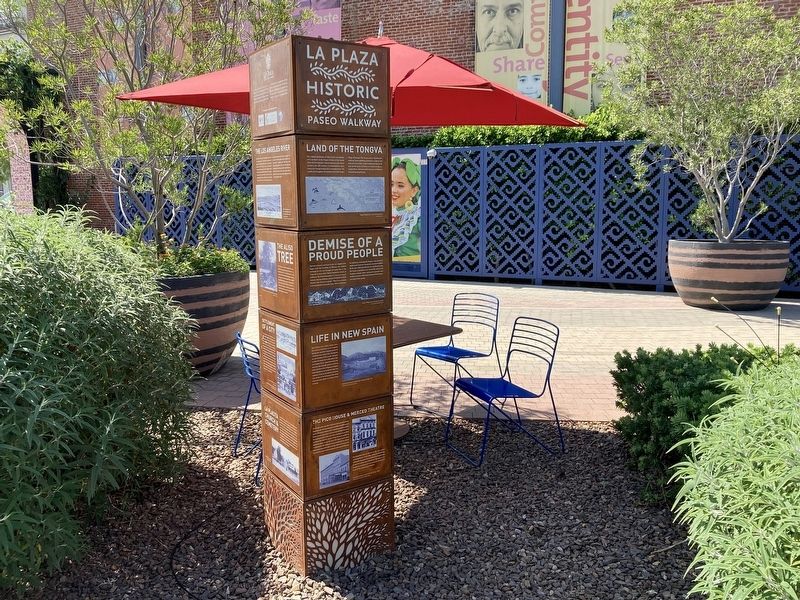
More about this marker. This marker has a dozen panels about local history, in random order. See nearby markers for more.
Photographed by Craig Baker, September 10, 2023
4. Land of the Tongva Marker
Credits. This page was last revised on July 4, 2024. It was originally submitted on July 4, 2024, by Craig Baker of Sylmar, California. This page has been viewed 553 times since then and 144 times this year. Photos: 1, 2, 3, 4. submitted on July 4, 2024, by Craig Baker of Sylmar, California.
