Salina in Saline County, Kansas — The American Midwest (Upper Plains)
Lynching in America ⎯⎯⎯ The Lynching of Dana Adams
Community Remembrance Project
Photographed by Mark Hilton, July 1, 2024
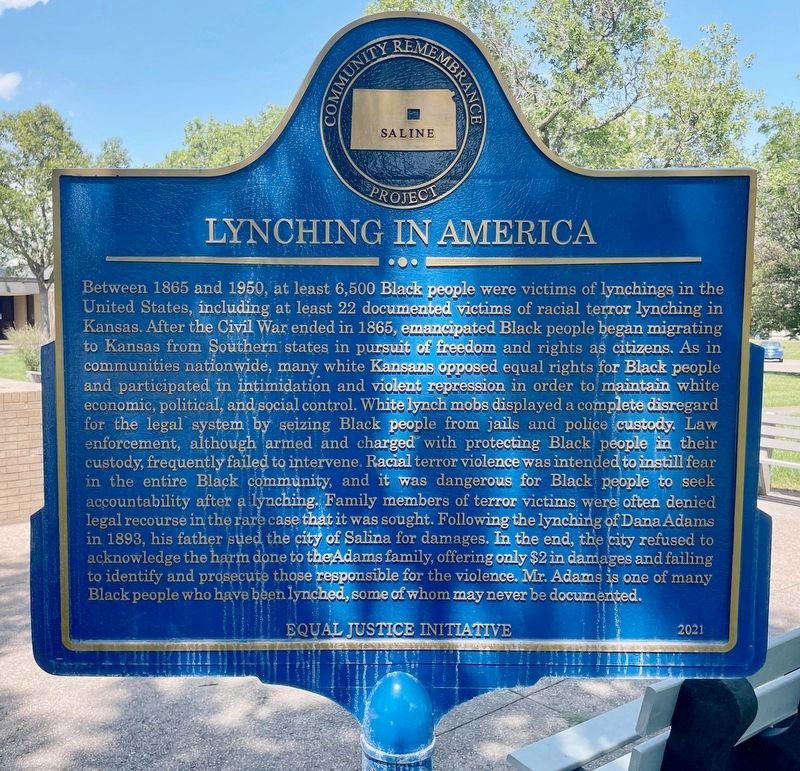
1. Lynching in America Marker
Inscription.
Lynching in America
Between 1865 and 1950, at least 6,500 Black people were victims of lynchings in the United States, including at least 22 documented victims of racial terror lynching in Kansas. After the Civil War ended in 1865, emancipated Black people began migrating to Kansas from Southern states in pursuit of freedom and rights as citizens. As in communities nationwide, many white Kansans opposed equal rights for Black people and participated in intimidation and violent repression in order to maintain white economic, political, and social control. White lynch mobs displayed a complete disregard for the legal system by seizing Black people from jails and police custody. Law enforcement, although armed and charged with protecting Black people in their custody, frequently failed to intervene. Racial terror violence was intended to instill fear in the entire Black community, and it was dangerous for Black people to seek accountability after a lynching. Family members of terror victims were often denied
legal recourse in the rare case that it was sought. Following the lynching of Dana Adams in 1893, his father sued
Click or scan to see this page online
the city of Salina for damages. In the end, the city refused to acknowledge the harm done to the Adams family, offering only $2 in damages and failing to identify and prosecute those responsible for the violence. Mr. Adams is one of many Black people who have been lynched, some of whom may never be documented.
The Lynching of Dana Adams
On April 20, 1893, a mob of at least 50 white railroad workers lynched a 19-year-old Black man named Dana Adams in Saline County near the Union Pacific depot. On the morning of April 20, Mr. Adams and three other Black men were in the waiting room of the train station when a white worker without justification ordered them to leave, leading to an altercation. Mr. Adams was later taken into custody, and the white man pressed charges, accusing him of "attempted murder." During this era, accusations lodged against Black people were rarely subject to serious scrutiny, and the mere mention of Black-on-white violence regularly led to criminalization and racial terror violence. A rushed trial was held the same day without legal representation for Mr. Adams. Within hours, Mr. Adams was sentenced to seven
Photographed by Mark Hilton, July 1, 2024
2. The Lynching of Dana Adams Marker
years in prison. Ignoring rumors of intent to lynch Mr. Adams, the police boarded Mr. Adams onto the Santa Fe train to transport him to prison. At the station, a lynch mob disconnected the train car holding Mr. Adams from the rest of the train and abducted him. Police officers failed to protect Mr. Adams and allowed the mob to drag him, handcuffed and pleading for his life, to the Union Pacific depot and hanged him from a telegraph pole. Several white men stripped the clothes from his lynched body to take as souvenirs. Although there were over 200 spectators, no one was held accountable for lynching Dana Adams.
Erected 2021 by Equal Justice Initiative.
Topics and series. This historical marker is listed in these topic lists: African Americans • Civil Rights. In addition, it is included in the Lynching in America series list. A significant historical date for this entry is April 20, 1893.
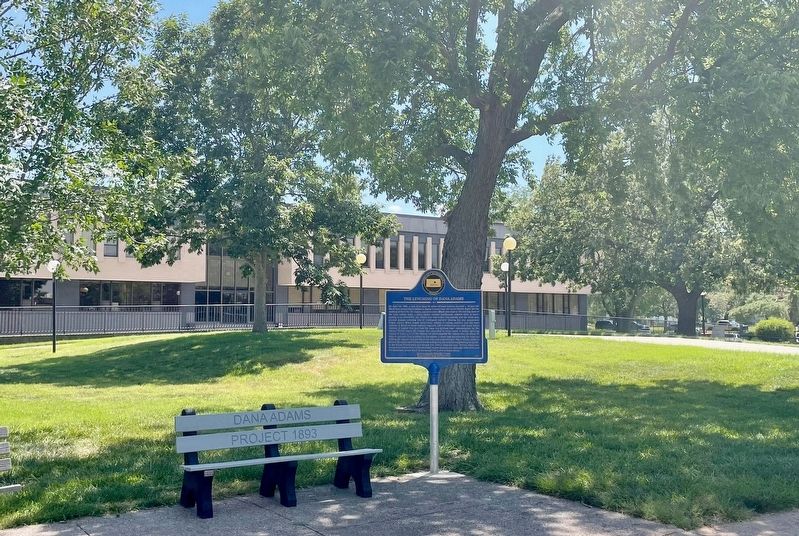
Location. 38° 50.654′ N, 97° 36.679′ W. Marker is in Salina, Kansas, in Saline County. It can be reached from North 7th Street north of Ash Street, on the left when traveling north. Located in the Robert Caldwell Plaza (south side of the Salina Public
Photographed by Mark Hilton, July 1, 2024
3. Lynching in America / The Lynching of Dana Adams Marker in Robert Caldwell Plaza.
Library). Touch for map. Marker is at or near this postal address: 301 W Elm St, Salina KS 67401, United States of America. Touch for directions.
Regionally, this marker is in the Smoky Hills. It is also in the American Midwest, in the Corn Belt, on the prairies, and on the Southern Plains. Globally, it is in North America, the Western Hemisphere, the Western World, and the Anglosphere. Historically, it finds itself in what was once the Louisiana Purchase.
Credits. This page was last revised on December 17, 2024. It was originally submitted on July 5, 2024, by Mark Hilton of Montgomery, Alabama. This page has been viewed 566 times since then and 64 times this year. Photos:1, 2, 3. submitted on July 5, 2024, by Mark Hilton of Montgomery, Alabama.