Grand Canyon Village in Coconino County, Arizona — The American Mountains (Southwest)
California Condor
Photographed by James Hulse, June 21, 2024
1. California Condor Marker
photo captions:
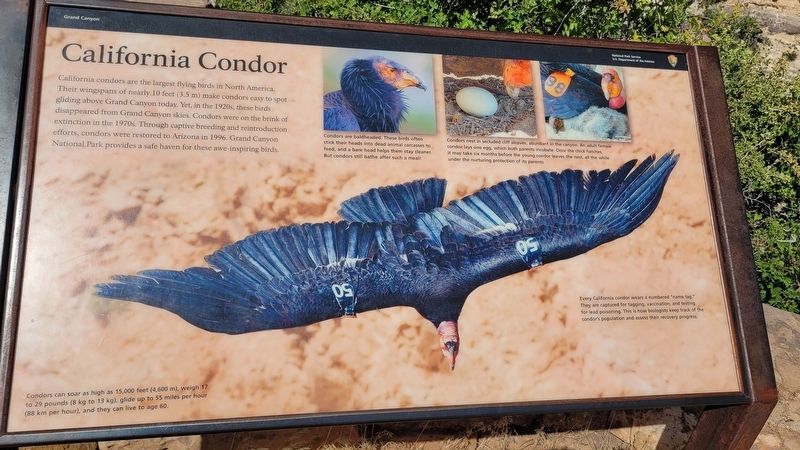
Condors are baldheaded. These birds often stick their heads into dead animal carcasses to feed, and a bare head helps them stay cleaner. But condors still bathe after such a meal!
Condors nest in secluded cliff alcoves, abundant in the canyon. An adult female condor lays one egg, which both parents incubate. Once the chick hatches, it may take six months before the young condor leaves the nest, all the while under the nurturing protection of its parents.
Condors can soar as high as 15,000 feet (4,600 m), weigh 17 to 29 pounds (8 kg to 13 kg), glide up to 55 miles per hour (88 km per hour), and they can live to age 60.
Every California
this page online
Erected by Grand Canyon, National Park Service, U.S. Department of the Interior.
Topics. This historical marker is listed in these topic lists: Animals • Parks & Recreational Areas. A significant historical year for this entry is 1996.
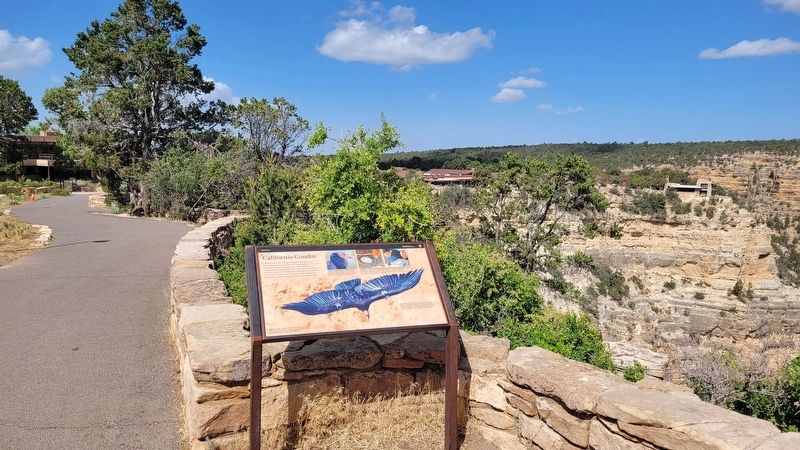
Location. 36° 3.451′ N, 112° 8.316′ W. Marker is in Grand Canyon Village, Arizona, in Coconino County. It is on North Village Loop west of El Tovar Rd. The marker is located along the rim trail. Touch for map. Marker is at or near this postal address: 5 N Vlg Lp, Grand Canyon AZ 86023, United States of America. Touch for directions.

Regionally, this marker is in Flagstaff & High Country and in Hopi. It is also in the American Southwest, in the Mountain West, on the Colorado Plateau, and at the Four Corners. Globally, it is in North America, the Western Hemisphere, the Western World, and the Anglosphere. Historically, it finds itself in what was once New Spain and also Mexico’s
Photographed by James Hulse, June 21, 2024
2. The California Condor Marker along the rim trail
Other nearby markers. At least 8 other markers are within walking distance of this marker: CCC Legacy (within shouting distance of this marker); Trans-Canyon Telephone Line (within shouting distance of this marker); El Tovar Hotel (about 400 feet away, measured in a direct line); a different marker also named El Tovar Hotel (about 500 feet away); Hopi House (about 500 feet away); El Tovar (about 500 feet away); a different marker also named Hopi House (about 500 feet away); Santa Fe Depot (about 600 feet away). Touch for a list and map of all markers in Grand Canyon Village.
Other markers no longer nearby. Hopi House (was about 500 feet away but has been reported to have been replaced with another marker now near it); Bright Angel Lodge (was about 600 feet away).
Also see . . . Condor Updates. National Park Service, U.S. Department of the Interior
In 1982 there were only 22 California Condors left in the world. In 1992, when the U.S. Fish and Wildlife Service (USFWS), with its public and private partners, began reintroducing captive-bred condors to the wild. In 2001 the first wild nesting occurred in Grand Canyon National Park since re-introduction. In 2002 there were only 8 pairs of wild nesting birds population-wide. In 2008, for the first time since the program began, more California condors were flying free in the wild than in captivity. Today there are nearly 500 – more than half of them flying free in Arizona, Utah, California, and Baja Mexico.(Submitted on July 7, 2024, by James Hulse of Medina, Texas.)
Credits. This page was last revised on September 11, 2026. It was originally submitted on July 6, 2024, by James Hulse of Medina, Texas. This page has been viewed 168 times since then and 17 times this year. Photos: 1, 2. submitted on July 7, 2024, by James Hulse of Medina, Texas.
