Vancouver in Clark County, Washington — The American West (Northwest)
In Memory of the Pioneers of the Oregon Trail 1844
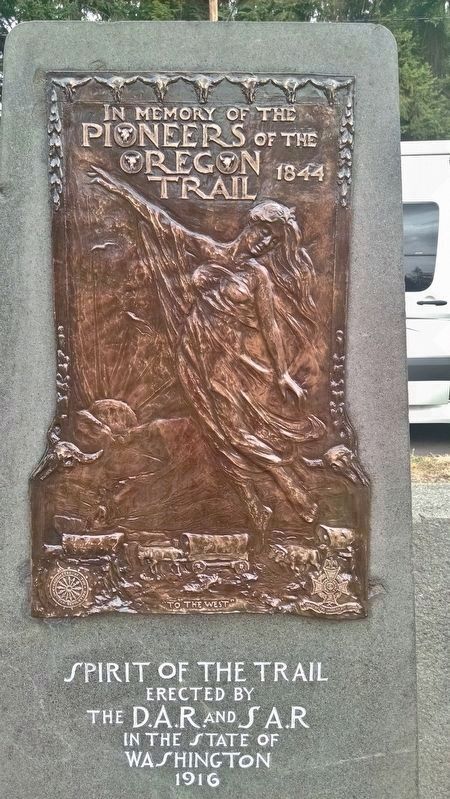
Photographed by Mick Hersey, July 9, 2016
1. In Memory of the Pioneers of the Oregon Trail 1844 Marker
Erected 1916 by the D.A.R. and the S.A.R. in the State of Washington.
Topics. This historical marker is listed in these topic lists: Roads & Vehicles • Settlements & Settlers. A significant historical year for this entry is 1916.
Location. 45° 39.171′ N, 122° 39.999′ W. Marker is in Vancouver, Washington, in Clark County. It can be reached from Main Street north of East 40th Street, on the right when traveling north. The marker is in front of 4008 Main Street, Vancouver, Clark County, WA and near the historic Covington House. Touch for map. Marker is at or near this postal address: 4008 Main Street, Vancouver WA 98663, United States of America. Touch for directions.

Regionally, this marker is in Greater Portland Area and in Southwest Washington State. It is also on the American Pacific Coast, in the Pacific Northwest, and in the Lewis & Clark Corridor. Globally, it is in North America, on the Pacific Rim, in the Western Hemisphere, in the Western World, and in the Anglosphere.
Other nearby markers. At least 8 other markers are within 2 miles of this marker, measured as the crow flies: Covington House (within shouting distance of this marker); Theodore A. Penland Rose Garden (approx. 1.2 miles away); Clark County Courthouse (approx. 1.6 miles away); The Reservation Monument (approx. 1.7 miles away); Officers Row (approx. 1.7 miles away); Congressional Medal of Honor Monument (approx. 1.7 miles away); Cannon Replica Project (approx. 1.7 miles away); The O. O. Howard House (approx. 1.7 miles away). Touch for a list and map of all markers in Vancouver.
More about this marker. The nearby Covington House is a log cabin built by Anne and Richard Covington who came to Fort Vancouver in 1848
this page online
Regarding In Memory of the Pioneers of the Oregon Trail 1844. Erected October 25, 1917, by the Daughters and Sons of the American Revolution, the Mary Ball Chapter took the lead—the bronze tablet on an eight-foot granite marker on the WA State side of the Columbia River Bridge. The small water fountains on the horns of the ‘buffalo skulls’ and dog drinking trough have been disabled. Inscribed on bronze plate with a floating female figure, setting sun, Oregon Trail wagon scene, bison skulls and other symbols with text: "In Memory of the Pioneers of the Oregon Trail 1844” and “To the West” [DAR insignia, SAR insignia] Below, cut in the granite: “Spirit of the Trail Erected by the D.A.R. and the S.A.R. in the State of Washington 1916.” 26th Continental Congress of the NSDAR 1917: Alonzo Victor Lewis, sculptor, WA State Sculptor Laureate of Tacoma, designed and supervised the execution of the fountain. Mr. Lewis was a nephew of Meriwether Lewis and descended from Fielding Lewis, the brother of John Lewis, father of the explorer…The fountain is of Tenino granite in three sections. The
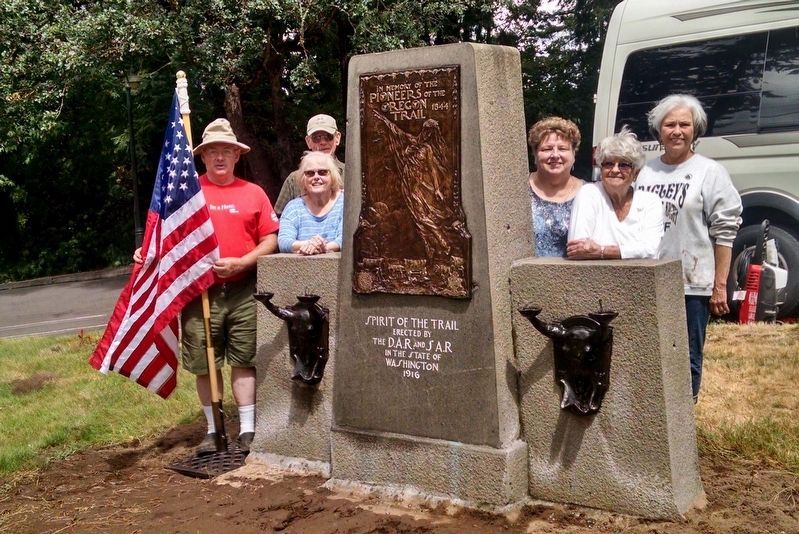
July 9, 2016
2. Ft Vancouver DAR Chapter & the Vancouver Women's Club at the centennial restoration & rededication.
According to page 302 of the DAR Magazine, April 1916, “The bridge between Vancouver and Portland, Oregon, is to be completed by November 1916, and it is hoped that the Oregon Trail Fountain will be unveiled at that time.”
In History and Register 1924 WSSDAR, it is stated that the unveiling of the fountain was delayed in February 1917 due to Red Cross Work and American Relief Work by the DAR (page 36) and in March 1917 it was specifically delayed yet again

Photographed by Shirley A Stirling, 2016
3. Fountain detail
Fort Vancouver Chapter NSDAR was first established on February 18, 1919 and rededicated the marker on September 20, 1920. In 1958 the monument was moved when the Interstate (I-5) Bridge’s second span was added. It was placed safely in storage for 31 years in Battle Ground, WA.
In 1989, the monument was placed along I-5 at the Visitor’s Center by WA State Department of Transportation (DOT). When DOT moved the monument they added a small plaque at the bottom of the center section inscribed: Centennial –89 Project WSDOT.
In 1998 the Visitor’s Center was closed when the property was purchased by Clark College. The monument was again put in storage.
In 2002 it was placed on the grounds of the Clark County Historical Museum and, on March 28, 2003, rededicated. The monument was later put in storage, in 2006, when the museum installed an elevator. As part of the 90th anniversary of their chapter in 2009, the members of Fort Vancouver NSDAR removed the monument from storage and placed it in front of the historic Covington House in Vancouver, they hope its final resting place.
In 2016 Mick Hersey, SAR member and Historical Memorial Preservationist, assisted Fort Vancouver Chapter DAR members and the Vancouver Women’s Club in cleaning and preserving the marker using traditional techniques. It was part of a project to clean and preserve all the markers in the DAR/SAR Oregon Trail series.
References: WISAARD Property ID #20552; History and Register 1924 WSSDAR, p 36, 40; DAR Magazine April, 1916, p 302.
Credits. This page was last revised on July 8, 2024. It was originally submitted on July 6, 2024, by Shirley A Stirling of Lacey, Washington. This page has been viewed 884 times since then and 514 times this year. Photos: 1, 2, 3. submitted on July 6, 2024, by Shirley A Stirling of Lacey, Washington. • James Hulse was the editor who published this page.
