Page in Coconino County, Arizona — The American Mountains (Southwest)
Navajo Generating Station, NGS
Photographed by James Hulse, June 22, 2024
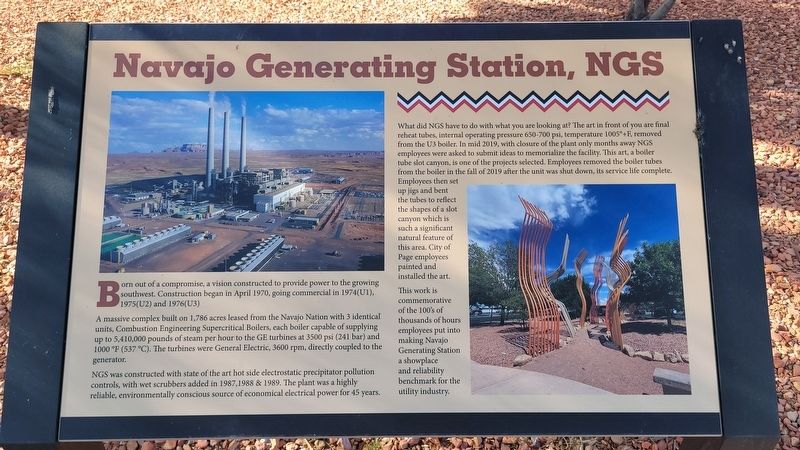
1. Navajo Generating Station, NGS Marker
Born out of a compromise, a vision constructed to provide power to the growing southwest. Construction began in April 1970, going commercial in 1974 (U1), 1975 (U2) and 1976 (U3).
A massive complex built on 1,786 acres leased from the Navajo Nation with 3 identical units, Combustion Engineering Supercritical Boilers, each boiler capable of supplying up to 5,410,000 pounds of steam per hour to the GE turbines at 3500 psi (241 bar) and 1000 °F (537 °C). The turbines were General Electric, 3600 rpm, directly coupled to the generator.
NGS was constructed with state of the art hot side electrostatic precipitator pollution controls, with wet scrubbers added in 1987, 1988 & 1989. The plant was a highly reliable, environmentally conscious source of economical electrical power for 45 years.
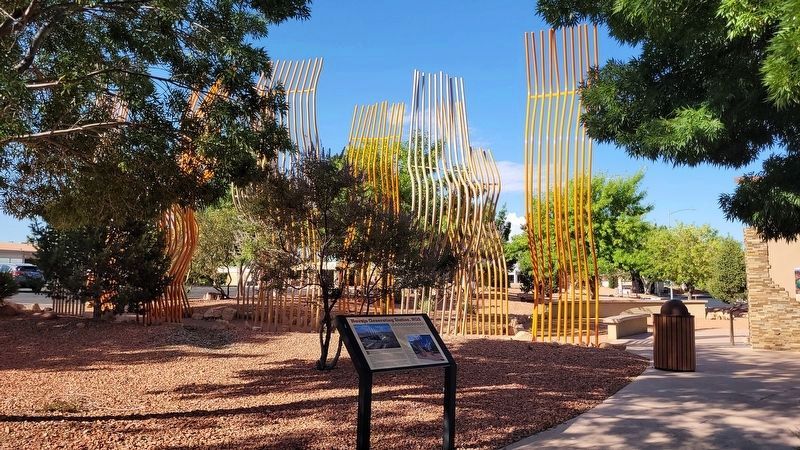
What did NGS have to do with what you are looking at? The art in front of you are final reheat tubes, internal operating pressure 650-700 psi, temperature 1005°+F, removed from the U3 boiler. In mid 2019, with closure of the plant only months away NGS employees were asked to submit ideas to memorialize the facility. This art, a boiler
this page online
Topics. This historical marker is listed in these topic lists: Indigenous Peoples and Communities • Industry & Commerce. A significant historical month for this entry is April 1970.
Location. 36° 55.18′ N, 111° 27.701′ W. Marker is in Page, Arizona, in Coconino County. It is at the intersection of North Lake Powell Boulevard and Vista Ave, on the left when traveling west on North Lake Powell Boulevard. The marker is located on the grounds of the city hall. Touch for map. Marker is at or near this postal address: 150 N Lake Powell Blvd, Page AZ 86040, United States of America. Touch for directions.

Regionally,
Photographed by James Hulse, June 22, 2024
2. Reheat tubes from the Navajo Generating Station and the marker
Other nearby markers. At least 8 other markers are within 2 miles of this marker, measured as the crow flies: Native Americans (a few steps from this marker); The First Europeans (a few steps from this marker); Rainbow Bridge National Monument (a few steps from this marker); Construction of Glen Canyon Dam (a few steps from this marker); Crossing of the Fathers (about 500 feet away, measured in a direct line); Saurischia Dinosaur Tracks (about 500 feet away); Emma Dean (about 500 feet away); Major John Wesley Powell (approx. 1.7 miles away). Touch for a list and map of all markers in Page.
Also see . . . Navajo Generating Station. Wikipedia
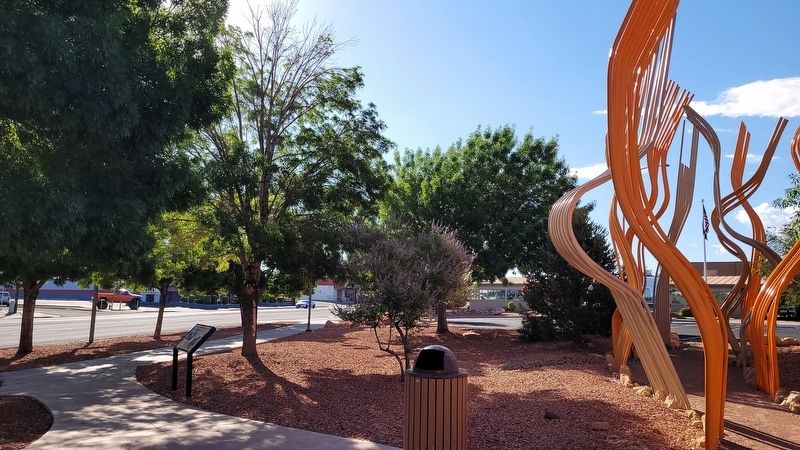
Navajo Generating Station was a 2.25-gigawatt (2,250 MW), coal-fired power plant located on the(Submitted on July 9, 2024, by James Hulse of Medina, Texas.)Navajo Nation, near Page, Arizona, United States. This plant provided electrical power to customers in Arizona, Nevada, and California. It also provided the power for pumping Colorado River water for the Central Arizona Project, supplying about 1.5 million acre feet (1.85 km3) of water annually to central and southern Arizona. As of 2017 permission to operate as a conventional coal-fired plant was anticipated until 2017–2019, and to December 22, 2044, if extended. However, in 2017, the utility operators of the power station voted to close the facility when the lease expires in 2019. In March 2019, the Navajo Nation ended efforts to buy the plant and continue running it after the lease expires.Photographed by James Hulse, June 22, 20243. The view of the Navajo Generating Station, NGS Marker along the street
Credits. This page was last revised on August 1, 2025. It was originally submitted on July 8, 2024, by James Hulse of Medina, Texas. This page has been viewed 313 times since then and 35 times this year. Photos: 1, 2, 3. submitted on July 9, 2024, by James Hulse of Medina, Texas.
