Seymour in Jackson County, Indiana — The American Midwest (Great Lakes)
Freeman Field Mutiny

Photographed by Duane and Tracy Marsteller, June 16, 2024
1. Freeman Field Mutiny Marker, Side One
Responding to pressure from the Black press and NAACP, the Army ordered the officers' release and replaced their white commander with decorated African American Col. Benjamin O. Davis, Jr. The Tuskegee Airmen's superb combat record and resistance to racism contributed to the 1948 desegregation of the U.S. military and shaped public discourse of the Civil Rights Movement.
Erected 2022 by Indiana Historical Bureau • Seymour Municipal Airport Authority • Freeman Army Airfield Museum • Friends of Tuskegee Airmen, Inc. (Marker Number 36.2022.1.)
Topics and series. This historical marker is listed in these topic lists: African Americans • Civil Rights • Military. In addition, it is included in the Indiana Historical Bureau Markers,
this page online
Location. 38° 55.524′ N, 85° 54.44′ W. Marker is in Seymour, Indiana, in Jackson County. It is on A Avenue 0.1 miles west of 1st Avenue East, on the right when traveling west. Marker is in front of the Freeman Army Airfield Museum. Touch for map. Marker is at or near this postal address: 1035 A Ave, Seymour IN 47274, United States of America. Touch for directions.

Regionally, this marker is in Southern Indiana. It is also in the American Midwest and in the Corn Belt. Globally, it is in North America, the Western Hemisphere, the Western World, and the Anglosphere. Historically, it finds itself in what was once the territory of the Mississippian Culture and also the Northwest Territory.
Other nearby markers. At least 8 other markers are within 3 miles of this marker, measured as the crow flies: B-25 Mitchell (a few steps from this marker); Freeman Field (approx. 1.3 miles away); Indian Treaty Corner (approx. 1.6 miles away); 10 O'Clock Indian Treaty Line (approx. 1.6 miles away); a different marker also named Freeman Field (approx. 1.7 miles

Photographed by Duane and Tracy Marsteller, June 16, 2024
2. Freeman Field Mutiny Marker, Side Two
Also see . . .
1. “Blacks Must Wage Two Wars”: The Freeman Field Uprising & WWII Desegregation. The refusal of more than 100 black officers to comply with “Jim Crow” policies underlined the broader push for civil rights in the World War II era. (Nicole Poletika, Indiana Historical Bureau “Untold Indiana” blog, July 31, 2017) (Submitted on July 10, 2024, by Duane and Tracy Marsteller of Murfreesboro, Tennessee.)
2. The Freeman Field Mutiny. Training in twin engine B-25 “Mitchell” bombers, the 477th [Bombardment Group] never actually saw combat overseas, but fought another battle here in the United States. Formed as an all-Black unit, it became famous not for its combat record, but for its fight against the military version of “separate but equal.” (John Curatola, The National WWII Museum, Feb. 15, 2023) (Submitted on July 10, 2024, by Duane and Tracy Marsteller of Murfreesboro, Tennessee.)
3. History of the Freeman Field mutiny.

Photographed by Duane and Tracy Marsteller, June 16, 2024
3. Freeman Field Mutiny Marker
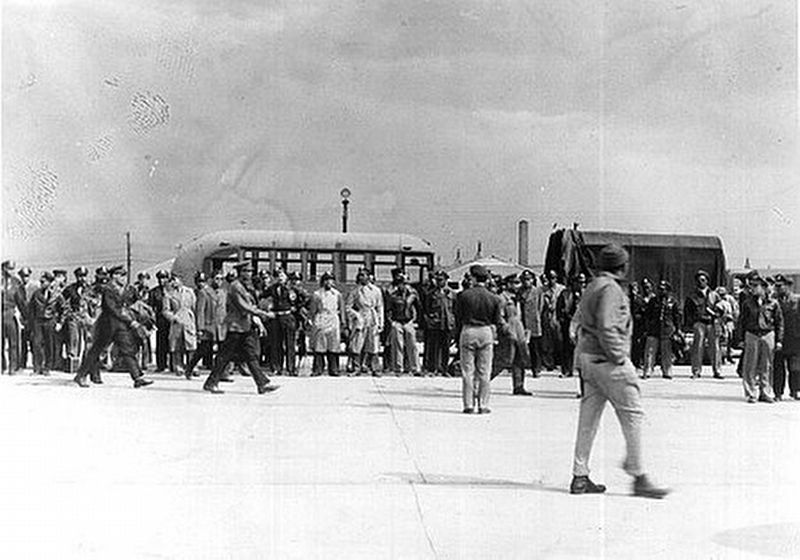
Master Sergeant Harold J. Beaulieu, Sr., via Library of Congress Prints & Photographs Division (Public Domain), April 1945
4. Freeman Field Mutiny
African-American officers at Freeman Field await transport to Godman Field, Kentucky after their arrest.
Credits. This page was last revised on July 10, 2024. It was originally submitted on July 9, 2024, by Duane and Tracy Marsteller of Murfreesboro, Tennessee. This page has been viewed 329 times since then and 51 times this year. Photos: 1, 2, 3. submitted on July 9, 2024, by Duane and Tracy Marsteller of Murfreesboro, Tennessee. 4. submitted on July 10, 2024, by Duane and Tracy Marsteller of Murfreesboro, Tennessee.
