Dublin in Morristown in Morris County, New Jersey — The American Northeast (Mid-Atlantic)
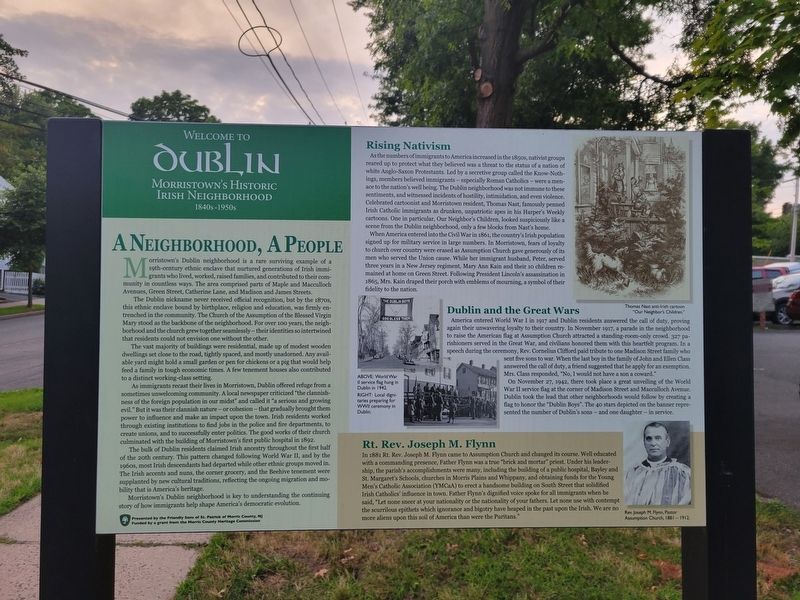
Welcome to Dublin
Morristown's Historic Irish Neighborhood
| — | 1840s-1950s | — |
Photographed by Kevin W., July 9, 2024
1. Welcome to Dublin Marker
A Neighborhood, A People
Morristown's Dublin neighborhood is a rare surviving example of a 19th-century ethnic enclave that nurtured generations of trish immigrants who lived, worked, raised families, and contributed to their community in countless ways. The area comprised parts of Maple and Macculloch Avenues, Green Street, Catherine Lane, and Madison and James Streets.
The Dublin nickname never received official recognition, but by the 1870s, this ethnic enclave bound by birthplace, religion and education was firmly entrenched in the city. The Church of the Assumption of the Blessed Virgin Mary stood as the backbone of the neighborhood. For over 100 years, the neighborhood and the church grew together seamlessly — their identities so intertwined that residents could not envision one without the other.
The vast majority of buildings were residential, made up of modest wooden dwellings set close to the road, tightly spaced, and mostly unadorned. Any available yard might hold a small garden or pen for chickens or a pig that would help feed a family in tough economic times. A few tenement houses also contributed
this page online
As immigrants recast their lives in Morristown, Dublin offered refuge from a sometimes unwelcoming community. A local newspaper criticiand the clannishness of the foreign population in our midst and called it "a serious and growing evil." But it was their clannish nature-or cohesion-that gradually brought them power to influence and make an impact upon the town. Irish residents worked through existing institutions to find jobs in the police and fire departments, to create unions, and to successfully enter politics. The good works of their church culminated with the building of Morristown's first public hospital in 1892.
The bulk of Dublin residents claimed Irish ancestry throughout the first half of the 20th century. This pattern changed following World War II, and by the 1960s, most Irish descendants had departed while other ethnic groups moved in. The Irish accents and nuns, the corser grocery, and the Beehive tenement were supplanted by new cultural traditions, reflecting the ongoing migration and mobility that in America's heritage.
Morristown's Dublin neighborhood is key to understanding
Photographed by Kevin W., July 9, 2024
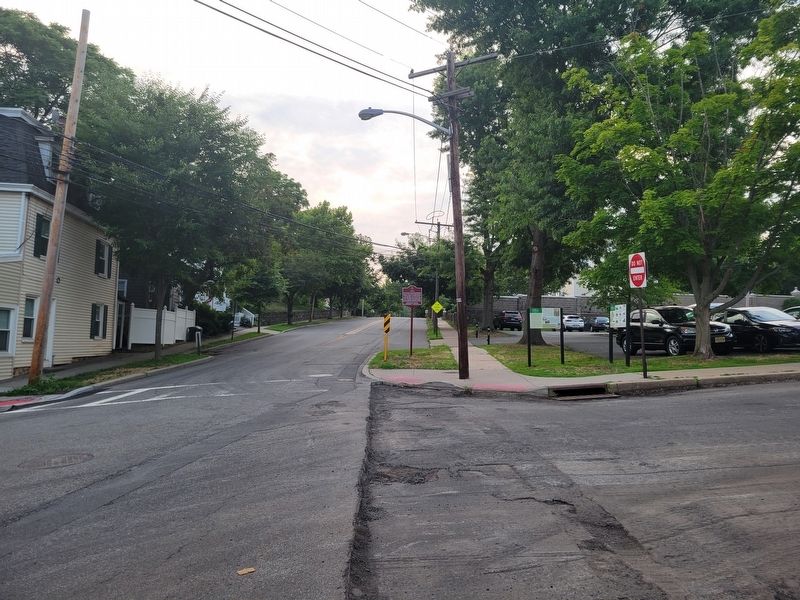
2. Dublin Markers
Rising Nativism
As the number of migrants to America increased in the 1850s, nativist groups reared up to protect what they believed was a threat to the status of a nation of white Anglo-Saxon Protestants. Led by a secretive group called the Know Nothings, members believed immigrants-especially Roman Catholics-were a menace to the nation's well being The Dublin neighborhood was not immune tentiments, and witnessed incidents of hostility, intimidation, and even violence. Celebrated cartoonist and Morristown resident, Thomas Nast, famously Irish Catholic immigrants as drunken, unpatriotic apes in his Harper's Weekly cartoons. One in particular, Our Neighbor's Children, looked suspiciously like a scene from the Dublin neighborhood, only a few blocks from Nast's home.
When America entered into the Civil War in 1861, the country's Irish population signed up for military service in large numbers. In Morristown, fears of loyalty to church over country were erased as Assumption Church gave generously of its men who served the Union cause. While her immigrant husband, Peter, served three years in a New Jersey regiment, Mary Ann Kain and their 10 children remained at home on Green Street. Following President Lincoln's assassination in 1866, Mrs. Kain draped their porch with emblems of mourning, a symbol of their fidelity to the nation.
Dublin and the Great Wars
America entered World War I in 1907 and Dublin residents answered the call of duty, proving again their unwavering loyalty to their country. In November 1917, a parade in the neighborhood to raise the American flag at Assumption Church attracted a standing-room-only crowd. 327 parishioners served in the Great War, and civilians honored them with this beartfelt programs. In a speech during the ceremony, Rev. Cornelius Clifford paid tribute to one Madison Street family who sent five sons to war. When the last boy in the family of John and Ellen Class answered the call of duty, a friend suggested that he apply for an exemption. Mrs. Class responded, "No, I would not have a son a coward."
On November 27, 1942, there took place a great unveiling of the World War Il service flag at the corner of Madison Street and Macculloch Ave. Dublin took the lead that other neighborhoods would follow by creating a flag to honor the "Dublin Boys." The 40 stars depicted on the banner represented the number of Dublin's sons — and one daughter — in service.
Rt. Rev. Joseph M. Flynn
In 1881 Rt. Rev. Joseph M. Flynn came to Assumption Church and changed its course. Well educated with a commanding presence, Father Flynn was a true "brick and mortar" priest. Under his leadership, the parish's accomplishments were many, including the building of a public hospital, Bayley and St. Margaret's Schools, churches in Morris Plains and Whippany, and obtaining funds for the Young Men's Catholic Association (YMCaA) to erect a handsome building on South Street that solidified Irish Catholics influence in town. Father Flynn's dignified voice spoke for all immigrants when be said, "Let one sneer at your nationality or the nationality of your fathers. Let none use with contempt the scurrilous epithets which ignorance and bigotry have heaped in the past upon the Irish. We are no more aliens upon this soil of Americe than were the Puritans."
Erected by Friendly Sons of St. Patrick of Morris County, NJ and the Morris County Heritage Commission.
Topics. This historical marker is listed in these topic lists: Immigration • Religion & Religious Structures • War, World I • War, World II. A significant historical month for this entry is November 1870.
Location. 40° 47.414′ N, 74° 28.723′ W. Marker is in Morristown, New Jersey, in Morris County. It is in Dublin. It is at the intersection of MacCulloch Avenue and Madison Street, on the right when traveling west on MacCulloch Avenue. Touch for map. Marker is at or near this postal address: 70 MacCulloch Ave, Morristown NJ 07960, United States of America. Touch for directions.

Regionally, this marker is in North Jersey and in the New York City Metropolitan Area. It is also in the American Northeast and in the Mid-Atlantic. Globally, it is in North America, the Western Hemisphere, the Western World, and the Anglosphere. Historically, it finds itself in what was once New Netherland and also one of the original Thirteen Colonies.
Other nearby markers. At least 8 other markers are within walking distance of this marker: Dublin (here, next to this marker); a different marker also named Welcome to Dublin (here, next to this marker); Church of the Assumption (about 500 feet away, measured in a direct line); Thomas Nast (approx. 0.2 miles away); MacCulloch Hall (approx. 0.2 miles away); Fires of Freedom (approx. 0.2 miles away); Saint Peter’s Church (approx. ¼ mile away); Morristown World War I Memorial (approx. ¼ mile away). Touch for a list and map of all markers in Morristown.
Another marker is no longer nearby. Macculloch Hall (was approx. 0.2 miles away but has been confirmed missing).
Credits. This page was last revised on March 11, 2026. It was originally submitted on July 10, 2024, by Kevin W. of Stafford, Virginia. This page has been viewed 684 times since then and 126 times this year. Photos: 1, 2. submitted on July 10, 2024, by Kevin W. of Stafford, Virginia.
