Savannah in Chatham County, Georgia — The American South (South Atlantic)
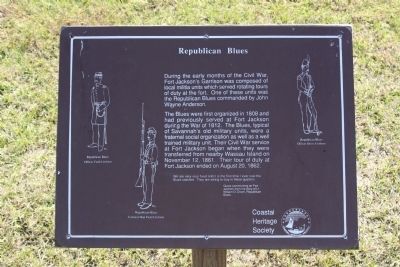
Republican Blues
Photographed by Mike Stroud, November 29, 2009
1. Republican Blues Marker
During the early months of the Civil War, Fort Jackson's Garrison was composed of local militia units which served rotating tours of duty at the fort. One of these units was the Republican Blues commanded by John Wayne Anderson.
The Blues were first organized in 1808 and had previously served at Fort Jackson during the War of 1812. The Blues, typical of Savannah's old military units, were a fraternal social organization as well as a well trained military unit. Their Civil War service at Fort Jackson began when they were transferred from nearby Wassau Island on November 12, 1861. Their tour of duty at Fort Jackson ended on August 20, 1862.
We are very near fixed and it is the first time I ever saw the Blues satisfied. They are willing to stay in these quarters.
Quote commenting on Fort Jackson from the diary of Lt. William D. Dixon, Republican Blues.
Erected by Coastal Heritage Society.
Topics. This historical marker is listed in these topic lists: Forts and Castles • War of 1812 • War, US Civil. A significant historical month for this entry is November 1905.
Location. 32° 4.92′ N, 81° 2.201′ W.
this page online

Regionally, this marker is on the Coastal Plain and on the Georgia Coast and the Golden Isles. It is also in the American South, specifically in the Deep South, and on the Eastern Seaboard. Globally, it is in the North Atlantic Region, North America, the Western Hemisphere, the Western World, and the Anglosphere. Historically, it finds itself in what was once New Spain, the territory of the Mississippian Culture, one of the original Thirteen Colonies, one of the Confederate States of America, and the Antebellum South.
Other nearby markers. At least 8 other markers are within 2 miles of this marker, measured as the crow flies: Garrison of Fort Jackson (a few steps from this marker); Fort James Jackson (within shouting distance of this marker); Construction of Fort Jackson (within
Photographed by Coastal Heritage Society, November 29, 2009
2. Republican Blues Marker
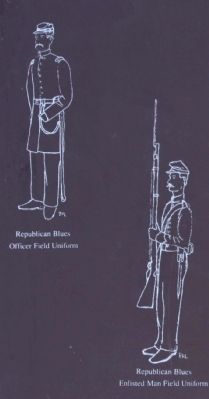
Republican Blues Officer Field Uniform (top)
Republican Blues Enlisted Man Field Uniform (lower)
Regarding Republican Blues. 1st Volunteer Regiment of Georgia
Mercer's-Olmstead's Georgia Infantry
Confederate States of America CSA
A Regimental History
Company C: Republican Blues or Independent Republican Blues, Chatham County, (John W. Anderson, George W. Anderson, Jr.)
This company was originally the Davis (William H. Davis) 2nd Republican Blues, Independent Company, Georgia Volunteer Infantry. The term of service for this company appears to have been 60 days. The company disbanded on 20 August 1861. Many of its members reenlisted here in this Olmstead’s 1st Regiment Georgia Volunteer First volunteer regiment of Georgia, which was organized prior to the war, composed of the militia
Photographed by Coastal Heritage Society, November 29, 2009
3. Republican Blues Marker
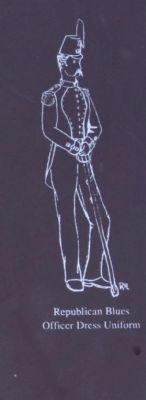
Republican Blues Officer Dress Uniform
Photographed by Mike Stroud, November 29, 2009
4. Republican Blues
HD. Qtrs. Batteries Below
Fort Jackson
March 24/62
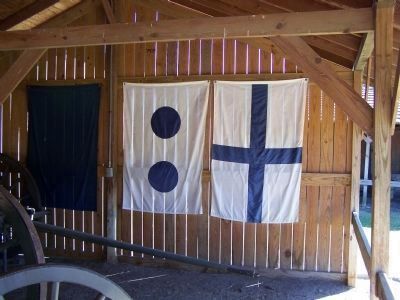
Special Orders No. 11 Day Signals
"...Enemy landing in force on the Georgia Shore will be indicated by the hoisting of a White Flag with Blue Cross
Enemy landing in force on the Carolina Shore will be indicated by a White Flag with two blue balls.
Enemy landing in force on Elba Island will be indicated by hoisting of a blue flag.
The Day Signal will be answered by lowering the flag
at the post and the Fort."
By order of Edward C. Anderson
Maj. Com d's
Special Orders No. 11 Day Signals
"...Enemy landing in force on the Georgia Shore will be indicated by the hoisting of a White Flag with Blue Cross
Enemy landing in force on the Carolina Shore will be indicated by a White Flag with two blue balls.
Enemy landing in force on Elba Island will be indicated by hoisting of a blue flag.
The Day Signal will be answered by lowering the flag
at the post and the Fort."
By order of Edward C. Anderson
Maj. Com d's
Photographed by Mike Stroud, November 29, 2009
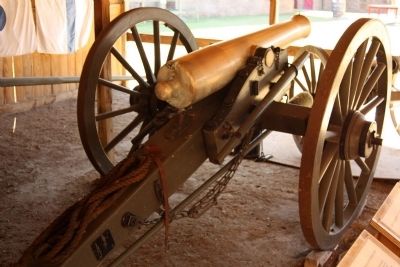
5. The Napoleon 12-Pounder Field Gun Model 1857
Photographed by Mike Stroud, November 29, 2009
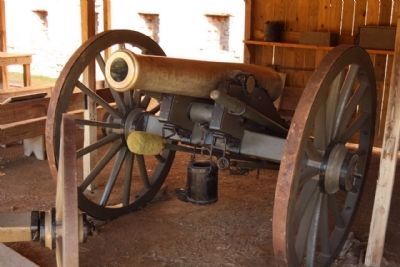
6. Twelve-pound Napoleon smoothbore cannon
This type of cannon was the mainstay of artillery for both the Union and Confederate armies during the American Civil War.
Photographed by Mike Stroud, November 29, 2009
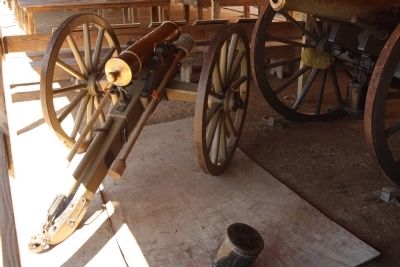
7. 12 pound Mountain Howitzer
Mostly used for defense against ground attacks
Photographed by Mike Stroud, November 29, 2009
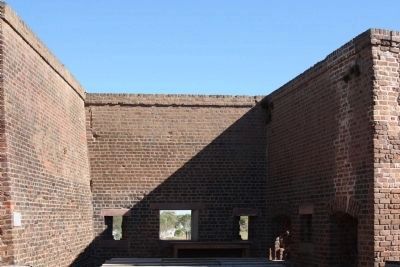
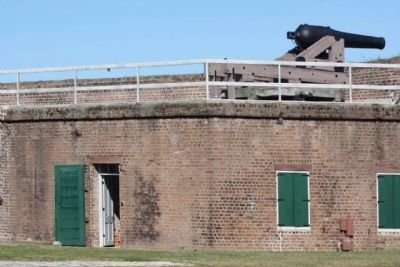
8. Demi-bastion
This is one of four "demi-bastions" in Fort Jackson. They were designed to protect the Fort's walls by firing into the flanks or sides of attacking troops. This demi-bastion had a 32-pounder cannon on a casemate carriage. It sat upon a wooden platform.
Cannons were never mounted in the remaining three demi-bastions.When the war broke out in 1861, a 12 pound Mountain Howitzer (picture 7, above) was placed at Fort Jackson for use in the demi-bastions.
Photographed by Mike Stroud, November 29, 2009
9. Coastal Cannon and Magazine

Photographed by Mike Stroud, November 29, 2009
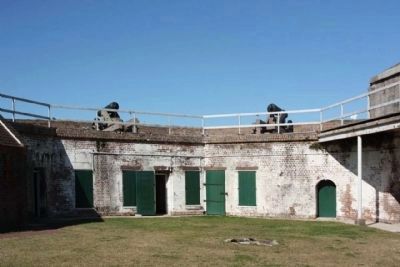
10. Heavy Artillery
Heavy artillery played a key role in the defense
of Savannah during the Civil War. In less than
a four mile stretch, the Confederacy had over
50 heavy artillery cannons guarding the
Savannah River. The Union was never able to
capture Savannah by water. The combination
of heavy artillery, the "Mosquito Fleet" (a
nickname for the Confederate Naval Squadron),
ironclads, river mines and other obstacles all
kept Savannah safe.
Two attempts were made to test the river defensive positions protecting the city in the fall of 1862; both ended with the retreat of the Union Navy. According to a newspaper article which chronicled the details of the second attack, the engagement lasted more than an hour and more than 100 rounds were exchanged. The engagement frightened many of the civilians in Savannah.
Two attempts were made to test the river defensive positions protecting the city in the fall of 1862; both ended with the retreat of the Union Navy. According to a newspaper article which chronicled the details of the second attack, the engagement lasted more than an hour and more than 100 rounds were exchanged. The engagement frightened many of the civilians in Savannah.
Photographed by Mike Stroud, November 29, 2009
11. Powder Magazine
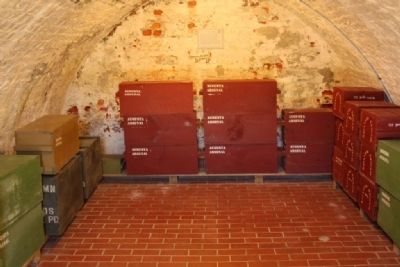
1812 Powder Magazine
This is one of two identical powder magazines
built during the initial phase, 1800-1812.
Confederate forces used these two rooms for
prepared ammunation storage. To protect the
magazines and their contents, Confederate
engineers erected an armor barrier of railroad
iron to shield each of the doorways. The second
magazine is hidden by the 1960,s stairway that
leads to the parapet.
Photographed by Mike Stroud, November 29, 2009
12. Powder Magazine
Photographed by Mike Stroud, November 29, 2009
13. Powder Magazine
Photographed by Mike Stroud, November 29, 2009
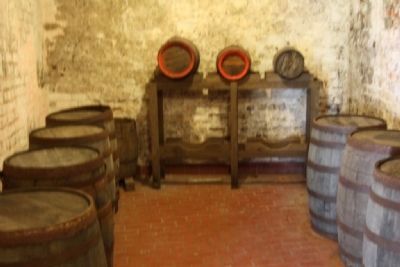
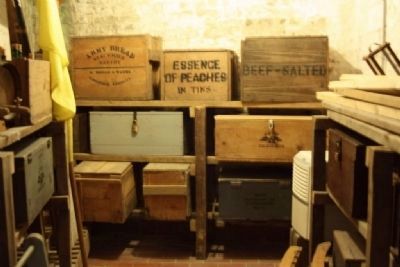
14. Rations storage in the Magazine as well
Photographed by Mike Stroud
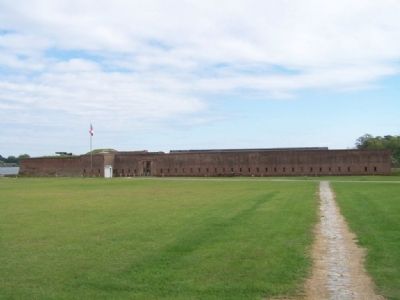
15. Fort Jackson
Photographed by Mike Stroud, November 29, 2009
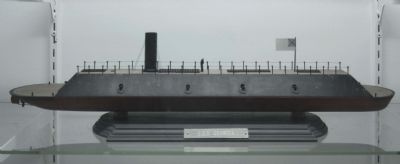
16. CSS Georgia model
Lies just off shore from Fort Jackson, this Ironclad was a part of the "Mosquito Fleet", scuttled to prevent capture. Attempts to reclaim her are ongoing
Photographed by Mike Stroud, November 29, 2009
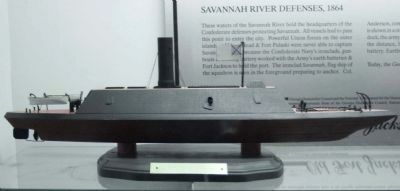
17. CSS Savannah model of the "Mosquito Fleet"
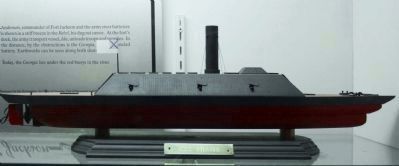
Photographed by Mike Stroud, November 29, 2009
18. CSS Atlanta model of the "Mosquito Fleet"
Photographed by Mike Stroud, November 29, 2009
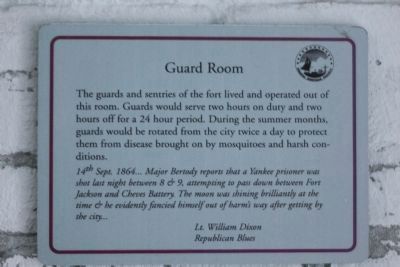
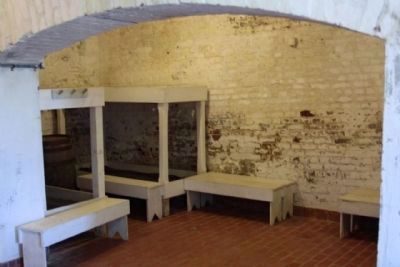
19. Republican Blues Guard Room
The guard and sentries of the fort lived and
operated out of this room. Guards serve two
hours on duty and two hours off for a 24 hour
period. During the summer months, guards
would be rotated from the city twice a day to
protect them from disease brought on by
mosquitoes and harsh conditions.
14th Sept. 1864... Major Bertody reports that a Yankee prisoner was shot last night between 8 & 9, attempting to pass down between Fort Jackson and Cheves Battery. The moon was shining brilliantly at the time & he evidently fancied himself out of harm's way after getting by the city...
Lt. William Dixon
Republican Blues
14th Sept. 1864... Major Bertody reports that a Yankee prisoner was shot last night between 8 & 9, attempting to pass down between Fort Jackson and Cheves Battery. The moon was shining brilliantly at the time & he evidently fancied himself out of harm's way after getting by the city...
Lt. William Dixon
Republican Blues
Photographed by Mike Stroud, November 29, 2009
20. Republican Blues Guard Room

Photographed by Mike Stroud, November 29, 2009
21. Republican Blues Guard Room
Photographed by Davis Freeman III, March 2, 2024
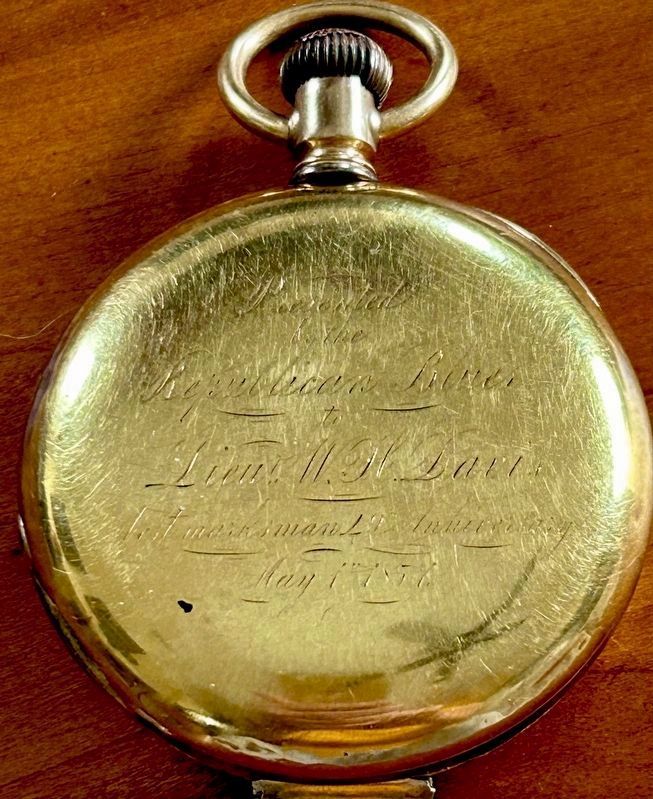
22. Republican Blues Marker
Presentation watch to W. H. Davis by the Republican Blues.
Credits. This page was last revised on March 4, 2024. It was originally submitted on December 4, 2009, by Mike Stroud of Bluffton, South Carolina. This page has been viewed 4,414 times since then and 80 times this year. Photos: 1, 2, 3, 4, 5, 6, 7. submitted on December 4, 2009, by Mike Stroud of Bluffton, South Carolina. 8. submitted on December 6, 2009, by Mike Stroud of Bluffton, South Carolina. 9, 10, 11, 12, 13. submitted on December 4, 2009, by Mike Stroud of Bluffton, South Carolina. 14. submitted on December 6, 2009, by Mike Stroud of Bluffton, South Carolina. 15. submitted on December 4, 2009, by Mike Stroud of Bluffton, South Carolina. 16. submitted on December 5, 2009, by Mike Stroud of Bluffton, South Carolina. 17, 18, 19, 20, 21. submitted on December 6, 2009, by Mike Stroud of Bluffton, South Carolina. 22. submitted on March 4, 2024, by Davis Freeman III of Knoxville, Tennessee. • Craig Swain was the editor who published this page.
