Bury St Edmunds in Suffolk, England, United Kingdom — Northwestern Europe (the British Isles)
The Magna Carta
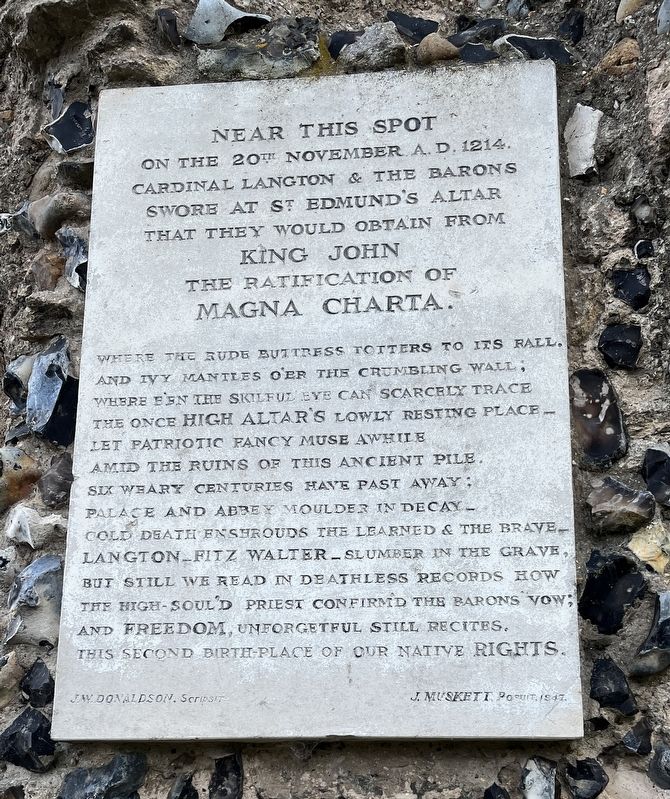
Photographed by Ray Gurganus, March 27, 2024
1. The Magna Carta Marker
on the 20th November A.D. 1214,
Cardinal Langton & the barons
swore at St Edmund's altar
that they would obtain from
King John
the ratification of
Magna Charta.
Where the rude buttress totters to its fall,
And ivy mantles o'er the crumbling wall,
where e'en the skilful eye can scarcely trace
the once high altar's lowly resting place,
Let patriotic fancy muse awhile
amid the ruins of this ancient pile.
Six weary centuries have past away:
palace and abbey moulder in decay,
cold death enshrouds the learned & the brave
Langton, Fitz Walter slumber in the grave
but still we read in deathless records how
the high-soul'd priest confirm'd the barons vow;
and freedom, unforgetful still recites.
This second birth place of our native rights.
J.W. Donaldson, Scripsit
J. Muskett, Posuit, 1847
Erected 1849.
Topics. This historical marker is listed in this topic list: Notable Events. A significant historical date for this entry is November 20, 1214.
Location. 52° 14.634′ N, 0° 43.195′ E. Marker is in Bury St Edmunds, England, in Suffolk. It can be reached from Abbeygate Street. Touch for map. Marker is
this page online

Regionally, this marker is in East Anglia. Globally, it is on the Atlantic Ocean, in the North Atlantic Region, in Europe, in Atlantic Europe, on one of the British Isles, in the Western World, and in the Anglosphere. Historically, it finds itself in what was once the Roman Empire.
Other nearby markers. At least 8 other markers are within walking distance of this marker: The Eastern End (here, next to this marker); Cnut's Church and its Successor (within shouting distance of this marker); The Heart of the Church (within shouting distance of this marker); The Chapter House (within shouting distance of this marker); St Edmunds Abbey (about 90 meters away, measured in a direct line); The Cloister (about 120 meters away); The Abbot's Palace (about 120 meters away); Captain Bartholomew Gosnold (about 150 meters away). Touch for a list and map of all markers in Bury St Edmunds.
Also see . . . Bury St Edmunds Role in the Magna Carta (Bury St. Edmunds and Beyond).
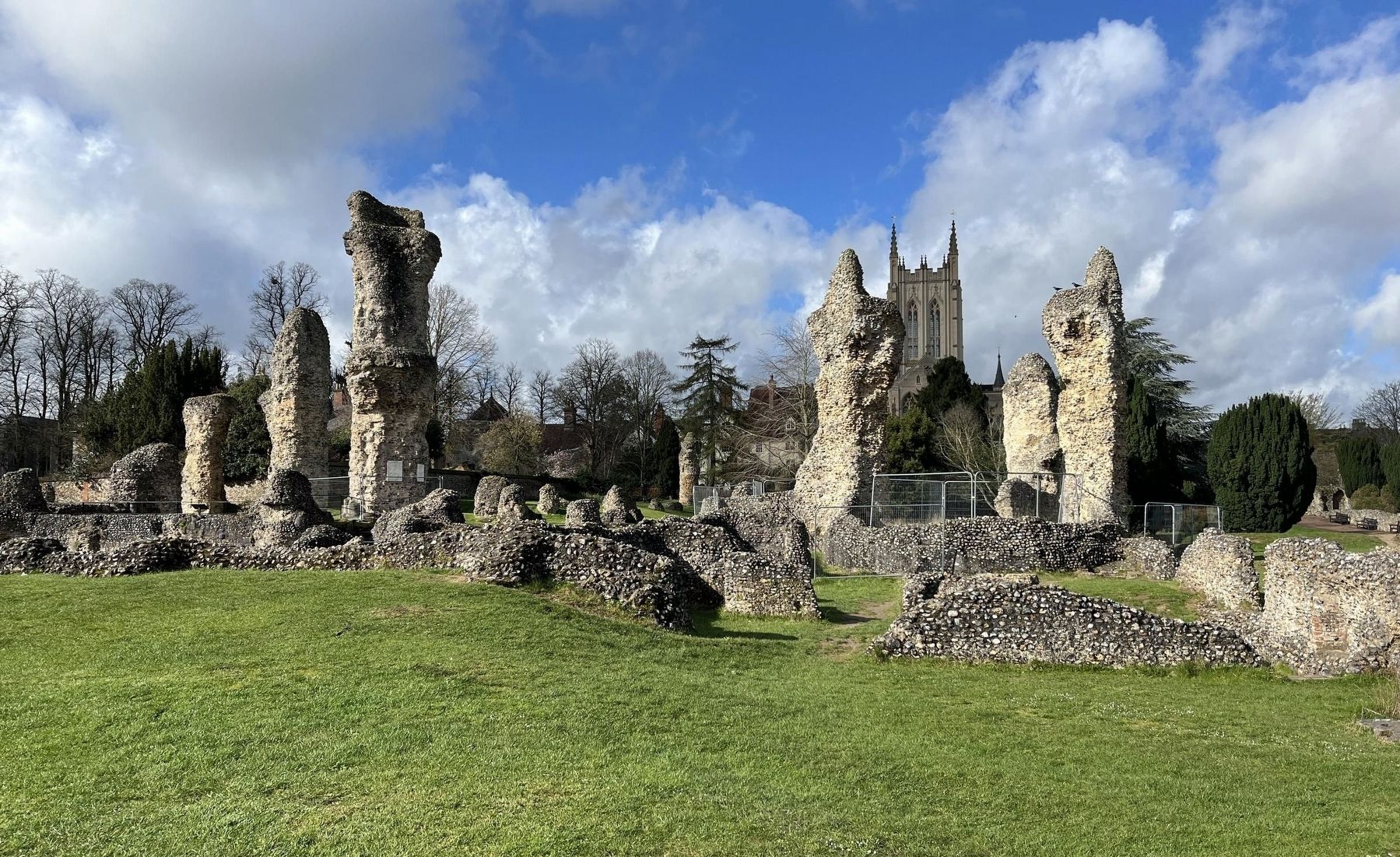
Excerpt: The Magna Carta is widely recognised as(Submitted on July 15, 2024.)one of the most important documents in the world and Bury St Edmunds played a very crucial role in its creation.Photographed by Ray Gurganus, March 27, 20242. The Magna Carta Marker in the distance on one of the remaining pillars
A group of Barons met in Abbey of St Edmund in 1214 and swore an oath to compel King John to accept the Charter of Liberties, a proclamation of Henry I. The most likely date for this meeting is November 20, 1214 because that was St Edmund’s Day.
This act led directly to the Great Charter or the Magna Carta, agreed at Runnymede on June 15 1215, which years later influenced the formation of the United States Constitution.
The people of Bury St Edmunds have celebrated this link for hundreds of years with the town’s motto ‘Shrine of the King, Cradle of the Law’, which refers to our historic links with King Edmund (later St Edmund and the first patron saint of England) and the Barons’ meeting which led to the creation of the Magna Carta.
In the Abbey Gardens visitors can see two commemorative plaques erected in 1849 on the ruined piers of the crossing of the Abbey Church.
Credits. This page was last revised on July 15, 2024. It was originally submitted on July 12, 2024, by Ray Gurganus of Washington, District of Columbia. This page has been viewed 173 times since then and 20 times this year. Photos: 1, 2. submitted on July 12, 2024, by Ray Gurganus of Washington, District of Columbia. • Andrew Ruppenstein was the editor who published this page.
