
Auchonvillers in Somme, Upper France, France — Western Europe
Hawthorn Ridge Cemetery No 2

Photographed by J. Makali Bruton, June 10, 2024
1. Hawthorn Ridge Cemetery No 2 Marker

This area was attacked on the first day of the First Battle of the Somme but not finally taken until November 1916, after fierce fighting. This cemetery contains the graves of 190 British and 24 Newfoundland soldiers, most of whom fell on 1 July 1916, Hunters Cemetery, which is nearby, contains the graves of 46 British soldiers who fell in the capture of Beaumont-Hamel in November 1916.
The War on the Western Front, 1914-1918
In the First World War the Western Front - a battle line extending from the Channel coast to Switzerland along which, for four years, millions of men fought and died was the principal and vital theatre. Against the German Army were arrayed the armies of the British Commonwealth, France, Belgium and, latterly, the United States. The first two months, a war of movement, saw the containment and partial repulse of the initial German thrust. There then followed three and a half years of static trench fighting-war of attrition - during which defensive power was paramount. Neither side could effect a breakthrough and great battles were fought for small territorial gains. The last seven months were again a war movement culminating in the Allied offensive, starting in August, which finally achieved the breakthrough leading to the armistice of 11 November 1918.
The six divisions of the British Expeditionary Force which went to France at the outset in 1914 were deployed amongst the French armies and played their full part from 23 August in the Battles of Mons, Le Cateau, the Marne, and the Aisne. The next three weeks, during which the battle line moved every day, were a highly critical period in which the German plan for ending the war at a stroke was foiled and the issue deferred.
In the first two weeks of October the BEF was moved from the central sector of the front to Flanders. This move shortened its lines of communication, which ran through Dunkirk, Calais and Boulogne, and enabled it to protect these ports which were vital both to its own supply and reinforcement and to the Royal Navy's command of the Channel. Over the next four years, during which its strength rose to fifty British and twelve overseas Commonwealth divisions - Canadian, Australian, New Zealand, South African, Indian and troops from Newfoundland, the British West Indies and other territories - the BEF progressively took over more of the northern sector of the Allied line and fought a series of battles of attrition of which the greatest was the First Battle of the Somme in 1916.
After the German offensives of late March to mid-July 1918 had been contained the advance to victory began on 8 August with the Battle of Amiens, continued on a broadening front with the Second Battles of the Somme and of Arras and, in September, extended to the Ypres Salient. The advance swiftly gathered momentum and by the day of the armistice the front line ran fifty miles or more eastward of the starting points.
Nearly 750,000 Commonwealth soldiers, sailors and airmen died on the Western Front-200,000 in Belgium and over 500,000 in France. They are commemorated upon headstones marking graves in over 1,000 war cemeteries and 2,000 civil cemeteries, or on one of the six memorials in Belgium and twenty in France which carry the names of more than 300,000 who have no known grave.
Cimetiere No 2 de "Hawthorn Ridge"
Ce secteur fut attaqué le premier jour de la Première Bataille de la Somme mais ne fut finalement pris qu'en novembre 1916, après des combats acharnés. Ce cimetière renferme les tombes de 190 soldats britanniques et 24 terre-neuviens tombés pour la plupart le 1er Juillet 1916. Le cimetière de "Hunters", qui est tout proche, renferme les tombes de 46 soldats britanniques tombés dans la prise de Beaumont-Hamel en novembre 1916.
La Guerre sur le Front Occidental 1914-1918
Pendant la Première Guerre Mondiale le Front Occidental - un front continu s'étendant de la côte de la Manche à la Suisse sur lequel, pendant quatre ans, des millions d'hommes ont combattu et sont morts- fut un théâtre d'opérations de toute première importance. Contre l'Armée Allemande étaient déployées les armées du Commonwealth Britannique, de la France, de la Belgique et, plus tard, des Etats-Unis. Pendant les deux premiers mois une guerre de manoeuvre permit de contenir et de refouler la poussée initiale allemande. Puis s'ensuivirent trois années et demie de combats statiques de tranchée - une guerre d'attrition au cours desquelles la capacité défensive était de la plus grande importance. Aucun des adversaires ne pouvait effectuer une sortie et de grandes batailles furent livrées pour des gains territoriaux infimes. Les sept derniers mois furent une guerre de manoeuvre culminant en une offensive alliée qui, ayant débuté en août, parvint finalement à accomplir une percée menant à l'armistice du 11 novembre 1918.
Au début de 1914 les six divisions du Corps Expéditionnaire Britannique en France furent déployées aux côtés des armées françaises et jouèrent leur plein rôle à partir du 23 août dans les Batailles de Mons, Le Cateau, la Marne et l'Aisne. Les trois semaines suivantes, pendant lesquelles le front du combat bougeait chaque jour, furent une période hautement critique au cours de laquelle le plan allemand pour mettre un terme rapide aux combats fut un échec et l'issue de la guerre remise à plus tard.
Pendant les deux premières semaines d'octobre le C.E.B. fut déplacé du secteur central du front dans les Flandres. Ce changement réduisit ses lignes de communication, qui passaient par Dunkerque, Calais et Boulogne, et lui permit de protéger ces ports qui étaient d'une importance vitale à la fois pour son propre ravitaillement et renforcement et pour le contrôle de la Manche par la Marine Royale. Pendant les quatre années suivantes les forces du C.E.B. s'accrurent à cinquante divisions britanniques et douze du Commonwealth d'outremer - des troupes du Canada, de l'Australie, de la Nouvelle-Zélande, de l'Afrique du Sud, de l'Inde et des autres territoires. Le C.E.B, reprit progressivement une plus grande partie du secteur nord du front allié et livra une série de batailles d'attrition dont la plus grande fut la Première Bataille de la Somme en 1916.
Les offensives allemandes de la fin mars à la mi-juillet 1918 furent contenues et la contre-offensive menant à la victoire commença le 8 août avec la Bataille d'Amiens, se poursuivit sur un front élargi avec les Deuxièmes Batailles de la Somme et d'Arras et, en septembre, s'étendit au Saillant d'Ypres. L'avance prit rapidement de l'ampleur et le jour de l'armistice la ligne du front atteignait quatre-vingt kilomètres ou plus à l'est des points de départ.
Presque 750.000 soldats, marins et aviateurs du Commonwealth perdirent la vie sur le Front Occidental-200.000 en Belgique et plus de 500.000 en France. Leur mémoire est commémorée par des stèles marquant leur tombes dans 1.000 cimetières militaires et 2.000 cimetières civils, ou par un des six monuments en Belgique et vingt en France qui portent les noms de plus de 300.000 d'entre eux qui n'ont pas de tombe connue.
Erected by Commonwealth
this page online
Topics. This memorial is listed in these topic lists: Cemeteries & Burial Sites • War, World I. A significant historical date for this entry is July 1, 1916.
Location. 50° 4.672′ N, 2° 38.89′ E. Memorial is in Auchonvillers, Hauts-de-France (Upper France), in Somme. It can be reached from Route D73 north of Route D50, on the right when traveling north. Touch for map. Memorial is in this post office area: Auchonvillers, Hauts-de-France 80300, France. Touch for directions.

Regionally, it is in the North Atlantic Region, Europe, the European Union, Atlantic Europe, the Schengen Area, Western Europe, a coastal Mediterranean country, and the Western World. Historically, it finds itself in what was once a French colony and also the Roman Empire.
Other nearby markers. At least 8 other markers are within walking distance of this marker: Hawthorn Ridge Cemetery No. 2 (a few steps from this marker); Hunters Cemetery (about 90 meters away, measured in a direct line); 51st Highland Division Memorial (about 180 meters away); ‘Y’ Ravine Cemetery (approx. 0.4 kilometers away); Beaumont-Hamel Newfoundland Memorial (approx.
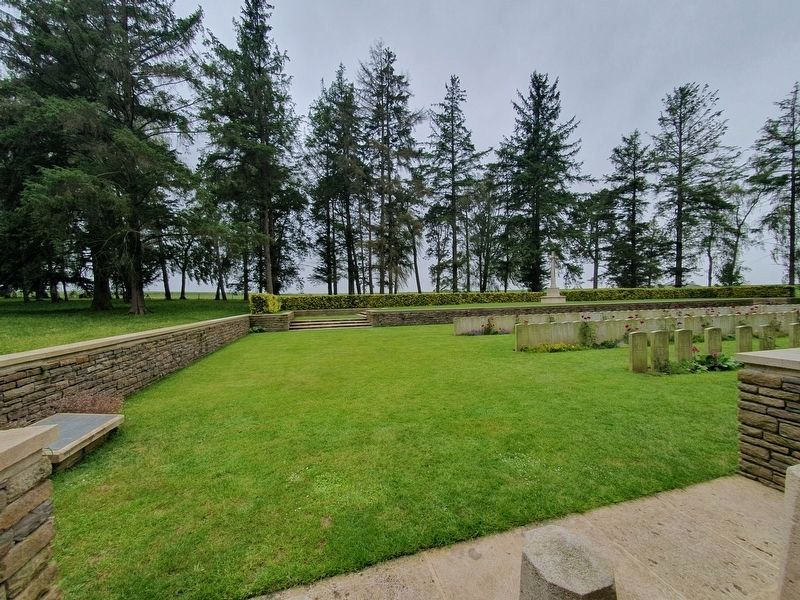
Photographed by J. Makali Bruton, June 10, 2024
2. Hawthorn Ridge Cemetery No 2 and Marker
Also see . . . Hawthorne Ridge Cemetery No. 2 at CWGC. (Submitted on July 12, 2024.)
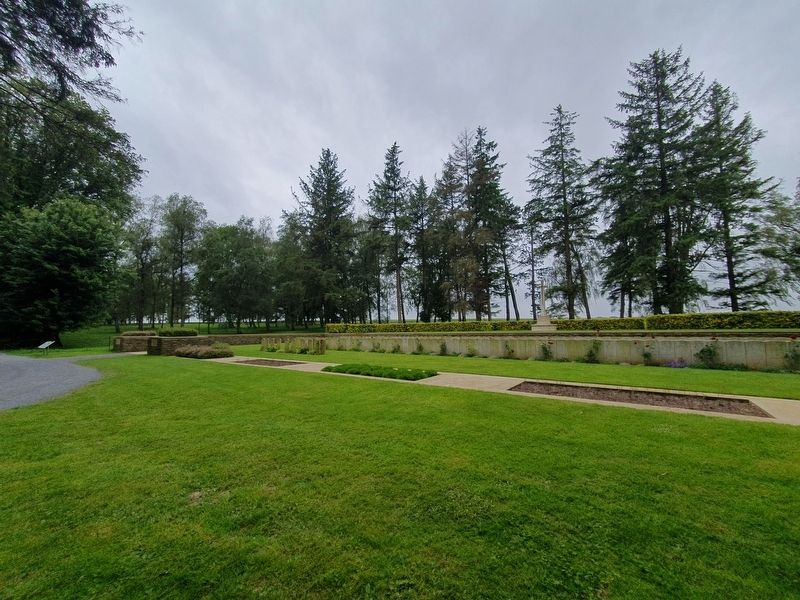
Photographed by J. Makali Bruton, June 10, 2024
3. Hawthorn Ridge Cemetery No 2
Credits. This page was last revised on July 12, 2024. It was originally submitted on July 12, 2024, by J. Makali Bruton of Washington, District of Columbia. This page has been viewed 112 times since then and 7 times this year. Photos: 1, 2, 3. submitted on July 12, 2024, by J. Makali Bruton of Washington, District of Columbia.
