Auchonvillers in Somme, Upper France, France — Western Europe
Hawthorn Ridge Cemetery No. 2

Photographed by J. Makali Bruton, June 10, 2024
1. Hawthorn Ridge Cemetery No. 2 Marker

In July 1916, this ground was in no-man's land close to the German front-line. It was unsuccessfully assaulted on the first day of the Battle of the Somme by the 29th Division. The area was strongly fortified, and German troops used the terrain for protection, especially the deep depression known as 'Y Ravine".
In the spring of 1917, the German Army withdrew to a new defensive line to the east, the Siegfriedstellung, called the Hindenburg line by the Allies. As British and French forces advanced, the Somme battlefields were searched and cleared. Originally named 'V Corps Cemetery No. 12’, this cemetery was begun at that time for the burial of remains discovered nearby.
This is now the final resting place of over 210 servicemen, of whom some 65 remain unidentified. The cemetery was designed by George Hartley Goldsmith, who served with the Royal Engineers during the war.
The Somme Offensive: Hawthorn Ridge
On the warm summer morning of I July 1916, this area was heavily bombarded by British artillery in preparation for the attack by 29th Division. Just north of here
this page online
At 7.20 am, the deafening thunder of the artillery was drowned out by a terrific roar as much of the Hawthorn Redoubt was obliterated. Hundreds of German soldiers of 119th Reserve Regiment were killed, the blast leaving a crater over 40 metres wide and 15 metres deep. Fresh white chalk thrown by the explosion lay like snow over the ridge as the surviving German defenders rushed from deep dugouts to take up their positions. Elements of the 2nd Battalion of the Royal Fusiliers were tasked with capturing the crater and supporting their comrades of 29th Division as they attacked on either side, but attempts to secure the crater before zero hour were defeated by Germans who had already managed to dig in around the edge.
At 7.30 am, the main assault of the 2nd Royal Fusiliers began. Attacking troops were met by devastating machine-gun and rifle fire, and German shells falling

Photographed by J. Makali Bruton, June 10, 2024
2. Hawthorn Ridge Cemetery No. 2 Marker - French text
Over half of the 2nd Royal Fusiliers, some 550 men, were wounded or killed in the first few hours of the attack. The bodies of some 70 men of the battalion were discovered close to this location in 1917. They were buried here and in Hawthorn Ridge Cemetery No.1, some 500 metres north, along with other men of 29th Division who died in the attack, including several members of the Newfoundland Regiment. Many of their comrades have no known grave, and their names are inscribed on the Thiepval Memorial.
Captions
The mine under German front-line positions at Hawthorn Redoubt is fired, 7.20 am, 1 July 1916
La mine sous les positions de la ligne de front allemande de la redoute Howthorn est mis à feu, 7h20, Illet 1916
Commonwealth War Graves Commission
The Commission is responsible for the commemoration of almost 1,700,000 members of the Commonwealth forces who gave their lives in the two world wars. The graves and memorials of these men and women, who came from all parts of the Commonwealth and who were of many faiths and of none, are found around the globe in some
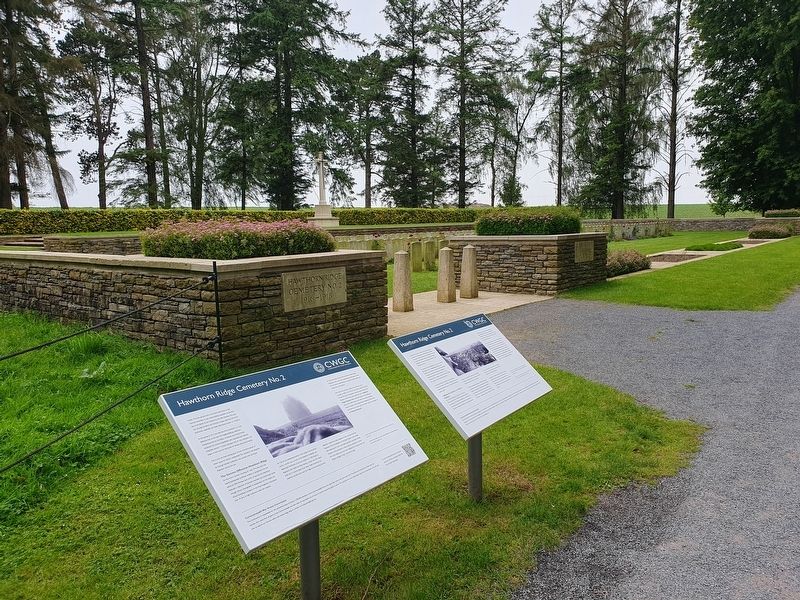
Photographed by J. Makali Bruton, June 10, 2024
3. Hawthorn Ridge Cemetery No. 2 and Marker
For more information about this location and some of those commemorated here, scan the QR code (right).
Hawthorn Ridge Cemetery No. 2
En juillet 1916, ce terrain se trouvait dans le no-man's land près de la ligne de front allemande. La 29° Division tenta vainement de le prendre d'assaut le premier jour de la bataille de la Somme. Le secteur était fortement fortifié, et les troupes allemandes utilisaient le terrain pour se protéger, en particulier la ravine dénommée 'Y Ravine'.
Au printemps 1917, l'armée allemande se retira sur une nouvelle ligne défensive à l'est, la Siegfriedstellung, dénommée Ligne Hindenburg par les Alliés. A mesure que les forces britanniques et françaises avançaient, elles cherchaient et déblayaient les champs de bataille de la Somme. Dénommé << V Corps Cemetery No.12 » à l'origine, ce cimetière fut établi à l'époque pour y enterrer les corps découverts à proximité.
C'est désormais la dernière demeure de plus de 210 soldats, dont 65 environ restent non identifiés. Le cimetière fut conçu par George Hartley Goldsmith, qui servit dans les Royal Engineers pendant la guerre.
L'offensive de la Somme : la crête de Hawthorn
Lors de la chaude matinée du I juillet 1916, ce secteur fut fortement bombardé par l'artillerie britannique en préparation de l'attaque de la 29 Division. Immédiatement au nord de ce lieu se trouvait la 'Redoute Hawthorn', labyrinthe de tranchées et de postes de mitrailleuses allemands que l'on jugeait quasiment imprenable. En préparation de l'attaque, la 252" Tunnelling Company des Royal Engineers avait posé plus de 18 tonnes d'explosifs à grande puissance sous la redoute.
À 7h20, le grondement assourdissant de l'artillerie fut noyé par un rugissement terrifiant lorsqu'une grande partie de la redoute Hawthorn fut oblitérée. Des centaines de soldats allemands du 119 Régiment de Réserve furen, tués, le souffle laissant un cratère de plus de 40 mètres de large et de 15 mètres de profondeur. La craie blanche et fraiche soulevée par l'explosion recouvrit la crête comme de la neige, alors que les défenseurs allemands survivants se précipitèrent de leurs profonds abris souterrains pour prendre leurs positions.
Des éléments du 2" Bataillon des Royal Fusiliers furent chargés de prendre le cratère et de soutenir leurs camarades de la 29" Division lors de leur attaque de chaque côté, mais les tentatives de prise du cratire avant l'heure H furent repoussées par les Allemands qui avaient déjà réussi à s'établir sur le pourtour.
À 7h30, l'assaut principal des 2 Royal Fusiliers débuta. Les troupes attaquantes firent face à des tirs dévastateurs de mitrailleuses et de fusils, et les obus allemands tombant dans les tranchées remplies d'hommes firent de nombreuses victimes avant qu'ils ne puissent avancer.
Plus de la moitié des hommes du 2º Royal Fusiliers, 550 hommes environ, furent blessés ou tués dans les premières heures de l'attaque. Les corps d'environ 70 hommes du bataillon furent découverts près de ce lieu en 1917. Ils furent enterrés ici et dans le Hawthorn Ridge Cemetery No. 1. à environ 500 mètres au nord, en même temps que d'autres hommes de la 29" Division qui perdirent la vie pendant l'attaque, y compris plusieurs membres du Newfoundland Regiment. Un grand nombre de leurs camarades n'ont pas de tombe connue, leurs noms sont inscrits sur le Mémorial de Thiepval.
Photo prise à 7h45, 15 minutes après l’heure H, on peut voir les figures minuscules des troupes d'assaut de la 29 Division. Le cratere de la crete Hawthorn se trouve au centre de horizon.
Taken at 7.45 am, 15 minutes after zero, tiny figures of 29th Division assault troops can be seen. The crater on Hawthorn Ridge is in the centre of the horizon.
Commonwealth War Graves Commission
La Commonwealth War Graves Commission est chargée de la commémoration de près de 1 700 000 membres des forces armées du Commonwealth qui donnèrent leur vie durant les deux guerres mondiales. On trouve les sépultures et les mémoriaux de ces hommes et femmes, originaires de toutes les parties du Commonwealth et qui appartenaient à de nombreuses religions ou parfois à aucune, dans quelque 150 pays à travers le monde. Pour plus d'informations sur la Commission, le travail que nous faisons et comment consulter nos documents en ligne, visitez le site www.cwgc.org ou contactez-nous au [email protected]
Erected by Commonwealth War Graves Commission.
Topics. This memorial is listed in these topic lists: Cemeteries & Burial Sites • War, World I. A significant historical month for this entry is July 1916.
Location. 50° 4.668′ N, 2° 38.899′ E. Memorial is in Auchonvillers, Hauts-de-France (Upper France), in Somme. It can be reached from Route D73 north of Route D50, on the right when traveling north. The marker and cemetery can be reached by walking from the Beaumont-Hamel Newfoundlanders Memorial. Touch for map. Memorial is in this post office area: Auchonvillers, Hauts-de-France 80300, France. Touch for directions.

Regionally, it is in the North Atlantic Region, Europe, the European Union, Atlantic Europe, the Schengen Area, Western Europe, a coastal Mediterranean country, and the Western World. Historically, it finds itself in what was once a French colony and also the Roman Empire.
Other nearby markers. At least 8 other markers are within walking distance of this marker: Hawthorn Ridge Cemetery No 2 (a few steps from this marker); Hunters Cemetery (about 90 meters away, measured in a direct line); 51st Highland Division Memorial (about 150 meters away); ‘Y’ Ravine Cemetery (approx. 0.3 kilometers away); Beaumont-Hamel Newfoundland Memorial (approx. 0.4 kilometers away); Newfoundland War Memorial Park Beaumont Hamel (approx. 0.6 kilometers away); The Solitary Caribou (approx. 0.6 kilometers away); Beaumont-Hamel, Newfoundlanders and the Great War (approx. 0.6 kilometers away).
Credits. This page was last revised on July 12, 2024. It was originally submitted on July 12, 2024, by J. Makali Bruton of Washington, District of Columbia. This page has been viewed 185 times since then and 31 times this year. Photos: 1, 2, 3. submitted on July 12, 2024, by J. Makali Bruton of Washington, District of Columbia.
