Seymour in Jackson County, Indiana — The American Midwest (Great Lakes)
The Farmers Club
1914
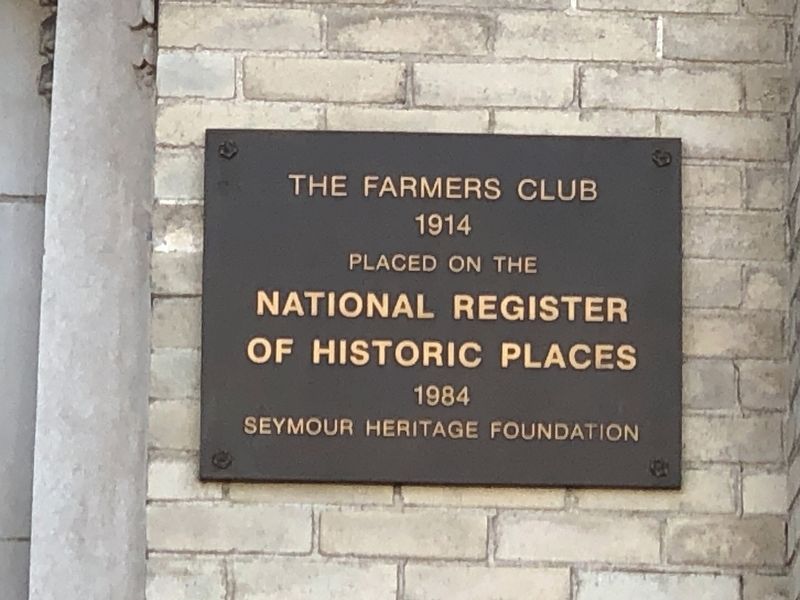
Photographed by Duane and Tracy Marsteller, June 16, 2024
1. The Farmers Club Marker
Erected by Seymour Heritage Foundation.
Topics and series. This historical marker is listed in these topic lists: Agriculture • Architecture. In addition, it is included in the National Register of Historic Places (NRHP) series list. A significant historical year for this entry is 1914.
Location. 38° 57.477′ N, 85° 53.387′ W. Marker is in Seymour, Indiana, in Jackson County. It is at the intersection of South Chestnut Street and St. Louis Avenue, on the right when traveling north on South Chestnut Street. Touch for map. Marker is at or near this postal address: 105 S Chestnut St, Seymour IN 47274, United States of America. Touch for directions.

Regionally, this marker is in Southern Indiana. It is also in the American Midwest and in the Corn Belt. Globally, it is in North America, the Western Hemisphere, the Western World, and the Anglosphere. Historically, it finds itself in what was once the territory of the Mississippian Culture and also the Northwest Territory.
Other nearby markers. At least 8 other markers are within 3 miles of this marker,
this page online
Regarding The Farmers Club. Excerpts from the National Register nomination:
The building was built to be used as a comfort house for the families of farmers who were doing business in town. It was constructed in 1914 and deeded by the Blish family to the farmers of Jackson County in memory of Captain Meedy W. Shields, the founder of Seymour. The Blishes were descendants of Shields and members of a Seymour family which, in 1856, established the first mill in the city. …
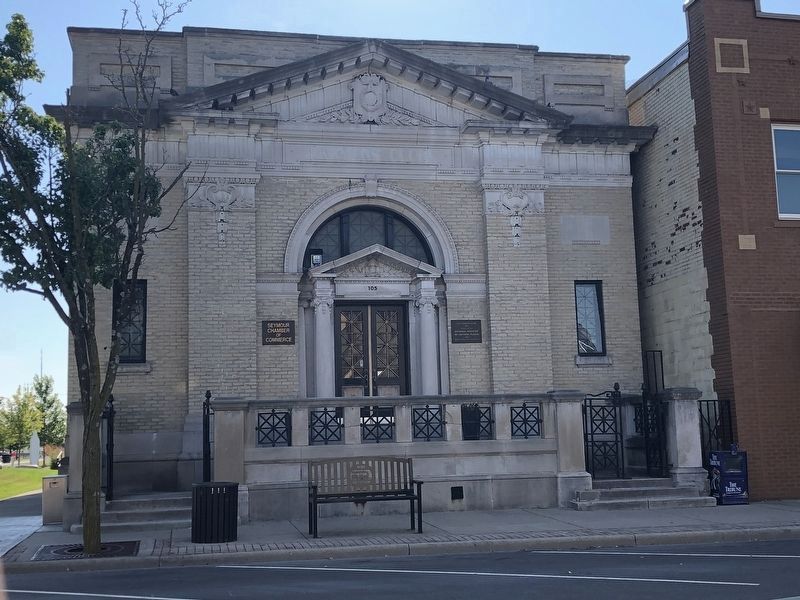
After the advent of the motor car, the need for the Club, as originally stated, was outmoded. It was used by the farm families until World War II, when it housed the U.S.O., after that the Teen Canteen, and presentlythe American Red Cross.Photographed by Duane and Tracy Marsteller, June 16, 20242. The Farmers Club MarkerFeatured marker is on the right. The building is now used by the Jackson County Chamber of Commerce.
Also important for its architecture, the Farmers Club is the only representation in Seymour of the Beaux Arts style.
Also see . . . Farmers Club (PDF). National Register nomination for the building, which was listed in 1983. (Prepared by Edwin J. Boley, Seymour Heritage Foundation; via National Archives) (Submitted on July 13, 2024, by Duane and Tracy Marsteller of Murfreesboro, Tennessee.)
Credits. This page was last revised on July 13, 2024. It was originally submitted on July 13, 2024, by Duane and Tracy Marsteller of Murfreesboro, Tennessee. This page has been viewed 199 times since then and 53 times this year. Photos: 1, 2. submitted on July 13, 2024, by Duane and Tracy Marsteller of Murfreesboro, Tennessee.
