Leavenworth in Leavenworth County, Kansas — The American Midwest (Upper Plains)
Lynching in America ⎯⎯⎯ Lynchings in Leavenworth County
Community Remembrance Project
Photographed by Mark Hilton, July 11, 2024
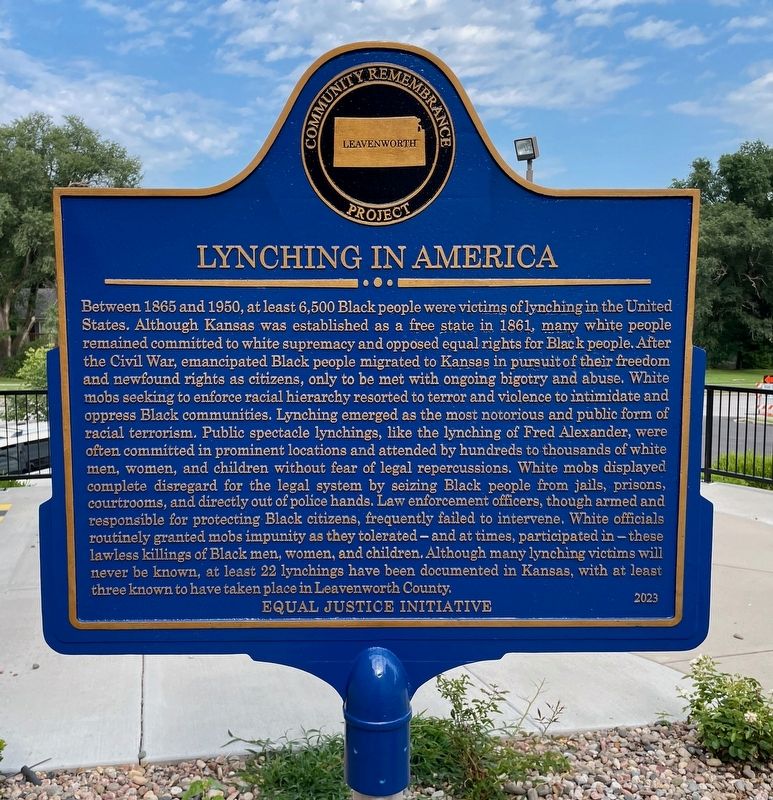
1. Lynching in America Marker
Inscription.
Lynching in America
Between 1865 and 1950, at least 6,500 Black people were victims of lynching in the United
States. Although Kansas was established as a free state in 1861, many white people
remained committed to white supremacy and opposed equal rights for Black people. After
the Civil War, emancipated Black people migrated to Kansas in pursuit of their freedom
and newfound rights as citizens, only to be met with ongoing bigotry and abuse. White
mobs seeking to enforce racial hierarchy resorted to terror and violence to intimidate and
oppress Black communities. Lynching emerged as the most notorious and public form of
racial terrorism. Public spectacle lynchings, like the lynching of Fred Alexander, were
often committed in prominent locations and attended by hundreds to thousands of white
men, women, and children without fear of legal repercussions. White mobs displayed
complete disregard for the legal system by seizing Black people from jails, prisons,
courtrooms, and directly out of police hands. Law enforcement officers, though armed and
responsible for protecting Black citizens, frequently failed to
Click or scan to see this page online
intervene. White officials
routinely granted mobs impunity as they tolerated- and at times, participated in - these
lawless killings of Black men, women, and children. Although many lynching victims will
never be known, at least 22 lynchings have been documented in Kansas, with at least
three known to have taken place in Leavenworth County.
Lynchings in Leavenworth County
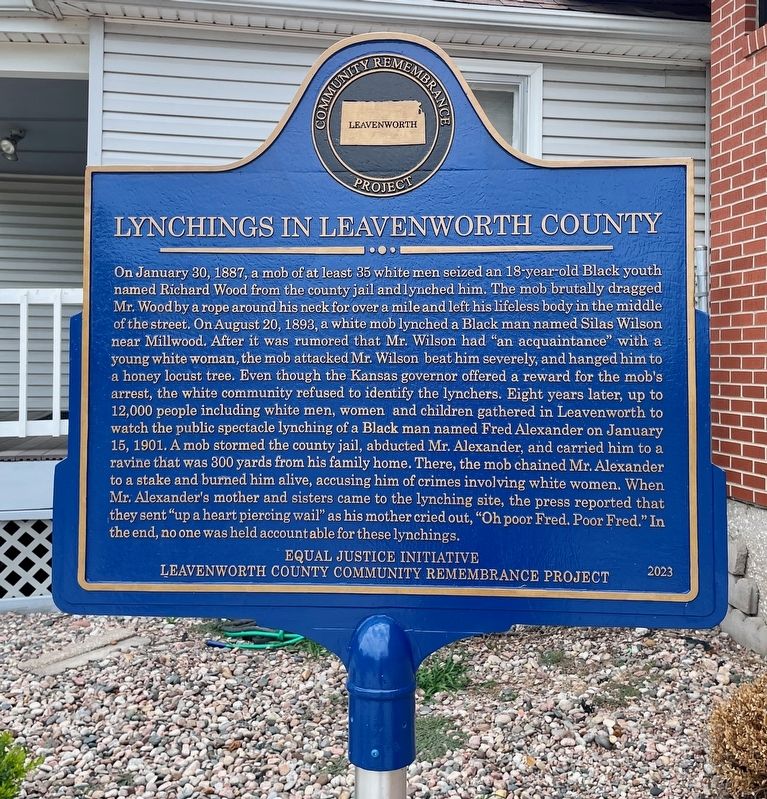
On January 30, 1887, a mob of at least 35 white men seized an 18-year-old Black youth
named Richard Wood from the county jail and lynched him. The mob brutally dragged
Mr. Wood by a rope around his neck for over a mile and left his lifeless body in the middle
of the street. On August 20, 1893, a white mob lynched a Black man named Silas Wilson
near Millwood. After it was rumored that Mr. Wilson had "an acquaintance" with a
young white woman, the mob attacked Mr. Wilson beat him severely, and hanged him to
a honey locust tree. Even though the Kansas governor offered a reward for the mob's
arrest, the white community refused to identify the lynchers. Eight years later, up to
12,000 people including white men, women and children gathered in Leavenworth
Photographed by Mark Hilton, July 11, 2024
2. Lynching in Leavenworth County Marker
to
watch the public spectacle lynching of a Black man named Fred Alexander on January
15, 1901. A mob stormed the county jail, abducted Mr. Alexander, and carried him to a
ravine that was 300 yards from his family home. There, the mob chained Mr. Alexander
to a stake and burned him alive, accusing him of crimes involving white women. When
Mr. Alexander's mother and sisters came to the lynching site, the press reported that
they sent "up a heart piercing wail" as his mother cried out, "Oh poor Fred. Poor Fred." In
the end, no one was held accountable for these lynchings.
Erected 2023 by Equal Justice Initiative, Leavenworth County Community Remembrance Project.
Topics and series. This historical marker is listed in these topic lists: African Americans • Civil Rights. In addition, it is included in the Lynching in America series list. A significant historical date for this entry is January 30, 1887.
Location. 39° 19.519′ N, 94° 54.946′ W. Marker is in Leavenworth, Kansas, in Leavenworth County. It is at the intersection of Kiowa Street and North 4th Street, on the right when traveling west on Kiowa Street. Located at the Richard Allen
Photographed by Mark Hilton, July 11, 2024
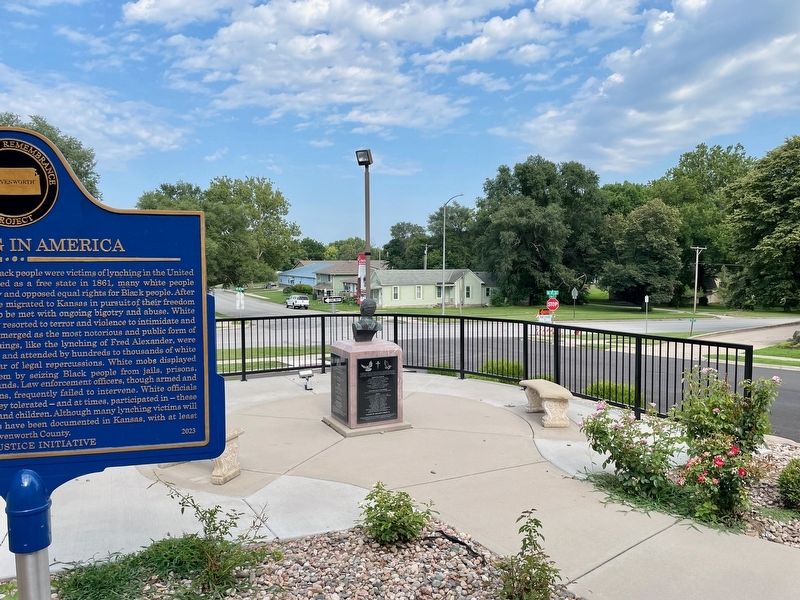
3. Lynching in America / Lynching in Leavenworth County Marker
Cultural Center & Museum. Touch for map. Marker is at or near this postal address: 410 Kiowa St, Leavenworth KS 66048, United States of America. Touch for directions.
Regionally, this marker is in Eastern Kansas and specifically in Greater Kansas City. It is also in the American Midwest, in the Lewis & Clark Corridor, in the Corn Belt, on the prairies, and on the Southern Plains. Globally, it is in North America, the Western Hemisphere, the Western World, and the Anglosphere. Historically, it finds itself in what was once the Louisiana Purchase.
Credits. This page was last revised on October 17, 2024. It was originally submitted on July 13, 2024, by Mark Hilton of Montgomery, Alabama. This page has been viewed 286 times since then and 56 times this year. Last updated on July 14, 2024, by Gianluca De Fazio of Harrisonburg, Virginia. Photos:1, 2, 3. submitted on July 13, 2024, by Mark Hilton of Montgomery, Alabama.