Near Calistoga in Napa County, California — The American West (Pacific Coastal)
Old Faithful Geyser of California

Photographed by Joseph Alvarado, June 1, 2024
1. Old Faithful Geyser of California Marker
Water for the Old Faithful Geyser of California comes from an underground river that is 350°F (177°C) and lives 2 miles below the earth's surface. When it flows over the hot molten magma deep in the earth, it boils, expands and is collected in large cavities. Under tremendous pressure from the heat, the water is forced through the fissures and fractures and erupts with an outpouring of steam followed by a fulmination of hot dancing water. At the time of eruption, temperatures of the water and steam drop to 122- 140°F (50-60°C).
In the early days of the National Geographic Society, Old Faithful Geyser of California was declared one of only three "faithful" geysers in the world because of its regular eruptions. It soon became one of the most visited places in the American West. The rainbows that form in the predictable sprays of mist are a wonderful feature in this serene setting at the top of the Napa Valley. To this day, Old Faithful Geyser of California remains as one of the most photographed places in the State of California.
Legend of the Healing Waters
Centuries ago, the people of the native Wappo Indian
this page online
Inset Image: Old Faithful Geyser of California was featured in the December 1948 issue of the National Geographic magazine article titled "My Life in the Valley of the Moon" by retired Army General H. H. Arnold.
WARNING: KEEP YOUR DISTANCE FROM THE GEYSER. HEAT AND STEAM PRESSURE CAN CAUSE SERIOUS BODILY INJURY. DO NOT THROW ROCKS OR DEBRIS INTO THIS WONDER OF NATURE.
Topics. This historical marker is listed in this topic list: Natural Features.
Location. 38° 35.82′ N, 122° 36.134′ W.

Photographed by Joseph Alvarado, June 1, 2024
2. Old Faithful Geyser and Marker

Regionally, this marker is in California’s Wine Country, in the San Francisco Bay Area, and on the Coast Ranges. It is also on the American Pacific Coast. Globally, it is in North America, on the Ring of Fire, in the Pacific Rim, in the Western Hemisphere, in the Western World, and in the Anglosphere. Historically, it finds itself in what was once New Spain and also Mexico’s Alta California.
Other nearby markers. At least 8 other markers are within 2 miles of this marker, measured as the crow flies: Hot Mineral Therapy Pool (a few steps from this marker); Old Faithful Capped Geyser (within shouting distance of this marker); 1947 Ford Truck: Workhorse of Yesteryear (within shouting distance of this marker); Old Faithful Steam Well (within shouting distance of this marker); Pioneer Cemetery (approx. 1.3
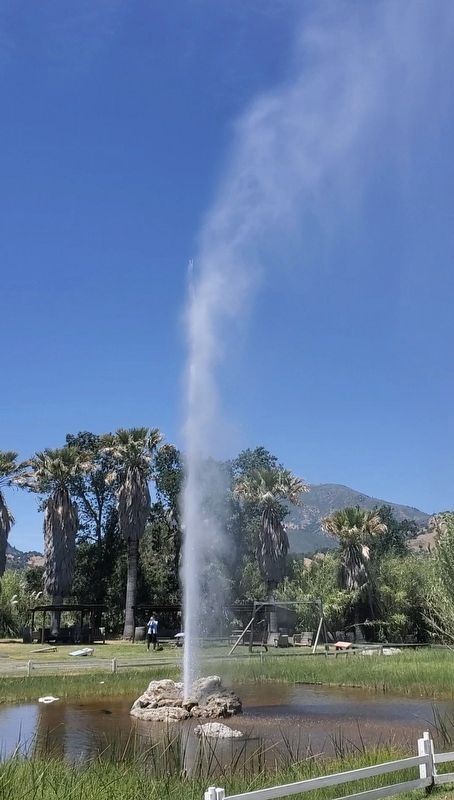
Photographed by Joseph Alvarado, June 1, 2024
3. Old Faithful Geyser of California
Also see . . . Old Faithful Geyser of California: History. (Submitted on July 14, 2024, by Joseph Alvarado of Livermore, California.)
Credits. This page was last revised on July 14, 2024. It was originally submitted on July 14, 2024, by Joseph Alvarado of Livermore, California. This page has been viewed 241 times since then and 39 times this year. Photos: 1, 2, 3. submitted on July 14, 2024, by Joseph Alvarado of Livermore, California.
