Burlington in Kit Carson County, Colorado — The American Mountains (Southwest)
A Farming Revolution
Burlington Colorado
Photographed by Mark Hilton, July 2, 2024
1. A Farming Revolution Marker
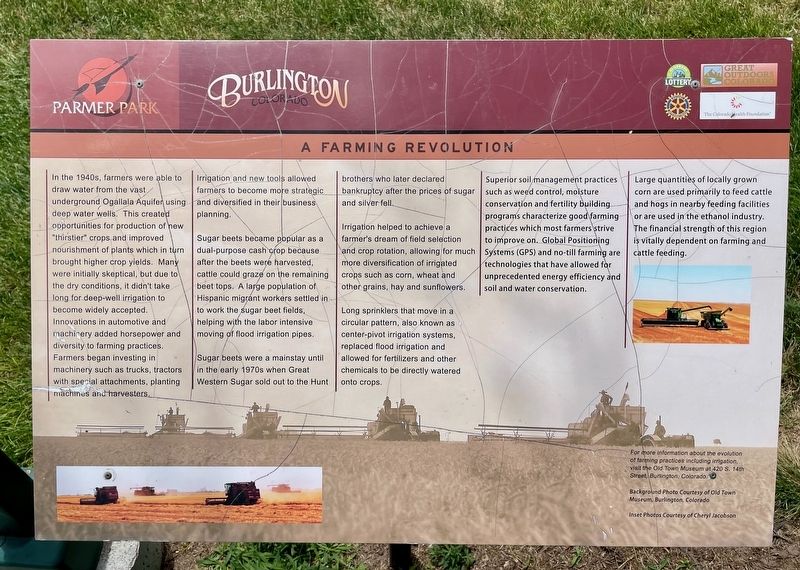
In the 1940s, farmers were able to draw water from the vast underground Ogallala Aquifer using deep water wells. This created opportunities for production of new "thirstier" crops and improved nourishment of plants which in turn brought higher crop yields. Many were initially skeptical, but due to the dry conditions, it didn't take long for deep-well irrigation to become widely accepted. Innovations in automotive and machinery added horsepower and diversity to farming practices. Farmers began investing in machinery such as trucks, tractors with special attachments, planting machines and harvesters.
Irrigation and new tools allowed farmers to become more strategic and diversified in their business planning.
Sugar beets became popular as a dual-purpose cash crop because after the beets were harvested, cattle could graze on the remaining beet tops. A large population of Hispanic migrant workers settled in to work the sugar beet fields, helping with the labor intensive moving of flood irrigation pipes.
Sugar beets were a mainstay until in the early 1970s when Great Western Sugar
this page online
Irrigation helped to achieve a farmer's dream of field selection and crop rotation, allowing for much more diversification of irrigated crops such as corn, wheat and other grains, hay and sunflowers.
Long sprinklers that move in a circular pattern, also known as center-pivot irrigation systems, replaced flood irrigation and allowed for fertilizers and other chemicals to be directly watered onto crops.
Superior soil management practices such as weed control, moisture conservation and fertility building programs characterize good farming practices which most farmers strive to improve on. Global Positioning Systems (GPS) and no-till farming are technologies that have allowed for unprecedented energy efficiency and soil and water conservation.
Large quantities of locally grown corn are used primarily to feed cattle and hogs in nearby feeding facilities or are used in the ethanol industry. The financial strength of this region is vitally dependent on farming and cattle feeding.
Erected by City
Photographed by Mark Hilton, July 2, 2024
2. A Farming Revolution Marker
Topics and series. This historical marker is listed in this topic list: Agriculture. In addition, it is included in the Rotary International series list.
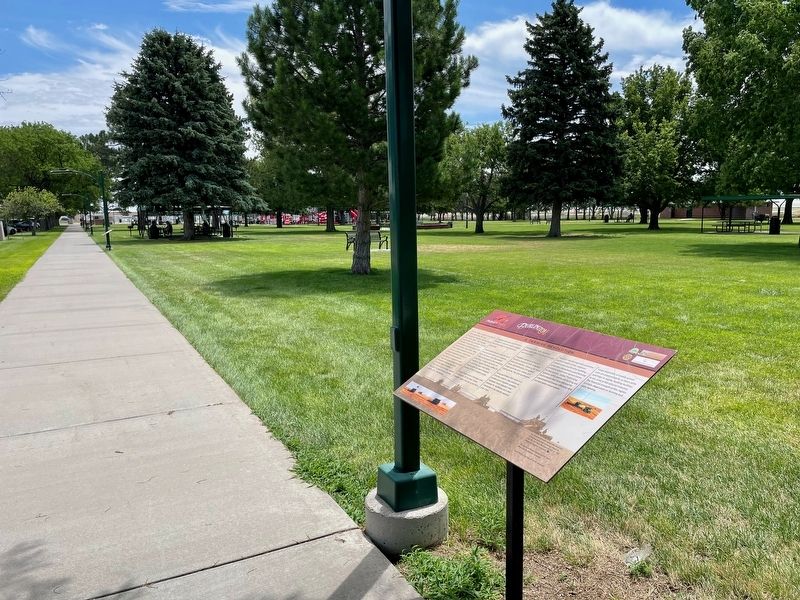
Location. 39° 17.728′ N, 102° 16.532′ W. Marker is in Burlington, Colorado, in Kit Carson County. It is on Ben Street west of Judy Street, on the left when traveling west. Located in Parmer Park. Touch for map. Marker is in this post office area: Burlington CO 80807, United States of America. Touch for directions.

Regionally, this marker is in the Eastern Plains. It is also in the American Mountain West, on the Great Plains, and specifically on the High Plains. Globally, it is in North America, the Western Hemisphere, the Western World, and the Anglosphere. Historically, it finds itself in what was once the Comanchería, the Dust Bowl, and the Louisiana Purchase.
Other nearby markers. At least 8 other markers are within walking distance of this marker: Farm Equipment - Then and Now (within shouting distance of this marker); As the Dust Settled (within shouting distance of this marker); What Lies Beneath (within shouting distance of this marker); The Winds of Change (within shouting distance of this marker); The Dust Bowl Years (within shouting distance of this marker); What's In a Name (about 300 feet away, measured in a direct line); The Open Range (about 400 feet away); The Early People (about 500 feet away). Touch for a list and map of all markers in Burlington.
Credits. This page was last revised on July 19, 2024. It was originally submitted on July 18, 2024, by Mark Hilton of Montgomery, Alabama. This page has been viewed 153 times since then and 29 times this year. Photos: 1, 2. submitted on July 18, 2024, by Mark Hilton of Montgomery, Alabama.
