Grayling Township in Crawford County, Michigan — The American Midwest (Great Lakes)
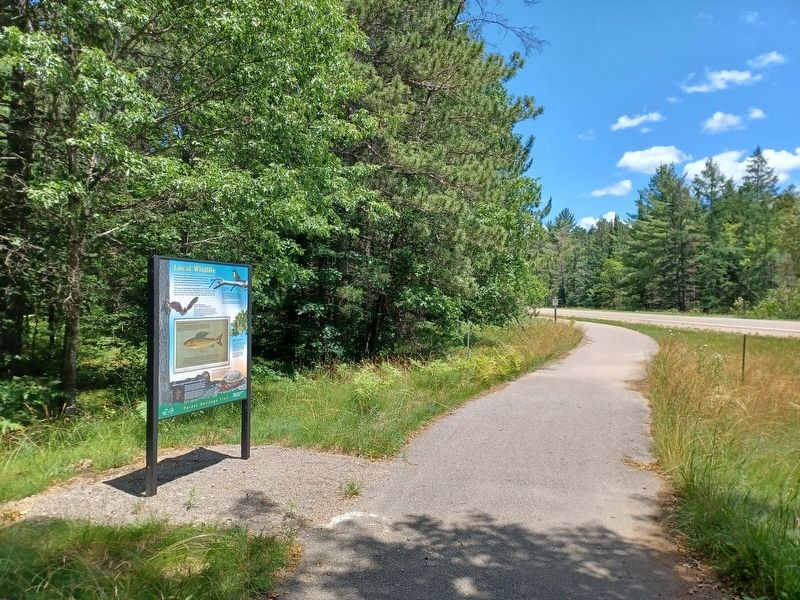
Local Wildlife
| — | Forest Heritage Trail | — |

Photographed by Joel Seewald, July 1, 2024
1. Local Wildlife Marker
Crawford County's forests are home to a variety of wildlife. The species pictured here are endangered or rare. What do their stories teach us about conservation and the effect of humans on the natural landscape?
Railroads and automobiles helped people travel farther to hunt and fish, often in excess. Today, Michigan's Department of Natural Resources works with Michigan's federally recognized tribal nations and groups like Trout Unlimited to manage Michigan's native wildlife.
Kirtland's warbler
(Setophaga kirtlandii)
bineshiinh
One of America's rarest songbirds, the Kirtland's warbler is making a comeback after years of protection under the Endangered Species Act. This bird nests in young jack pine forests. It became endangered when forest management efforts aimed to prevent all forest fires. This tactic stopped the growth of new jack pine stands whose cones require fire to release seeds, thereby reducing the warbler's habitat.
Today, controlled fires allow new jack pine forests to grow, has led to an increased number of nesting birds. The Kirtland's warbler was removed from the endangered species list in 2019.
Northern long-eared bat
(Myotis septentrionalis) apakwaanaajinh
Habitat
this page online
Arctic grayling (Thymallus arcticus) ngmnos Native only to Michigan, Alaska and arctic Canada, the Arctic grayling once thrived in the rivers of the lower peninsula. Overfishing, habitat loss due to logging and competition with introduced species (like brown trout) led to its extinction from Michigan by the 1930s. In the early 2020s, more than 50 partners began working to restore self-sustaining populations of Arctic grayling to its historical range in Michigan.
It is now but a few years [since] these noble fish could be taken in large quantities at Grayling, a station on the Jackson, Lansing & Saginaw Railroad.... While I was on the river in August ... two large camps, all non-residents and strangers ... killed five thousand fish.... For two miles below from their camps decaying fish whitened the stream, and the offal and fish entrails left unburied in camp tainted the air, as the dead fish poisoned the water.
L.
Photographed by Joel Seewald, July 1, 2024
2. Local Wildlife Marker
Yellow-banded bumble bee
(Bombus terricola) amo
One of the earliest bee species to emerge in the spring is the yellow-banded bumble bee. It is a valuable pollinator for plants like blueberries, peppers and pumpkins. They nest in groups underground, and in winter they often hibernate in abandoned rodent burrows. Raking or mowing in the fall or early spring can disturb them.
To help these bees thrive, grow native flowers and limit the use of pesticides. You could also maintain a small pile of brush, leaf litter or hedge clippings to create a nest for them.
Hungerford's crawling water beetle (Brychius hungerfordi) manidoons
Less than 1/4" in length, Hungerford's crawling water beetle lives in the clean and cool riffles of fast-flowing streams. Often found below beaver dams, the beetle is very sensitive to water quality during its early stages of life. Known as an indicator species, its presence means the water is healthy.
This rare beetle has been found in five isolated locations in Michigan and northern Ontario. Some researchers believe they are leftover from glacial periods, when their habitat was more common. Hungerford's crawling water beetle was first classified in 1952 by P. J. Spangler, a University of Michigan teaching assistant.
Wood turtle (Glyptemys insculpta) miskwaadesi
This shy, secretive reptile lives in the woods near rivers and streams. Although it can live for 40 years in the wild, habitat destruction, traffic and poaching for the illegal pet trade have hurt the population. If you see a wood turtle on the road, please safely move it if possible.
Wildlife is listed as follows:
English (scientific name)
Anishinaabemowin
Erected 2023 by Michigan History Center & Michigan Department of Natural Resources.
Topics. This historical marker is listed in this topic list: Environment. A significant historical year for this entry is 2019.
Location. 44° 43.568′ N, 84° 41.134′ W. Marker is near Grayling, Michigan, in Crawford County. It is in Grayling Township. It is on Hartwick Pines Road (State Highway 93) north of Hidden Cabin Road, on the right when traveling south. The marker is alongside the Grayling Bicycle Turnpike, a hiking/biking path next to the highway. Touch for map. Marker is in this post office area: Grayling MI 49738, United States of America. Touch for directions.

Regionally, this marker is in Northern Michigan Lower Peninsula. It is also in the American Midwest. Globally, it is in North America, the Great North Woods, the Western Hemisphere, the Western World, and the Anglosphere. Historically, it finds itself in what was once the Northwest Territory.
Other nearby markers. At least 8 other markers are within 4 miles of this marker, measured as the crow flies: Glacial Landscape (approx. one mile away); Forest Heritage Trail (approx. one mile away); Volunteers Matter (approx. 1.3 miles away); Forest Caretakers (approx. 1.3 miles away); Hartwick Pines State Park (approx. 1½ miles away); Major Edward E. Hartwick (approx. 1½ miles away); Camp Grayling (approx. 3.7 miles away); Michigan Grayling (approx. 4 miles away). Touch for a list and map of all markers in Grayling.
Credits. This page was last revised on July 16, 2025. It was originally submitted on July 19, 2024, by Joel Seewald of Madison Heights, Michigan. This page has been viewed 198 times since then and 18 times this year. Photos: 1, 2. submitted on July 19, 2024, by Joel Seewald of Madison Heights, Michigan.
